
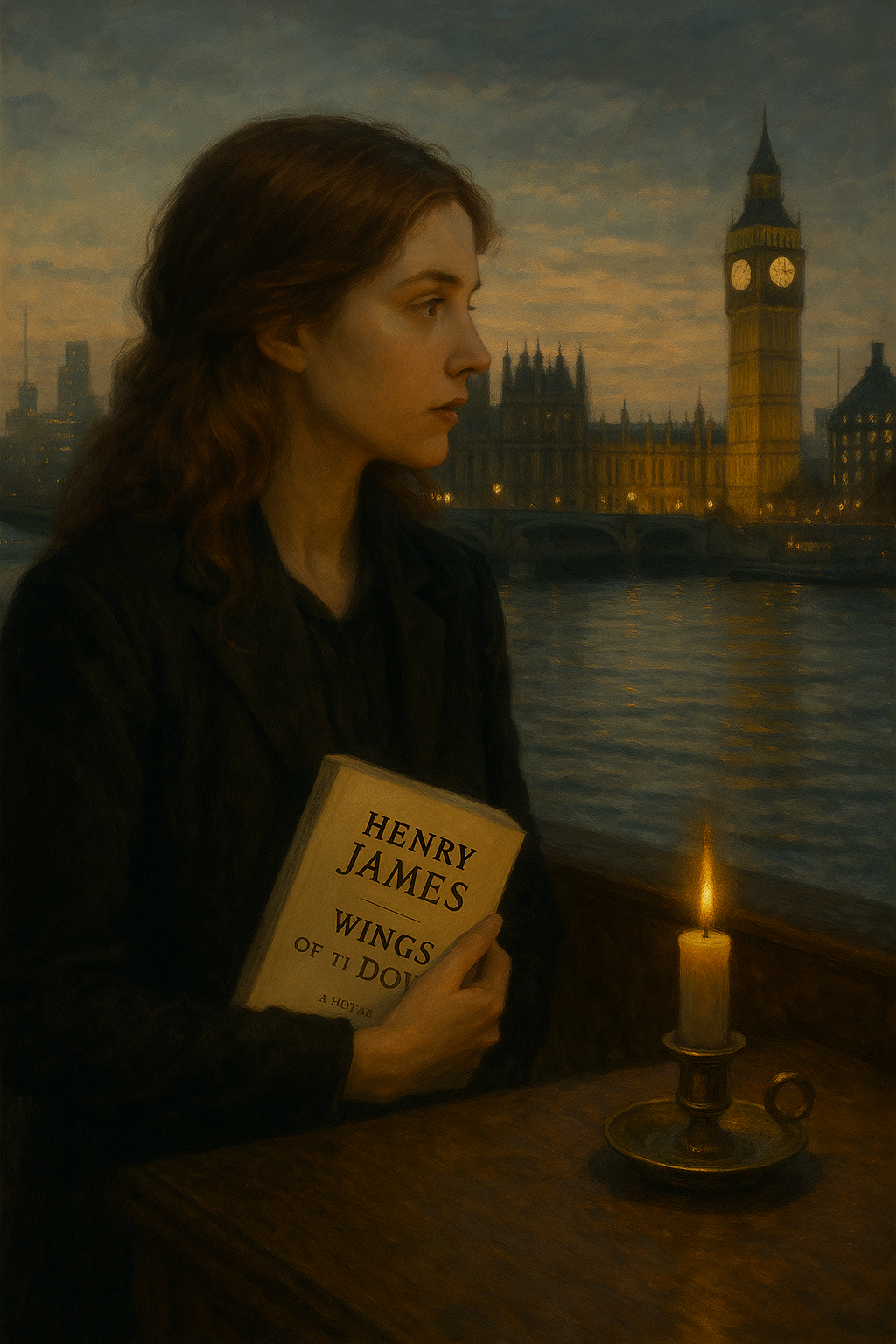
by Cassandra Blackwood
Posted from London, January 3rd
I’ve never had much patience for Henry James as a man.
He was too delicate with his own desire. Too careful. His prose loops and curls like incantations that almost say something, then flinch and turn away. He believed, perhaps, that passion should remain behind closed doors, pressed between pages like dried petals.
And yet — as a novelist, he’s a master of slow, excruciating truths.
I’ve just re-read The Wings of the Dove. The copy came to me in the post, wrapped in old linen, smelling faintly of pine and dried rosehips. No note — but I can guess who sent it. Lillian prefers her gestures coded.
It’s a cruel, beautiful novel — full of misdirection, decay, and cold London rooms. A dying heiress, Milly Theale, is loved — or perhaps only desired — by people who want her money more than her. And yet she’s the only character with true clarity. She knows she’s dying. She knows she’s being used. And when the moment comes, she forgives them. Not out of weakness, but out of a freedom none of them understand.
I kept stopping at one line:
“She saw the truth. She gave the truth back.”
Ethan would’ve understood that.
He never left a note. Not really. Just a glance — the kind you carry in your chest like a brand. And then he was gone. Into Faerie. Or shadow. Or something worse.
Sylvia says he’ll return when our child needs him most. Lillian is less certain — but she saw him, she says, in a scrying pool once. Drenched in light. Unharmed. Changed.
They both tell me to grieve gently. But they never say for whom.
I didn’t ask him to go. That’s the part I can’t shake. He made the choice himself. Like Merton Densher, Ethan tried to rewrite the terms of love after the fact. Tried to be noble, to hand me back a life I never asked for — one where he is only a memory and I am free to raise our son in peace.
It was a gift. And a curse.
Sometimes I feel the flat vibrate just before dawn. Not from trains or storms. But as if time itself is adjusting. I whisper to the river then. Not to call him back. Not yet.
To remember him rightly.
Henry James knew how love can distort the soul. How freedom, when freely given, can be a terrible burden.
Ethan wasn’t like James. He didn’t hide from his passions.
He walked straight into the dark with them still burning.
I hate him for that.
But oh, I love him, too.
And I won’t let his gift go to waste.
Not this time.
— Cassandra
veronica.writes.back (posted from Cornwall)
January 3rd, 11:47 p.m. GMT
C—
I read this aloud. Twice. Once for myself. Once for someone who may no longer be listening, but still deserves to hear.
I remember when Wings of the Dove first wrecked me. I was twenty-five, in Rome, sunburnt and invincible, and suddenly confronted by a novel that whispered:
What if your power was built on someone else’s tragedy?
You are stronger than Milly.
You are wiser than Kate.
And as for Ethan—well. I suppose the real difference between him and Merton Densher is that Ethan actually did the damn thing. No dithering. No silk gloves.
I feel him too, sometimes. In the crackle of the hearth just before it dies. In the rustle of unopened letters. In the shadows that stretch too long on moonless nights. He’s not gone. Not really. He’s just… elsewhere.
One last thing. I never thanked you.
Not for the child. Not for the choice.
But for never turning me into your enemy.
You could have.
And still—here we are.
—V
P.S. The postcards will keep coming. I’ve found another one. A place. A presence.
Not Faerie… but close.
Tell the boy I’ll see him soon.
From the Reading Nook at Mystic Reads
January 4th
Sylvia set the kettle down with a decisive clank, her rings flashing as steam rose.
“She’s writing again,” she said, eyes never leaving the glowing screen. “Veronica.”
Lillian, seated beneath the portrait of Jonathan in his more scholarly years, sighed but didn’t look up. “Of course she is. It’s winter. And she’s Veronica.”
Edward, perched near the window — or, rather, floating a few inches to the left of it — muttered, “Dangerous correspondences. Always have been. Ask Byron.”
Sylvia waved him off with a flick of her fingers. The tea leaves in her cup had begun swirling of their own accord. “It’s not danger I smell, Edward. It’s movement. Veronica’s not just reminiscing. She’s recalibrating.”
“She’s also asking to see the child again,” Lillian said gently.
Sylvia sat. The silence between them pulsed. Outside, the harbor fog slunk through the narrow streets like memory itself — thick, clinging, and slightly salted.
Lillian spoke first. “Do you think it’s wise?”
“No.” Sylvia smiled faintly. “But it may be necessary.”
They read the comment again. Veronica’s words shimmered slightly, even on the paper printout Lillian insisted on making.
A place. A presence. Not Faerie… but close.
“She’s not wrong,” Lillian said. “About Cassandra. About Ethan.”
“No.” Sylvia’s voice was quiet now. “And neither are you. I’d forgotten the power of refusal. Of not becoming the enemy, even when the world demands it.”
Edward moaned faintly. “You’re all going to end up in some Jamesian tragic loop of self-reproach and fog-drenched standoffs.”
“We already live in Falmouth, dear,” Lillian said mildly. “That ship’s sailed.”
Sylvia tapped the teacup. The leaves had formed a distinct shape now: a lighthouse.
She raised an eyebrow.
“Shall we write back?” Lillian asked.
Sylvia shook her head. “No need. She’s already reading us.”
Postcard Received at Mystic Reads – January 6th
Postmark: Trieste, Italy
Stamp: A faded moonlit pier and the word “LUCE” printed in delicate script
Front:
A sepia-toned photograph of a narrow Venetian-style alleyway at dusk, water lapping gently at the foot of ancient stone steps. A lantern glows just out of frame. The air looks salted with mist.
Back (written in dark green ink, steady and elegant):
Dear Ladies,
I thought you might like to know that I have seen the child.
Not in person, of course — not yet. But he’s well. And watched over. More closely than even Cassandra suspects.
There is something stirring on the wind here in Trieste. A key, perhaps. A name I haven’t heard since the days when Marcus still whispered to statues and thought himself cleverer than the stones.
I’ve traced a pattern on the church floor that matches one we found beneath the museum in Falmouth. A perfect hexagram. Something’s waking.
You’ll hear from me again before the thaw. Until then — tell Edward to stop sulking. I’ve seen him in the mirror behind your tea counter. He looks thinner.
— V*
P.S. If Wren writes, tell him I still remember the smell of salt and ink. And that I never did mind the silence — not when it’s full of meaning.
Update from Mystic Reads – January 7th
Title: “Ink, Memory, and the Shape of the World”
It was Lillian who noticed it.
Tucked behind a warped copy of Cornish Coastal Lore (2nd ed., 1924), spine gnawed by age and a distracted cat, was a folded vellum map the color of old bones. It hadn’t been catalogued. Sylvia swore it hadn’t been there last week. And Edward?
Edward went dead silent.
The map was hand-inked in a precise, archaic style — rivers like veins, forests stippled with thumb-sized trees. No labels. No compass rose. Just a faint green hexagram at the corner and, in spidery writing along the crease:
Et ego fui ibi. Tempus vidit, non deus.
(I too was there. Time watched — not God.)
Lillian laid it on the reading table with care, smoothing the creases like a reverent archivist. Edward hovered behind her, pale even by ghostly standards.
“It’s mine,” he whispered. “I drew this. In 1803. After the rites on the Blackwood land. But I never wrote those words. And I never sent it to anyone.”
Sylvia frowned. “You think it was sent by someone else?”
He nodded slowly. “Someone who’s seen more of me than I’ve seen of myself.”
Outside, the church bells in Falmouth rang midday. Inside Mystic Reads, time had twisted itself into a hush.
Later that evening, Sylvia made a pot of rosehip tea and slid the map beneath a piece of glass in the back room. “We’ll need this soon,” she murmured to Lillian.
“And the child?”
Sylvia’s voice was quiet. “I think he’s already begun to dream of it.
Postcard from Mallorca: “When the Sun Stops Being Enough”
by Inspector Nicholas Wren (Retired, Supposedly)
I’ve officially reached the point where the sunsets are starting to bore me.
There. I said it.
Mallorca has been kind. The villa — a gift from my possibly-dead Aunt Evelyn (who may or may not still write to me in her own code) — sits on the edge of a lemon grove. The walls are warm stone. The sherry is excellent. The air smells like rosemary and salt.
And I am restless.
This morning, I found a package on the step. No return address. Inside: a sliver of parchment folded four times, stained with something that looked suspiciously like rose oil. On it, a portion of a map. No landmarks. Just a fragment. Green ink. A looping, antique hand.
Three symbols. One of them I’ve seen before — in a letter Veronica once enclosed without comment.
I’ve read all her letters. I read the latest one twice. She’s back in Cornwall. Of course she is. Where the ground hums and people like Sylvia see more in candlewax than I ever could in a full police archive.
Part of me wants to toss the map into the fire, pour another glass, and watch the sea forget everything.
But another part?
Another part wonders if that faint edge of green ink — the same ink I saw once tattooed on Cassandra’s wrist, if I’m not mistaken — is more than a reminder. Perhaps it’s a key.
I was never meant for stillness. Veronica knows that. Hell, she’s counting on it.
Maybe it’s time to dust off my boots, pack a coat I haven’t worn since Devon, and take the long way north — via Vienna, maybe Trieste. I hear the churches there have strange acoustics.
If I show up at Mystic Reads, someone better put the kettle on.
— Wren
Entry from Mystic Reads: “The Ghost Loses His Temper”
Filed by: Lillian (who needed a strong cup of tea afterward)
It happened just after dusk. The last of the shop’s customers had left, and Sylvia was reorganizing a shelf of old pamphlets on Cornish burial rites when the temperature dropped — not with the usual hush that signaled Edward’s entrance, but with a snap, like a string breaking inside a piano.
And then there he was.
Not his usual self, either. Not translucent and courtly, not drifting like a memory too polite to impose. No, this time Edward arrived like weather. Fully formed. Tangible. Solid shoes striking the floorboards. Waistcoat flaring like he’d stepped out of 1810 and was prepared to duel someone before dinner.
Sylvia blinked. “You’re—”
“—Real? For now,” he said curtly, and he was angry. Not brooding. Not wistful. Angry.
He slammed a gloved hand on the reading table. A crack split the wood — not a metaphor. A crack.
“I warned you not to let Wren follow the green path.”
Sylvia stood still, staring. “You never said—”
“I implied it,” Edward snapped. “And I left clues. That ought to have been enough.”
Lillian reached for her tea. Missed the cup. Spilled the sugar instead.
“This path leads to a convergence,” Edward continued. “Something I only glimpsed once. Something I never meant to find—and never meant to reawaken.”
Then — and here’s where the truly bizarre thing happened — he bled.
Just a little. Just from the corner of his mouth. But it was red. Vivid. Real.
Sylvia reeled back like she’d been slapped. “You’re not meant to bleed,” she whispered.
Edward pressed a handkerchief to his mouth. “No. I’m not. But time’s thinner now. Memory’s wearing holes in the veil. And someone — perhaps your Ethan, perhaps your Veronica — has disturbed the thread too deeply.”
Then, as if that wasn’t enough, he turned to the empty fireplace, raised one finger, and lit it with no match.
“Find the letter I hid in the hollow of the bookcase,” he said. “The one bound in ash bark. It’s time you read what I didn’t dare say before.”
And just like that, he vanished — in smoke, not silence.
Sylvia hasn’t said a word since. She just sat down, very carefully, and stared at the flames.
I, for one, am making stronger tea.
— L.
Scene: “A Disruption in the Line”
The rotary phone at the back of Mystic Reads rang with the shrill urgency of a kettle boiled too long. Lillian, who had just replaced a volume on West Country ghost lore, narrowed her eyes and answered.
“Falmouth three-two-eight,” she said crisply.
“What the hell is going on, ladies?!”
“Nice to speak with you too, Wren,” Lillian replied without missing a beat, sinking into the armchair beside the phone. “Now… let’s start over again, shall we?”
“The fireplace in my aunt’s villa lit itself. No matches. No firewood. Just… flames. And don’t tell me I imagined it — the damn thing hissed at me like it knew my name. Then the Henry James novel I was halfway through closed itself. Like it was done with me.”
Sylvia, sitting across the room, looked up from the parchment in her lap — the one that smelled faintly of ash bark. “Which James?” she murmured.
Lillian covered the mouthpiece. “He says the fire spoke and the book rejected him.”
“Ah,” Sylvia muttered, “The Bostonians, then.”
“Also,” Wren barked through the receiver, “your ghost friend Edward? He’s in my mirror. Not a dream. He winked. Winked, Lillian. That man is dead.”
“Yes,” Lillian said serenely, “but only just.”
“He bled, Wren,” Sylvia called toward the phone, her voice unusually brittle. “Right in front of us. A good tablespoon’s worth.”
There was a long pause on the line.
“I see,” Wren said finally. “That would explain the nosebleed I got while making tea.”
Sylvia’s eyes narrowed. “What kind of tea?”
“Earl Grey. Not that it—”
“It matters,” Sylvia whispered.
Lillian rolled her eyes. “You two and your dramatics. Wren, the short version is this: Edward’s crossed a boundary he wasn’t meant to. Time is… loosened. And something — or someone — is feeding on that instability.”
“Well, I hope it chokes,” Wren muttered. “Because if I see one more Victorian in my reflection, I’m chucking the mirror into the sea.”
“Don’t,” Sylvia warned. “It might swim back.”
“Great. Just great. Shall I come home, then?”
There was silence. Lillian tapped her pen against the desk.
“Define ‘home,’ Wren,” she said gently.
He sighed. “Where you are. Where she—” (his voice faltered) “—might be.”
Sylvia turned away. “She’s back. Sort of. But she hasn’t come here yet.”
Wren said nothing for a while. Then, with a quieter voice:
“Tell her I read all her letters. I kept every one. Even the ones with ink smudges and biscuit crumbs.”
Lillian smiled despite herself. “You just did, dear. I suspect she knows.”
“Good,” he said. “Then tell Edward to keep his bloody gloves to himself. And warn him — if he shows up in my mirror again, I’m lighting two candles and reading Kafka. See how he likes that.”
The line went dead. Lillian stared at the receiver a moment longer, then hung up.
Sylvia exhaled slowly. “They’re all coming back, aren’t they?”
Lillian glanced at the fire, which still burned — too brightly for this time of night.
“Yes,” she said quietly. “And I fear none of them are coming alone.”
Leave a Reply