
Introduction:
The Picatrix is one of those books that seems to shimmer between worlds: part philosophical treatise, part grimoire, part cautionary tale. Written in Arabic in 10th-century Spain and translated into Latin a few centuries later, it promised nothing less than the ability to harness the stars themselves. For some, it was a treasury of cosmic wisdom; for others, a perilous trap whispered to be demonic. In my story, I imagine what happens when two women—Sylvia and Lillian, both investigators in the mystical town of Falmouth, Cornwall—find themselves at odds over a Venus talisman from the Picatrix. Should they use it to soften suspicion and win over Inspector Wren, whose stance as ally or adversary remains uncertain? Or is the book too dangerous, its promises too seductive?
The Scene:
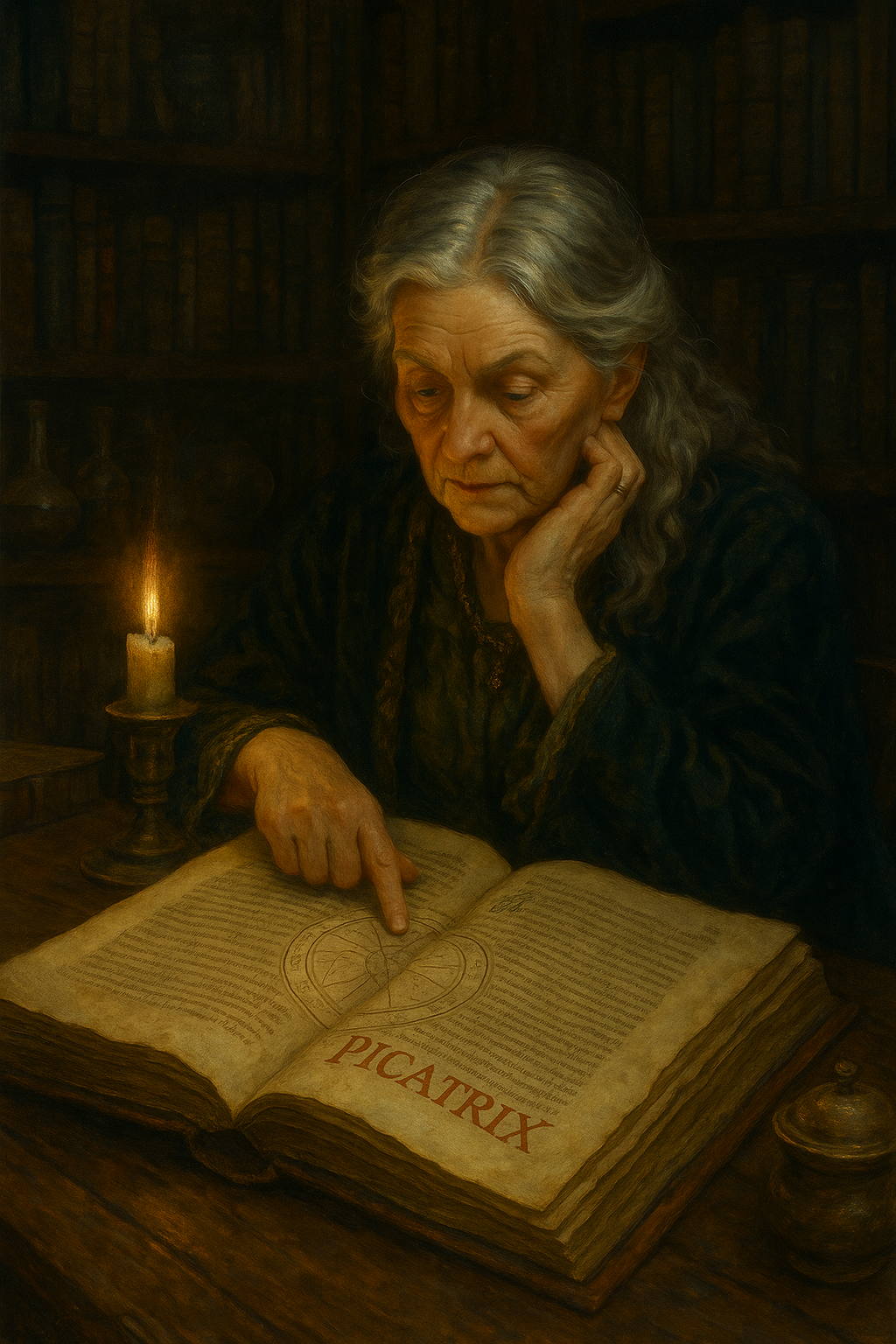
The shop smelled of burnt rosemary and rain. A clock over the door ticked with a stutter, as though it sometimes lost its courage. The black cat had installed itself on the Picatrix, tail curled like a question mark across the margin. Every time Sylvia turned a page, the air smelled faintly of copper and fig leaves, though there were neither in the room.
She hadn’t meant to open the book. For years her West Country charms had been enough — rosemary tucked in lintels, thread knotted with a whispered word, the hush of candlelight when Jonathan was still alive. But the Heart had twisted the air around Falmouth, and her little workings fell flat. Worse, Inspector Wren was no village man; he was a Londoner, stiff with skepticism. Her charms slid off him like rain on slate. If Wren turned against them, the town would follow. For the first time, Sylvia feared her craft had grown too small. That was why her hands trembled now over the Latin script, why she dared the pages she had once sworn to leave shut.
She traced a line of text with her fingertip, her voice hushed but urgent.
“Lil, listen: ‘When you wish to do the magical works of Venus, do it in the day of Venus, the Sun being in the beginning of Pisces and the Moon in Cancer. Clean yourself and bathe, and when you are cleaned and bathed, go to where there are figs or palms and take with you a ram. Say: Hueydez, Helyz, Hemyluz, Deneriz, Temeyz, Cemlux, Arhuz, Meytaryz. When you have said this, ask for what you wish. But beware that you do not ask for something attributed by the nature of another planet.’”
Her eyes burned, bright as candleflame.
“Don’t you see? It’s precise — dates, signs, even the incantation. This isn’t wild superstition, it’s a method. If we performed it, Venus herself might soften Wren’s heart — and with him, the town. One softened word from him could stop them calling us witches.”
Lillian adjusted her spectacles, unimpressed.
“Or we’d stand in the rain at the edge of a fig tree with a bleating ram and a mouthful of nonsense syllables, hoping not to have called down Mars by mistake. That, Sylvia, is why the Picatrix is suspect: it dresses philosophy in the garments of sorcery, then demands obedience without reason. Even if it ‘works,’ who is to say why — or at what cost?”
Sylvia’s hand trembled harder.
“Reason doesn’t heal fear. If the town hardens against us, no one will speak, no one will trust. Cassandra will close her door. And Wren —” she faltered — “Wren may declare us adversaries, and then Jonathan’s name will be blackened with mine. This talisman could turn suspicion into concord. Without it, we may stand alone against the Heart itself.”
The cat sneezed, scattering ash into the margins. Neither woman brushed it away.
The bell above the door rang with a note like water over glass, and Margaret entered, trailing mist and the perfume of violets. She peeled her gloves slowly, each finger deliberate, and her smile curved but did not warm.
“Venus again?” she said, as though she’d overheard them from the quay. “You’d think she rented the upstairs room.”
Sylvia flushed. Lillian snapped the Picatrix shut with surgical neatness. Margaret set her gloves on the cat’s back, and the creature didn’t stir, only blinked its lantern eyes.
“My grandmother stitched charms into hems,” Margaret said, her voice a soft ribbon with its faint Eastern-European cadence. “Juniper thread, always hidden. My professors in Paris quoted the Picatrix, but never dared light a candle. Both claimed spells could turn the world on its axis. Both lied.”
Sylvia’s eyes flickered, desperate. “Then what does a spell like this do?”
Margaret touched the book lightly, as though it might bruise.
“It doesn’t change them. It changes you. The Venus talisman wouldn’t bend Inspector Wren to your will. It would bend you — soften you, Sylvia — so you could bear his suspicion without breaking under it.” She paused, watching the fire crawl across the grate. “The question is whether you can afford to be softened in a world that sharpens knives.”
The clock above the door stuttered again, caught its rhythm, and moved on. Lillian looked away first, her shoulders tight with something between pride and unease.
“I should like to footnote that,” she muttered.
Sylvia’s laugh cracked, half sorrow, half release.
Margaret claimed the armchair like a throne, the cat climbing into her lap as if it had been waiting for her all along.
Reflection:
What I love about this scene is that it captures the double-edged allure of the Picatrix. Sylvia reaches for it out of desperation, when her familiar West Country charms feel too small against the tide of suspicion and Inspector Wren’s watchful eye. The book promises precision, certainty, even power — but its very precision makes it suspect. Lillian’s rationalism is safer, perhaps wiser, yet also powerless against fear and gossip. And Margaret’s verdict lingers like smoke: the spell would not change Wren or the town at all, but Sylvia herself.
Leave a Reply