
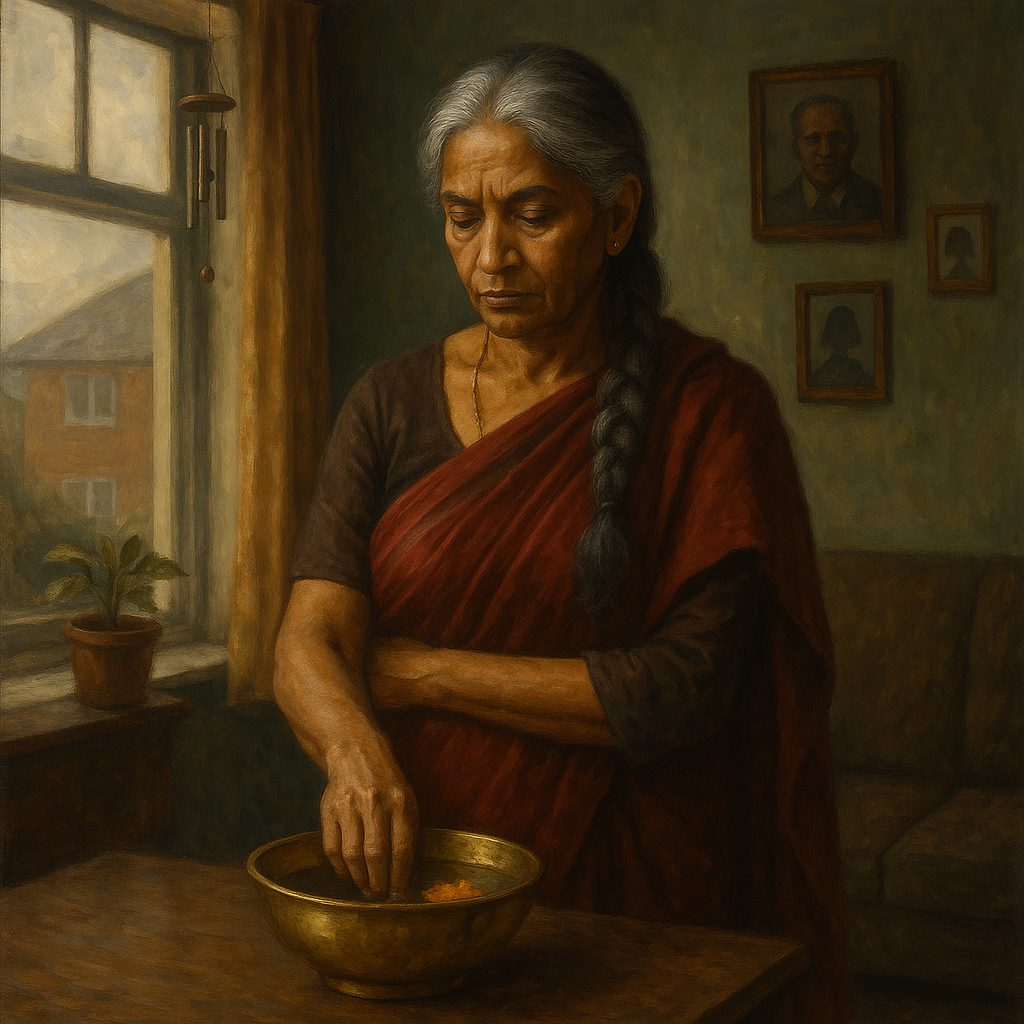
Dusk fell soft and heavy over the housing estate, the kind of twilight that made everything look newly built and faintly unreal. The houses sat in obedient rows, their pebble-dashed walls identical, their porches staring out like neat, forgettable faces.
Except number sixty four.
The air shifted as Sylvia and Lillian drew near. A low hum seemed to hang about the garden—incense, or something older. Marigolds glowed orange in the fading light. Strings of drying chillies hung beside the door like a warning or a welcome, it was impossible to tell.
Lillian frowned. “It feels… charged.”
Sylvia adjusted her shawl. “So does a thunderstorm.”
They rang the bell. After a pause, the door opened to reveal Mrs. Saroj Patel: tall, elegant, her sari a deep garnet red, her silver hair drawn into a perfect braid. She looked them over with the slow, steady gaze of someone long accustomed to being judged and no longer caring.
“So,” she said, “you have come. At last.”
The sitting room smelled of sandalwood and iron. Photographs lined the walls, but none newer than a decade. A brass bowl of water gleamed on the low table, a single marigold floating inside.
Sylvia smiled. “That’s beautiful.”
“My mother’s,” said Saroj. “She used it for blessings.” A beat, then— “I find other uses.”
Lillian sat carefully, knees together, hands folded. “Mrs. Patel, we’re not here to accuse you. We simply hoped to talk. Your neighbours… they’re frightened.”
Saroj’s lips curved. “Fear,” she said softly, “is respect when people have forgotten how to show it.”
Lillian met her gaze. “Or guilt, perhaps. But there’s a difference between being strong and becoming cruel.”
Saroj laughed—low, musical, but not kind. “You think I’m cruel? Ask them who spread lies about me, who called me names in their little WhatsApp group, who poured bleach on my garden wall. I warned them to stop. They didn’t. Now they know I’m not one to ignore.”
Sylvia studied her face. “You’ve suffered a lot, haven’t you?”
Saroj’s expression flickered. “I have endured,” she said. “That’s different.”
The room seemed to pulse, faintly—perhaps it was just the lamplight catching the bowl, but Sylvia felt it in her chest. Without thinking, she leaned forward and brushed her fingers along the water’s edge. The marigold spun lazily, turning its face to her.
“I think you’ve carried too much bitterness,” Sylvia murmured. “It’s gone stagnant, like old water. Sometimes you have to pour it out before it poisons the roots.”
Saroj’s eyes darkened. “You think your charms can undo what is mine?”
“I think kindness is older than any charm,” said Sylvia.
For a moment, neither moved. Then the air in the room shifted, cooler somehow. In the bowl, the reflection wavered. The marigold petals trembled—and for an instant, Sylvia saw another woman’s face in the water: younger, unburdened, laughing.
Saroj gasped and leaned forward, hands gripping the table. The image vanished.
“What did you do?” she whispered.
Sylvia looked genuinely surprised. “I only reminded the water what it once knew.”
Saroj drew herself upright, pride hardening her face again. “You meddle in what you don’t understand. I will not be told what to do. Not by my neighbours, and not by you.”
Lillian rose slowly. “We didn’t come to command you, Mrs. Patel. We came because we believe you’re still human underneath the armour. But armour rusts. And when it does—well, that’s up to you.”
Saroj said nothing. Her jaw trembled once, then stilled.
They left her standing there, tall and proud beside the trembling bowl.
Outside, the air was damp and full of streetlight. A fox crossed the pavement ahead of them, glancing back once before vanishing between the bins.
Sylvia exhaled. “She’s strong. Too strong for her own good.”
“She’ll fight it,” Lillian said.
“Of course,” Sylvia murmured. “But sometimes the fight is what begins the undoing.”
As they walked away, the wind stirred faintly through the estate. Behind them, at number sixty four, the wind chimes moved, though no breeze had touched them.
Lillian paused, turning back. “Did you feel that?”
Sylvia didn’t answer at first. The marigolds in the garden were swaying, though the others along the row stood still.
Finally she said, “She’s listening. That’s something.”
They moved on into the dark, the quiet tap of their shoes fading into the hush.
At the house behind them, one petal slipped free of the marigold in the bowl, circling once before sinking slowly out of sight.
For three nights after they left, the air around number sixty four hung still, as though the estate were holding its breath. Then, on the fourth morning, the weather broke.
Mrs. Saroj Patel woke early, certain she’d heard her wind chimes move. The sound was faint, almost thoughtful, like someone knocking at a door and thinking better of it. When she rose, the curtains stirred though the window was shut.
She made her tea carefully. Across the room, the brass bowl gleamed in the half-light. The marigold inside had sunk, its petals drained of colour. She told herself she didn’t care. She would light incense later, set things right.
Outside, the garden felt altered. The marigolds, once brazen, seemed softer now, their leaves beaded with dew that shimmered faintly as if catching an unseen light. A blackbird sat on the fence and began to sing. Saroj hadn’t heard birds here in months.
The tune worked its way into her chest, sharp and strange. She stayed there a long time, not listening and not able to stop.
Back inside, her phone chimed. A message from the neighbour two doors down — the woman she had sworn never to forgive.
Are you all right, Mrs. Patel? I made too much biryani. Would you like some?
Saroj frowned at the screen, her instinct flaring and fading all at once. She put the phone down without replying.
The marigold in the bowl had risen again, floating. Its reflection wavered, a breath of movement beneath the surface — light, or laughter, or perhaps only the room shifting around her.
She touched the water gently. It was cool and clean.
Outside, the wind chimes stirred again, this time bright and certain.
She closed her eyes and let them ring.
In Falmouth, the morning came in mist. The gulls were late to cry, and the harbour moved in its sleep. Sylvia woke before dawn, uneasy for no reason she could name.
She set water to boil and opened the kitchen window. The air smelled of salt and sage. Steam rose from the kettle, curling toward the ceiling, and she thought suddenly — absurdly — of Mrs. Patel.
Not with triumph. Just a strange tenderness, as though some small thread of weather had passed through them both.
The brass bowl on her sill trembled slightly. Inside, the water cleared, and a single marigold petal drifted across it — bright as a thought made visible.
Sylvia smiled faintly. “All right, then,” she said to the air. “So you heard me.”
Outside, the fog began to lift. The light turned the bottles on her windowsill to amber and sea-glass green.
For a long while she stood there, listening — to the hush of the harbour, to a single far-off chime that might have been the wind, or might have been something answering back.
No one saw the wind change that morning, or noticed that the blackbird sang a little further down the coast the next day.
But it did, and it was enough.
Leave a Reply