
From the notebooks of Sylivia Moon, Mystic Reads, Falmouth
There’s an old saiyng that a land never quite forgets the language in which it was first addressed. Whether that’s true, I couldn’t rightly say, although I’ve lived in Cornwall long enough to suspect the stones here remember more than they’re willing to say.
Cornish, or Kernewek, belongs to the Brythonic branch of the Celtic languages, alongside Welsh and Breton. It was spoken in these parts long before English became the language of our courts, schools, and marketplaces. And for centuries, it was the ordinary speech of ordinary people: fishermen, farmers, miners, mothers calling their children home.
Not a language reserved for druids and sorcery, mind you, whatever certain romantic gentlemen of the nineteenth century might have wished us to believe.
It was the language of bread and butter, quarrels and courtship, gossip and grief. Which, when you think about it, is where most of the important business of living takes place.
Then came the slow retreat.
English spread through administration, commerce, and religion. The Reformation dealt Cornish a particularly cruel blow. In 1549, when the English Book of Common Prayer was imposed upon communities where many still understood little English, Cornwall rose in rebellion. Thousands died in the fighting and its aftermath. The language survived, but the world in which it had flourished was changing.
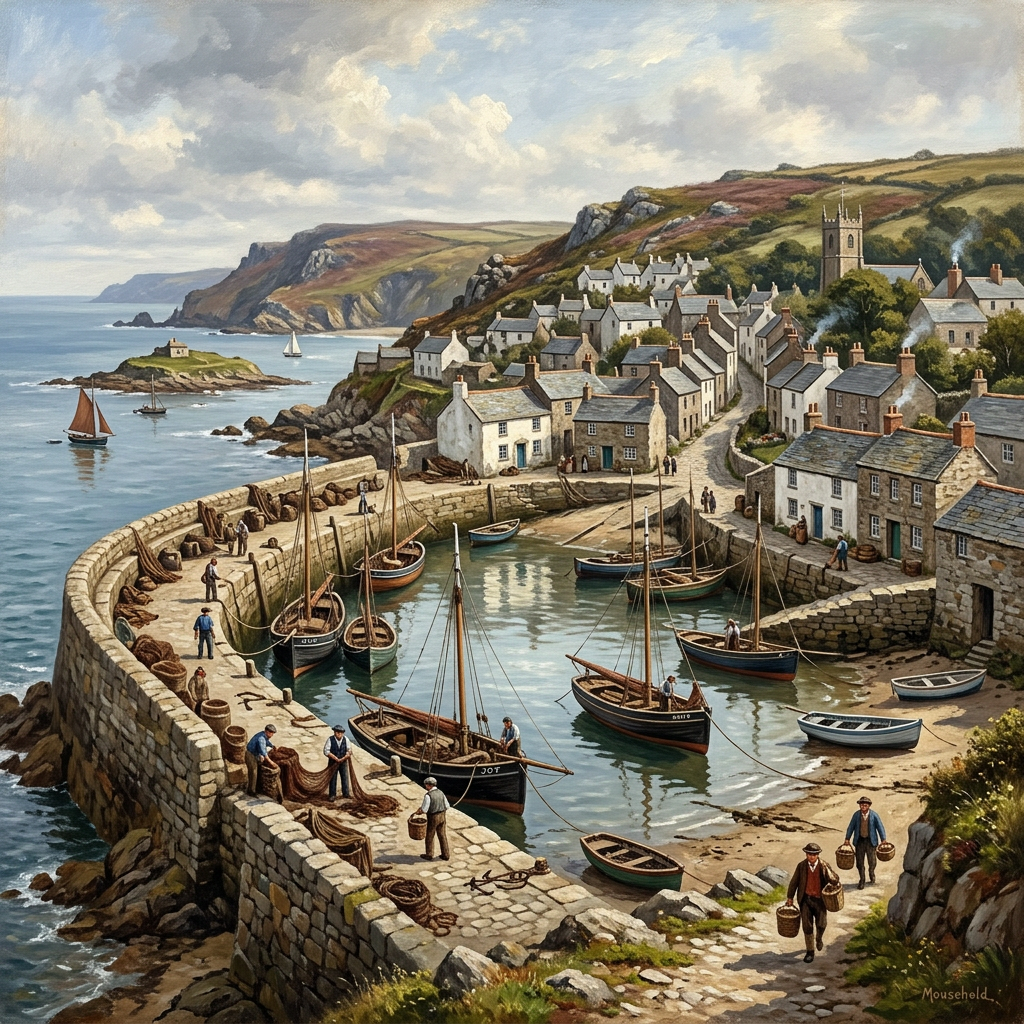
By the eighteenth century, Cornish had retreated largely to the far west. Dolly Pentreath of Mousehole, who died in 1777, became famous as its supposed last native speaker. A convenient little ending for the history books, that. One woman dies, and an entire language is declared dead alongside her.
Except it wasn’t quite true.
Cornish persisted in fragments, conversations, fishing communities, and the memories of people who had never thought themselves important enough to appear in anyone’s history. In 1904, Henry Jenner published his Handbook of the Cornish Language, helping to launch a revival that continues today.
And that brings me to something I’ve been pondering.
When a language disappears from ordinary conversation, what exactly has been lost? The words themselves may survive on paper. Scholars may reconstruct their pronunciation, and children may learn to speak them again. But can anyone recover precisely what those words meant to the people who first uttered them?
I have spent most of my life working with old charms, rhymes, and remedies. Some were handed down through my family, others borrowed from neighbours, books, and those peculiar encounters one learns not to discuss over Sunday luncheon. I’ve always believed there was something worth preserving in them, though I’ve occasionally wondered whether I understood half as much as I imagined.
A charm that once comforted a frightened mother might become, two centuries later, an incantation promising supernatural protection. The words remain. The meaning changes.
And who is to say which meaning is the true one?
Lillian would undoubtedly have something tiresome and philosophical to say about that. She’d remind me that people make meaning, that words have no obligation to retain the intentions of those who first spoke them.
I should probably argue with her.
Yet there’s something about the Cornish language that gives me pause. For generations, people decided it was finished. Then other people decided it wasn’t. Neither judgement made much difference to the wind over Pendennis or the tides washing into Falmouth Harbour.
The language survived because human beings cared enough to carry it forward, not because the landscape demanded its preservation.
Perhaps that’s the lesson for an old wise woman who has spent too many years believing that everything hidden must eventually reveal itself.
We preserve what we can. We interpret what remains. And sometimes, without quite realising it, we mistake our interpretation for the thing itself.
Still, I shan’t be throwing away my spell books.
There’s wisdom in knowing the limits of one’s knowledge, but there’s no sense in becoming entirely unreasonable.


Leave a Reply