
Café of Sages: An Existential Encounter
A young prodigy named Jonathan sat in the heart of a bustling modern university, nestled in the ivy-clad walls of its ancient philosophy department. Barely 24, Jonathan had already published papers that left his professors in awe and had spoken at international conferences where his insights on existentialism garnered praise. Although many believed his academic achievements had inflated his ego, Johnathan was ever fearful he’d be exposed as uniformed and ill-educated
One evening, while poring over a rare manuscript, Prolegomena to Any Future Metaphysics, written by Immanuel Kant, in the university library in preparation for an important exam, Jonathan discovered a hidden compartment in the wooden desk. Inside, there was a small, ornate box with intricate carvings. Curious, he opened it and found an old pocket watch with a note that read: “Time is the greatest teacher.” As he examined the watch, it began to glow, and before he could react, Jonathan was enveloped in a swirling vortex of light.
When the light dissipated, Jonathan found himself standing in the middle of a cobblestone street. The signs around him were in a language he recognised as French, and the scent of freshly baked bread wafted through the air. A newspaper stand caught his eye, and he could hardly believe what he saw: he was in Paris—specifically, Paris in the 1930s.
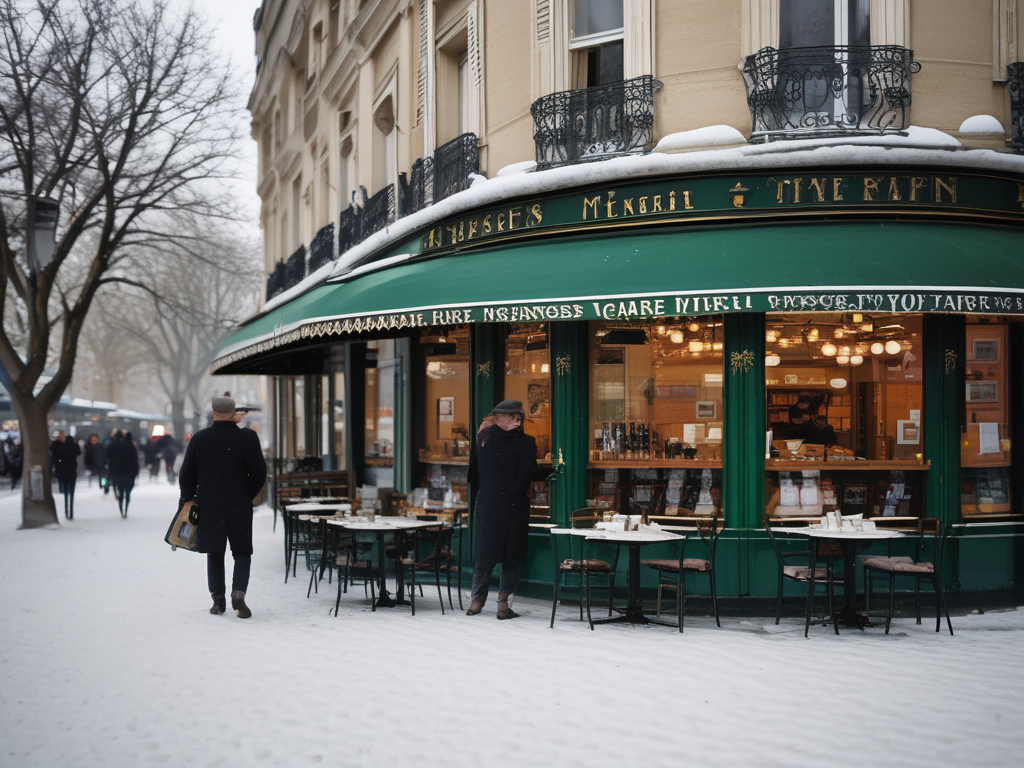
Jonathan, a whirlwind of shock and fascination, his love for puzzles momentarily forgotten, found himself drawn to a small café, Le Deux Magots. Inside, the air was thick with cigarette smoke and animated discussions. His eyes were immediately drawn to a corner table, where two figures sat, deep in conversation: Jean-Paul Sartre and Simone de Beauvoir.
Summoning his courage, Jonathan approached them. “Excusez-moi, are you Jean-Paul Sartre and Simone de Beauvoir?” he asked in his best French.
Sartre looked up, his penetrating gaze scrutinising the young stranger. “Yes, we are. And who might you be?”
“I’m Jonathan, a philosopher from the future. I admire your work greatly, especially how you built upon and transformed Kantian ideas to develop your unique blend of existentialist philosophy, ” Jonathan said, trying to mask his arrogance with feigned humility. “Someday, I wish to do the same.”
De Beauvoir raised an eyebrow. “From the future, you say, and you’re interested in how Kant influenced us? Interesting. Have a seat, Jonathan.”
As he joined, he resisted the urge to flaunt his knowledge as he joined them. “In my time, your works are studied globally. I’ve published extensively on existentialism myself. Perhaps I could share some of my insights with you.”
Sartre leaned back, a slight smirk on his face. “Very well, Jonathan. Enlighten us.”
For the next hour, Jonathan pontificated, dissecting Sartre and de Beauvoir’s ideas, adding his theories, and occasionally hinting that his interpretations were more refined. The pair listened politely, exchanging glances but saying little.
Finally, de Beauvoir spoke. “Jonathan, your knowledge is impressive. But tell us, what do you live for? What drives you?”
Caught off guard, Jonathan stumbled. “Well, the pursuit of knowledge, of course. To understand the human condition better than anyone else.”
Sartre leaned forward, his eyes intense. “And what have you done with this knowledge? How has it shaped your actions, your relationships, your existence?”
Jonathan faltered. “I… I publish. I lecture. I educate others.”
De Beauvoir’s gaze softened, but her words were firm. “Knowledge without lived experience is hollow, Jonathan. Philosophy is not just an intellectual exercise; it’s a way of life. We write and speak not to boast, but to grapple with the essence of being, to engage with the world authentically.”
Sartre nodded. “You speak of existentialism, but do you live it? Or are you merely using it as a pedestal to elevate yourself above others?”
Jonathan felt a pang of shame. He had always prided himself on his intellect, but he now realised how detached he had become from the essence of what he studied. His pride had blinded him to philosophy’s true purpose.
The conversation shifted, and for the first time, Jonathan listened more than he spoke. He absorbed the wisdom of Sartre and de Beauvoir, not as a superior mind, but as a humble student.
Jonathan felt a warmth he hadn’t known as the evening wore on. The café, the people, and the conversation were all part of the lived experience he had neglected. When he finally rose to leave, he thanked Sartre and de Beauvoir sincerely. Wishing him luck, for certainly, he’d need it in the game of life, the pair smiled and waved goodbye.
As he stepped outside, the pocket watch began to glow again. The familiar vortex enveloped him, and instantly, he was back in the university library. The desk, the manuscripts, everything was as he had left it.
Jonathan’s hand brushed against the desk, and the watch disappeared, leaving behind a warm feeling. He was confused yet somehow clearer. The ancient book he had been studying was now closed, with an unfamiliar constellation on its cover that hinted at something powerful and old.
A shudder ran through him as he touched the constellation, sparking the air with a strange energy. The library lights flickered, and elongated shadows seemed to move. It felt like reality had shifted, responding to something unseen.
Suddenly, a chime rang out in the library – the grandfather clock striking midnight. But it sounded eerie and different, each toll vibrating through Jonathan’s soul. As the twelfth chime faded, a mysterious figure of slight and slender build emerged from the shadows. His hair was powdered and tied back into a small ponytail as was the fashion of the 18th century, and he had an embroidered waistcoat, a silk cravat, and thick woollen knee-breeches. His blue eyes gleamed with arcane knowledge.
The stranger locked eyes with Jonathan and smiled thinly. “Sir,” he spoke in an old accent, “it seems you have something of mine. The pocket watch, please.” With those enigmatic words hanging in the air, he held his hand expectantly. Tension filled the room, drawing Jonathan towards a terrifying destiny far beyond his academic pursuits. Jonathan found himself inexplicably reaching for the stranger’s hand despite every instinct telling him otherwise. What, he wondered, with mixed emotions, for authentic or not, he’d already been through quite a lot for one night, might happen next?
Leave a Reply