
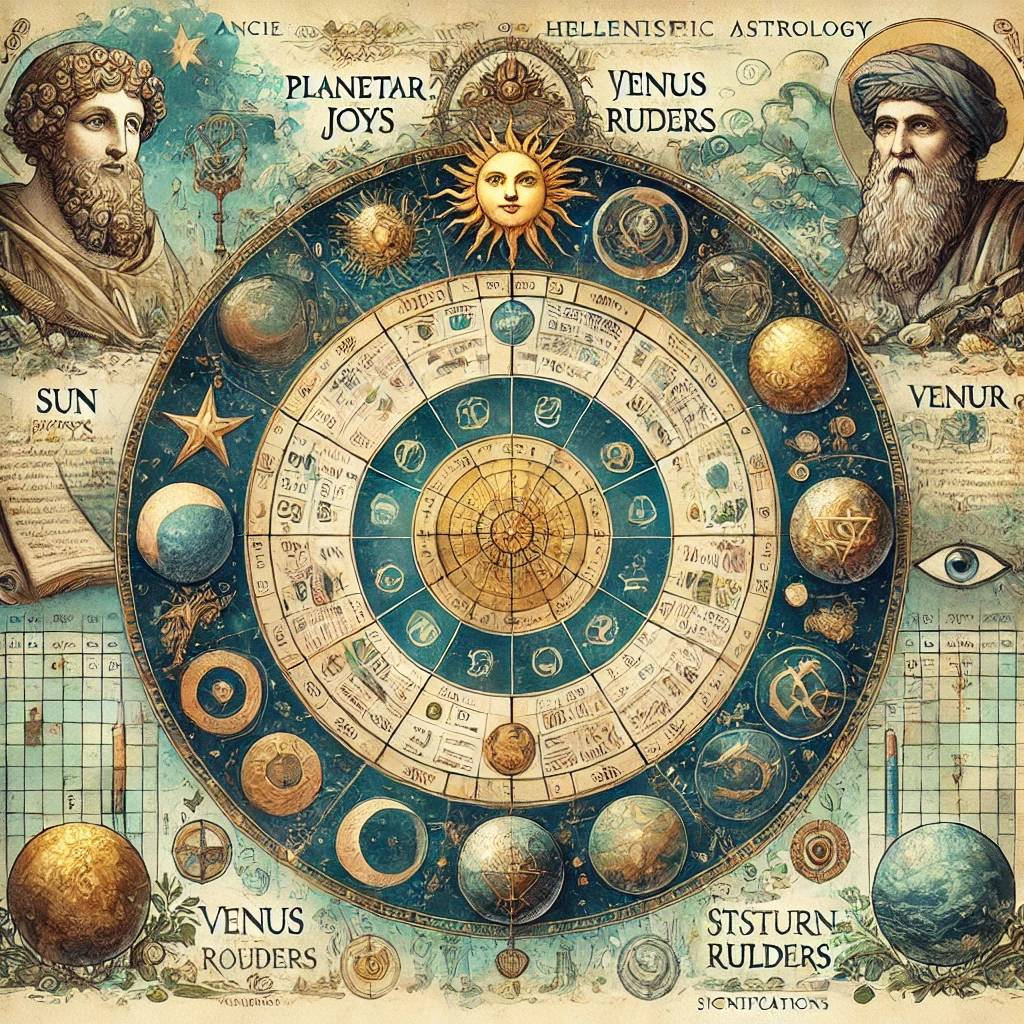
The Planetary Joys and House Significations
In Hellenistic astrology, each planet is associated with a particular house where it is said to “rejoice.” These planetary joys are not merely symbolic but reflect a structured system that links the planets, houses, and elements in a way that offers insights into the philosophical and cosmological underpinnings of ancient astrology. For instance, the Sun, associated with vision and purpose, finds its joy in the 9th house—often called the “place of God.” The Moon, aligned with intuition and the subconscious, is placed in the 3rd house, known as the “place of the Goddess.” The specific associations are as follows:
- Sun rejoices in the 9th house (God)
- Moon rejoices in the 3rd house (Goddess)
- Jupiter rejoices in the 11th house (Good Spirit)
- Venus rejoices in the 5th house (Good Fortune)
- Mars rejoices in the 6th house (Bad Fortune)
- Saturn rejoices in the 12th house (Bad Spirit)
- Mercury rejoices in the 1st house (Helm)
This system is foundational to the Hellenistic astrological model, in which each joy reflects deeper qualities of the houses, aligning with the planetary characteristics. For example, Jupiter—the planet of growth, expansion, and luck—rejoices in the 11th house, which traditionally relates to hopes, community, and gains. Conversely, Saturn, often seen as a malefic or challenging force, finds its joy in the 12th house, associated with isolation, suffering, and hidden matters. This pairing underscores a philosophical alignment, where planetary qualities influence house significations, and house meanings, in turn, reflect the nature of the planets rejoicing there.
The Diurnal and Nocturnal Hemispheres
The concept of “sect”—the division of planets into day (diurnal) and night (nocturnal) groups—is critical in Hellenistic astrology, and it finds a natural integration within the planetary joys. Brennan explains that diurnal planets (Sun, Jupiter, and Saturn) are arranged in the upper half of the chart, representing visibility and activity, while nocturnal planets (Moon, Venus, and Mars) align with the lower half, symbolizing hidden, introspective, and internal qualities.
Mercury, which can shift between day and night affiliations, is uniquely placed in the 1st house, the “Helm,” at the threshold between the diurnal and nocturnal hemispheres. This positioning highlights Mercury’s role as a messenger, adaptable and able to traverse both realms, linking conscious awareness (above the horizon) and the subconscious or internal experience (below the horizon).
The Connection Between Planetary Joys and the Four Elements
One of Brennan’s groundbreaking insights is how the planetary joys provide an original rationale for associating zodiac signs with the four classical elements—fire, earth, air, and water. He explains that the placement of planetary joys follows a cosmic order that mimics Aristotle’s theory of “natural place”:
- Fire rises to the top of the cosmos (associated with the Sun and Jupiter, who rejoice near the Midheaven).
- Earth descends to the bottom (Moon and Venus in the lower hemisphere).
- Air ascends and settles below fire (Saturn and Mercury near the Ascendant).
- Water rests above the earth (Mars near the Descendant).
This cosmic hierarchy became a cornerstone for assigning elements to the zodiac triplicities. The planets rejoicing in each section directly correspond with elemental rulership in the zodiac signs: Sun and Jupiter for fire, Moon and Venus for earth, Saturn and Mercury for air, and Mars for water. Through this model, the joys create a compelling framework connecting planets, houses, and elements that later became fundamental to astrological interpretation.
Influence on the Triplicity Lords and Life Stages
The structure of planetary joys also informs the Hellenistic system of triplicity rulers, which divides signs into groups (or “triplicities”) associated with specific planets. Each triplicity is aligned with a set of planets that govern different stages of life or aspects of personality, which could be day, night, and a “cooperating” lord. Brennan demonstrates how the order of triplicity lords mirrors the sequential arrangement of planets within the joys. For instance, in the fire triplicity (Aries, Leo, and Sagittarius), the Sun, Jupiter, and Saturn are linked through joy placements and similarly govern the fire signs in a logical progression from “morning” to “evening.”
Sect and the Nature of Planetary Malefics
The arrangement of planetary joys further addresses one of the core challenges in ancient astrology: understanding the role of “malefic” planets, such as Mars and Saturn, within the context of sect. By looking at the joys through this lens, we find a more nuanced approach to malefics. Saturn, for example, becomes more benefic when it operates in a day chart, “warmed” by the Sun’s influence. Mars, by contrast, benefits in a night chart, as it is “tempered” in the lunar realm.
Brennan’s analysis proposes that these qualities are not inherent but are contextually based on their positioning in the joys and sect arrangement. This offers a more balanced view of the so-called malefic planets, suggesting that their influence can be constructive or destructive depending on their sect alignment and house position.
Joys and the Foundations of House Meanings
Brennan argues that the significance of the houses in Hellenistic astrology was deeply rooted in the planetary joys rather than a direct correspondence with zodiac signs, as seen in modern astrology. In this framework, house meanings often derive from the nature of the planet rejoicing in them. The 5th house, for example, gains its association with pleasure and creativity partly because Venus, the planet of love and beauty, rejoices there.
The hemispheric division also plays a role in house meanings, with the upper hemisphere (diurnal) representing matters of the mind, spirit, and visibility, while the lower (nocturnal) half relates to the body, fortune, and hidden realms. This framework provided early astrologers a basis for interpreting house significations, not as static meanings but as fluid concepts shaped by planetary characteristics.
Implications and Contributions to Hellenistic Astrology
The planetary joys, as described by Brennan, represent a sophisticated system that not only grounded the practice of Hellenistic astrology but also integrated philosophy, cosmology, and symbolism into a unified model. This model goes beyond practical interpretation, reflecting an ancient worldview where cosmic order, elemental forces, and human experience are intrinsically interconnected.
Brennan’s work emphasizes that the joys likely served as a foundational blueprint in Hellenistic astrology, helping to establish early doctrines and providing a systematic approach to chart interpretation. His analysis bridges the worlds of historical astrology and philosophy, showing that astrological meanings are not merely observational but are also deeply philosophical, reflecting the ancients’ attempt to connect the heavens and human experience in a coherent and meaningful way.
In conclusion, “The Planetary Joys and Origins of House and Triplicity Significations” reveals that Hellenistic astrology was not only a predictive system but also a cosmological philosophy, using planetary placements, sect, and elemental qualities to explore the human soul, body, and fortune within a structured cosmic order. This exploration of planetary joys as the foundation of house meanings offers a profound understanding of astrology’s philosophical roots, bringing to light the ways ancient astrologers harmonized the cosmos, elements, and human experience in their practices.
Leave a Reply