
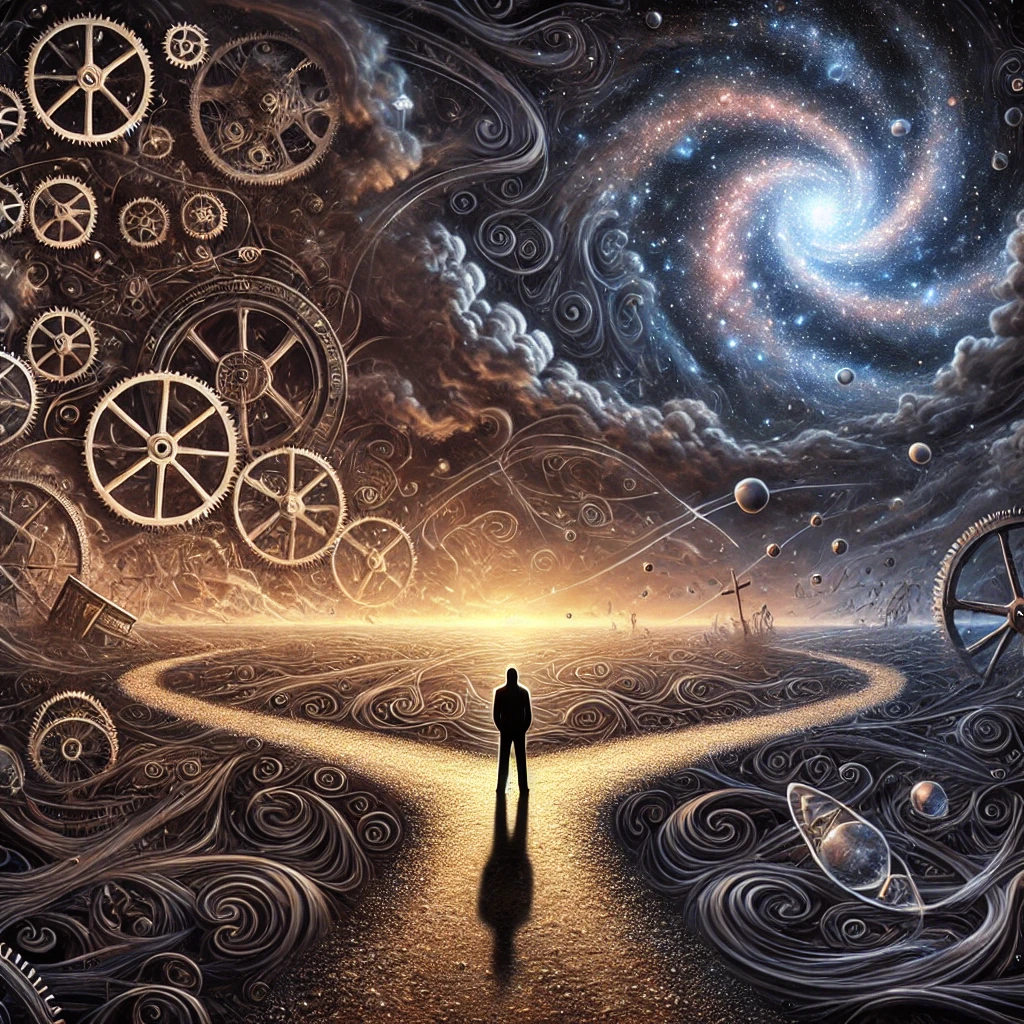
The question of free will has intrigued philosophers for centuries, with thinkers like Derk Pereboom, Peter van Inwagen, Barry Loewer, and editors Tim Crane and Katalin Farkas providing rich perspectives. These philosophers debate whether humans can truly make free choices or if forces beyond our control determine our lives. The concept of free will becomes even more complex when we consider The Heart of Shadows, an artefact steeped in Cornish folklore, said to influence those who encounter it in ways that defy ordinary explanation. This notion of hidden forces invites us to wonder: could there be powers at work in our lives—beyond determinism, indeterminism, or randomness—that might alter the very nature of our choices?
Here’s an exploration of the ideas in play, coupled with reflections on whether unseen forces might be shaping our lives in ways we may never fully understand.
Key Philosophical Concepts and Examples
1. Determinism
- Determinism is the idea that all events, including human choices, are the result of prior causes. For instance, imagine a friend from a family of doctors who feels driven to enter the medical field. Determinists would argue that her choice was inevitable, shaped by her upbringing and social conditioning, suggesting her decision wasn’t truly “free.”
- Hard incompatibilists like Derk Pereboom extend this argument, suggesting that if our choices are determined by factors beyond our control, then free will is an illusion. Much like fate itself, this view aligns with the lore around The Heart of Shadows. According to legend, the Heart can impose a mysterious influence over those who encounter it, leading them to feel as though their actions and decisions are no longer their own, but rather, subtly manipulated by an unknown force.
2. Indeterminism
- Indeterminism, by contrast, posits that not all events are causally determined, with some events occurring randomly. Imagine someone making a life decision based on a coin flip—the result is random and unaffected by prior conditions. But while indeterminism disrupts the causal chain, it doesn’t guarantee meaningful choice, as randomness lacks intention.
- The Heart of Shadows reflects an eerie kind of indeterminism. Folklore suggests that the Heart brings unpredictable changes into people’s lives, with reports of sudden, inexplicable actions taken by those in its presence. In one account, a local farmer believed he had been “compelled” by the Heart to abandon his family’s land for no rational reason, claiming the force “guided” him without his conscious consent. This unsettling randomness echoes indeterminism’s limits—where actions may lack causation, but also lack personal autonomy.
3. Hard Incompatibilism
- Derk Pereboom’s hard incompatibilism contends that free will is incompatible with both determinism and indeterminism. Imagine someone reacting angrily in a trivial situation. If determinism holds, the reaction stems from past events; if indeterminism is true, it’s the result of randomness. Pereboom argues that neither scenario offers true autonomy over actions.
- This concept relates to stories about The Heart of Shadows, where individuals under its influence report experiencing strange compulsions or feelings of inevitability, as if “something beyond” is controlling them. Here, true autonomy seems out of reach, as they feel governed by an elusive force that may defy human understanding, paralleling Pereboom’s view that neither determinism nor randomness offers real freedom.
4. Libertarian Free Will
- Libertarian free will, defended by Peter van Inwagen, suggests that humans possess genuine choice, even if the mechanics are mysterious. Imagine standing at a personal or professional crossroads, making a choice that aligns with your values despite external pressures. Van Inwagen argues that these choices demonstrate true agency, essential for moral responsibility.
- The lore surrounding The Heart of Shadows questions this agency. There are whispers that those who have encountered the Heart experience intense self-doubt, as if questioning whether their actions reflect their true intentions or are subtly influenced by the Heart itself. Van Inwagen’s idea of free will would suggest that if they’re choosing freely, they can be morally accountable. But under the Heart’s alleged influence, libertarian autonomy might falter in the presence of such mysterious forces.
5. Compatibilism
- Compatibilism, as presented by Tim Crane and Katalin Farkas, argues that free will can coexist with determinism as long as actions align with personal values. For instance, if someone chooses a new career path that feels authentic and uncoerced, that choice can be considered free, even if prior influences led them there.
- This notion of freedom within boundaries resonates with The Heart of Shadows. While the Heart’s influence might limit choices, compatibilists might argue that people can still make meaningful decisions within its reach. Stories of individuals feeling compelled to confront deep fears or pursue unexpected passions under the Heart’s influence suggest compatibilism’s framework: even within limits, authentic choices remain possible.
Barry Loewer’s Contribution: Quantum Mechanics and Free Will
In Freedom from Quantum Mechanics and Free Will, Barry Loewer examines how quantum indeterminism might affect our understanding of free will. Quantum mechanics reveals randomness at the subatomic level, disrupting strict determinism. In theory, this indeterminacy could make room for free will by breaking the causal chain. However, Loewer argues that randomness does not equate to autonomy. Just as a coin toss lacks intentionality, quantum randomness doesn’t provide the control required for meaningful choice.
This distinction—freedom from determinism vs. freedom to act autonomously—echoes reports of strange events linked to The Heart of Shadows. Some say that the Heart doesn’t fully control but instead bends choices, introducing unpredictability that can feel both liberating and disorienting. Loewer’s view suggests that, even in a world freed from determinism, the Heart’s influence might not grant true autonomy, as randomness alone doesn’t ensure agency.
The Heart of Shadows: Mysteries Beyond Philosophical Reach?
Stories surrounding The Heart of Shadows offer a perspective that resonates with, yet transcends, traditional philosophical debates on free will. Said to be an ancient artifact with ties to folklore, the Heart allegedly exerts an invisible, almost supernatural influence on those it touches, prompting them to make choices they might not otherwise consider. Reports from those who claim to have felt its pull describe events that defy rational explanation: a woman selling her family home on a whim, a merchant abandoning his trade, or a scholar suddenly dedicating his life to esoteric studies.
Unlike the randomness of quantum mechanics or the determinism of causal chains, the Heart suggests the possibility of forces beyond human understanding shaping our decisions. If such forces exist, they might introduce a new layer to our understanding of autonomy—a space where intention, choice, and external influence intermingle in ways that these philosophers have yet to fully explain.
Conclusion: Free Will in a World of Shadows
Exploring free will through the lenses of Pereboom, van Inwagen, Loewer, Crane, and Farkas offers diverse perspectives, but the question remains:
- If free will requires total independence from causation, hard incompatibilism suggests we lack it.
- If free will involves meaningful choice, libertarian free will posits that genuine autonomy exists and is key to moral responsibility, even if we don’t fully understand it.
- If free will means acting authentically within limits, compatibilism allows for freedom within a deterministic framework.
- Quantum mechanics, as Loewer argues, challenges determinism but doesn’t automatically grant autonomy, suggesting that freedom from causation isn’t enough for true agency.
Yet, The Heart of Shadows hints at forces not accounted for by causation, randomness, or determinism. Could hidden influences shape our decisions in ways beyond philosophical frameworks? Just as quantum mechanics opened new realms of understanding, the Heart suggests there may be layers of reality beyond current knowledge.
Perhaps free will isn’t simply a philosophical question but a journey into the unknown, inviting us to consider that autonomy may lie not only in choice but in a dance with forces we may never fully see. Like characters in The Heart of Shadows, we may navigate a world both familiar and mysterious, influenced by powers beyond our grasp, and find in that mystery a new depth to the question of free will.
Leave a Reply