
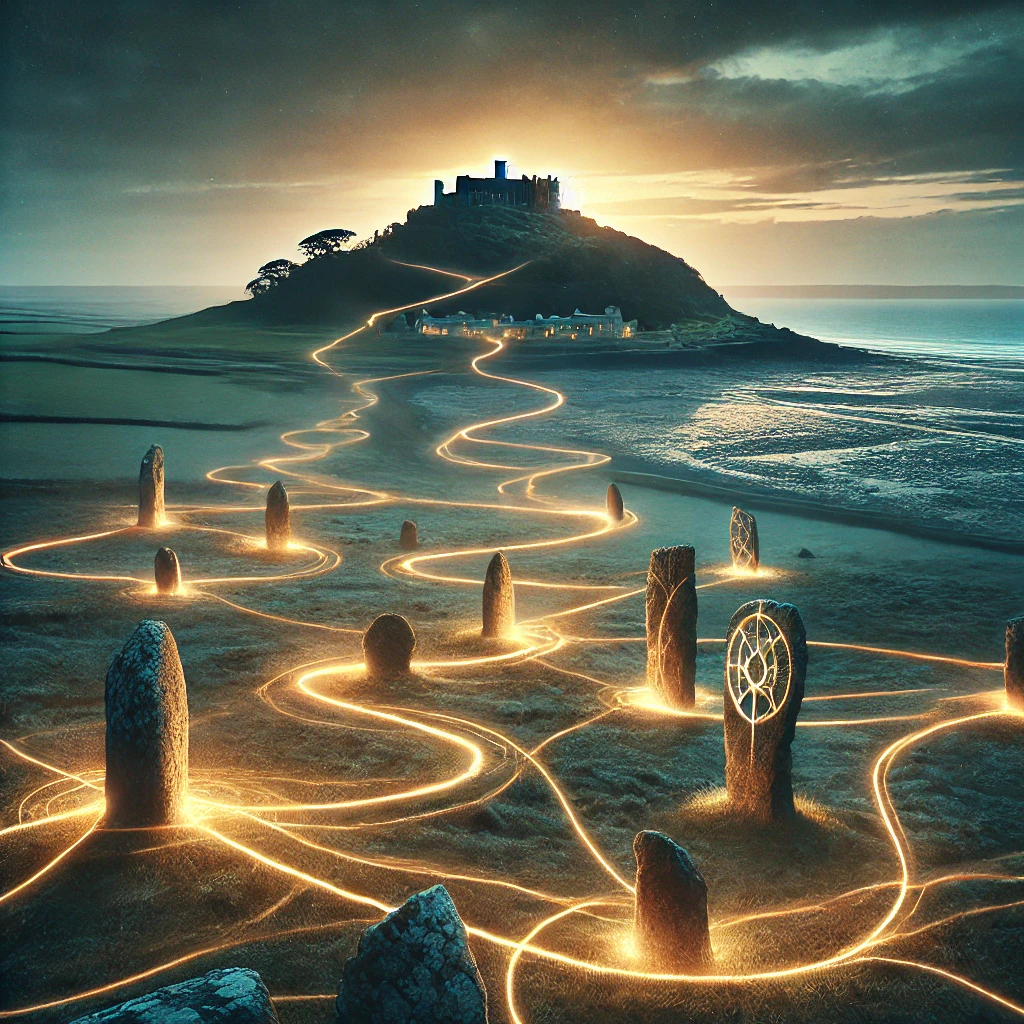
As a West Country witch and seeker of the mystical, I’ve long been captivated by the invisible threads said to crisscross the earth: ley lines. These ancient energy pathways are steeped in folklore, mystery, and an undeniable sense of the sacred. Whether you’re a curious skeptic or an intuitive explorer, there’s something enchanting about the idea of walking the ancient songlines of our land.
What Are Ley Lines?
The concept of ley lines arises from the belief that the earth is covered by a web of subtle energies, a network that ancient civilizations knew and revered. These lines, marked by natural formations and sacred sites, are thought to link powerful nodes where energy converges. Some call them pathways of earth’s electromagnetic field; others say they’re spiritual arteries connecting us to the divine.
In England, this web is most famously represented by the St. Michael Line, which sweeps from Land’s End in Cornwall, through Glastonbury, and onward to the Norfolk coast. Along this line, you’ll find iconic landmarks like St. Michael’s Mount, Glastonbury Tor, and Avebury. It’s as if the land itself whispers secrets of an older time, waiting for those attuned enough to listen.
The Magic of Cornwall’s Ley Lines
Cornwall, with its rugged coastlines and ancient stone circles, holds some of the most vibrant nodes on these lines. Standing at St. Michael’s Mount, you can almost feel the energy coursing through the land, a subtle hum beneath the roar of the sea. This sacred site, aligned with others on the line, is a testament to the spiritual significance ancient peoples placed on the geography of their world.
Hamish Miller, in his remarkable book The Sun and the Serpent, explored the deeper intricacies of the St. Michael Line. His discoveries revealed that there are actually two intertwined lines of energy—one carrying masculine, solar energy, and the other feminine, lunar energy. These lines twist and coil across the landscape like serpents, balancing and complementing each other.
Miller wrote that at certain points, where these lines intersect or form nodes, the energy can be palpable. These spots often correspond with ancient monuments or churches, such as the chapel atop St. Michael’s Mount or the sacred hill of Glastonbury Tor. The lines’ intertwined nature reflects the duality of life: creation and destruction, light and shadow.
In his research, Miller also uncovered that these energies could manifest with “intentions,” shaped by the landscape, the people who interact with them, and even the rituals performed on these sites. He believed that while these lines could offer inspiration, healing, and enlightenment, they also carried the potential for disruption if approached carelessly.
A Practical Connection: Walking the Lines
Walking ley lines is more than a physical journey; it’s an opportunity to connect with history, the earth, and yourself. The Aboriginal peoples of Australia have their ‘songlines,’ pathways marked by stories and ceremonies. In much the same way, England’s ley lines allow us to retrace the steps of our ancestors, rediscovering a connection to the land and its myths.
If you’re venturing out to explore, start with awareness. Visit standing stones, hilltop churches, or natural formations thought to be ley line markers. Pause at these nodes, meditate, and listen. Perhaps you’ll feel the faint pull of the energies described in folklore—or perhaps you’ll simply find a moment of stillness amidst the noise of modern life.
Ley Lines and the Caution They Demand
While ley lines are often associated with harmony and inspiration, some believe they carry darker energies as well. Miller warned that these currents of power could act unpredictably, influenced by both the land and those who engage with them. It’s no surprise that tales of hauntings and strange occurrences often cluster around these lines and their nodes.
If you choose to explore, go with respect, care, and grounding. Bring offerings of thanks—a flower, a small crystal, or even a simple moment of gratitude. The land remembers, and its energies demand reverence.
Cornwall: A Gateway to Mystery
Cornwall’s ley lines are a portal to England’s ancient magic. They connect us to stories etched in stone, myths carried on the wind, and energies that bind us to the earth. Whether you’re standing on the cliffs of Land’s End, walking the labyrinth at Glastonbury, or meditating by a forgotten stone circle, these lines invite us to step into a world where the veil between past and present, seen and unseen, grows thin.
Hamish Miller often described his walks along these lines as a dance with the earth’s spirit, a way to touch the divine and rediscover his own essential self. “To walk the line,” he wrote, “is to feel the heartbeat of the land.”
So, my friends, tread lightly, listen closely, and always carry a little salt in your pocket. The land is alive with stories, and the ley lines are its whispers.
Until next time,
Sylvia Moon
Leave a Reply