
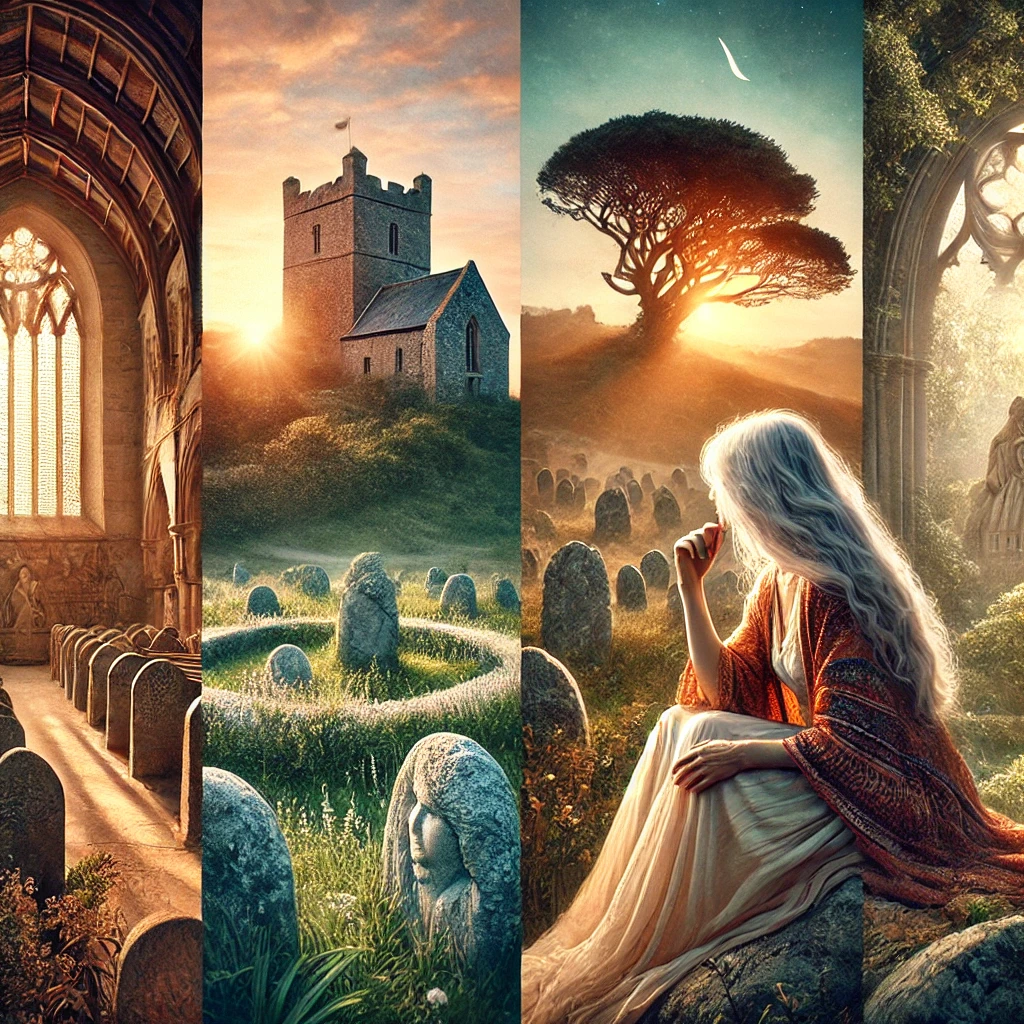
….of my four favourite heroines, which soon I will visit:
Lillian’s Favorite Place in Cornwall: St. Just-in-Roseland Church
Lillian loves St. Just-in-Roseland Church, a quiet, atmospheric medieval church nestled in a subtropical garden near the Fal River. It speaks to her scholarly and contemplative nature—a place where she can reflect, process her thoughts, and feel connected to history. The churchyard, rich with ancient gravestones, ferns, and exotic plants, appeals to her appreciation for the interplay of history, spirituality, and natural beauty. She enjoys sitting on the old stone benches, absorbing the sense of continuity and tradition while listening to the soft rustling of trees and the distant calls of seabirds.
The church’s serene and almost timeless quality allows her to think clearly—a contrast to the chaos of their investigations. It also grounds her mystical curiosity in something tangible, blending her rational mind with the possibility of the unknown.
Sylvia’s Favorite Place in Cornwall: Boscawen-Un Stone Circle
In contrast, Sylvia is most drawn to Boscawen-Un Stone Circle, a Bronze Age sacred site southwest of Penzance. This ancient, liminal space feels deeply alive to her, humming with energy from centuries of rituals, prayers, and magic. Unlike Lillian’s preference for structured history, Sylvia revels in the wildness and raw mysticism of this place.
Boscawen-Un is untamed, deeply connected to the land and the unseen, a place where time feels fluid. She often walks the circle barefoot, sensing the lingering presence of past wisdom keepers. She has performed small personal rituals here—whispering spells to the stones, making offerings to the land, and feeling the pulse of something older than written history.
Comparison & Contrast
- Lillian seeks structure and reflection in a place tied to recorded history, whereas Sylvia embraces the wild unknown in a site that predates written records.
- Lillian’s favorite place is a Christian site, a testament to organized spiritual tradition, while Sylvia’s is a pagan site, steeped in folk magic and oral lore.
- St. Just-in-Roseland is cultivated, serene, and enclosed, aligning with Lillian’s preference for ordered thought. Boscawen-Un is raw, open, and exposed to the elements, much like Sylvia’s deep-rooted mystical instincts.
- Both places carry a sense of timelessness and sacred energy, but one is rooted in structured history, while the other remains untamed and mysterious.
Despite these differences, both locations offer them solace, insight, and a connection to something beyond the everyday world, reflecting their different but complementary approaches to magic, knowledge, and the unknown.
Margaret’s Favorite Place in Cornwall: Godolphin House & Estate
Margaret’s favorite place is Godolphin House, an ancient estate with a storied past, hidden within the rolling Cornish countryside. Once the home of a powerful mining dynasty, it exudes elegance, secrecy, and quiet authority—qualities Margaret appreciates.
She loves the walled gardens, where the carefully curated flora reflects her own sense of control and precision, but she is most drawn to the remains of the medieval house, where the whispers of history feel close. The estate is neither wild nor overly structured—it is a place of calculated beauty, secrecy, and endurance, much like Margaret herself. She enjoys walking the hidden paths, contemplating past intrigues and power struggles, feeling an affinity with those who once held influence here.
The Godolphin Hill that rises above the estate offers a panoramic view of land meeting sea, which reminds Margaret of her own need to see all angles before making a move. The history of mining wealth, lost fortunes, and shifting power speaks to her, as she too is a master of reinvention.
Cassandra’s Favorite Place in Cornwall: Tintagel Castle
Cassandra, on the other hand, is captivated by Tintagel Castle, the legendary birthplace of King Arthur, where myth and history intertwine. Unlike Margaret, who finds power in secrecy, Cassandra embraces legend and grandeur—places where magic and reality blur.
Standing on the windswept cliffs, she feels the presence of something ancient, beyond human ambition. The tides crashing below, the ruins perched on the edge of the world, and the Arthurian myths that linger in the air stir something deep within her. Cassandra is drawn to the romance of legend, the untouchable power of myth, and the notion that certain truths are hidden behind stories.
While Margaret prefers contained power, Cassandra thrives in the dramatic, mystical, and elusive. She sees herself in the figures of Morgan le Fay and the priestesses of Avalon, knowing that power often lies in the unseen currents beneath the surface, rather than in visible wealth or influence.
Comparison & Contrast
Margaret vs. Cassandra
- Margaret values control and quiet influence, preferring an estate where history remains intact. Cassandra is drawn to wild, legendary places, where power is intangible but felt in every gust of wind.
- Godolphin House is a place of strategic maneuvering and history, while Tintagel is a place of mystery, magic, and untamed myth.
- Margaret respects history as a lesson in power, whereas Cassandra sees it as something fluid, shaped by those who control the narrative.
How They Compare to Sylvia & Lillian
- Lillian seeks knowledge and reflection in a place of historical continuity (St. Just-in-Roseland). Margaret is similar in that she values the endurance of power, but she is far more calculating and strategic about it.
- Sylvia connects with the mystical wilds of Boscawen-Un. Cassandra shares her love of the untamed and magical, but while Sylvia communes with the land, Cassandra embraces legend and destiny.
- Margaret aligns more with Lillian in appreciating historical places, but Margaret values power over understanding.
- Cassandra and Sylvia both believe in forces beyond the material world, but Cassandra sees them as something to be harnessed, while Sylvia experiences them as something to be honored.
Final Thoughts
Each woman’s favorite place reflects how they interact with power, history, and the unseen:
- Margaret: The strategist, drawn to places of quiet dominance.
- Cassandra: The enigma, lured by places where history and myth blur.
- Lillian: The scholar, seeking insight in structured history.
- Sylvia: The mystic, immersing herself in wild, sacred spaces.
These preferences reveal their deepest motivations, relationship with control and mystery, and approach to uncovering the truth.
Leave a Reply