
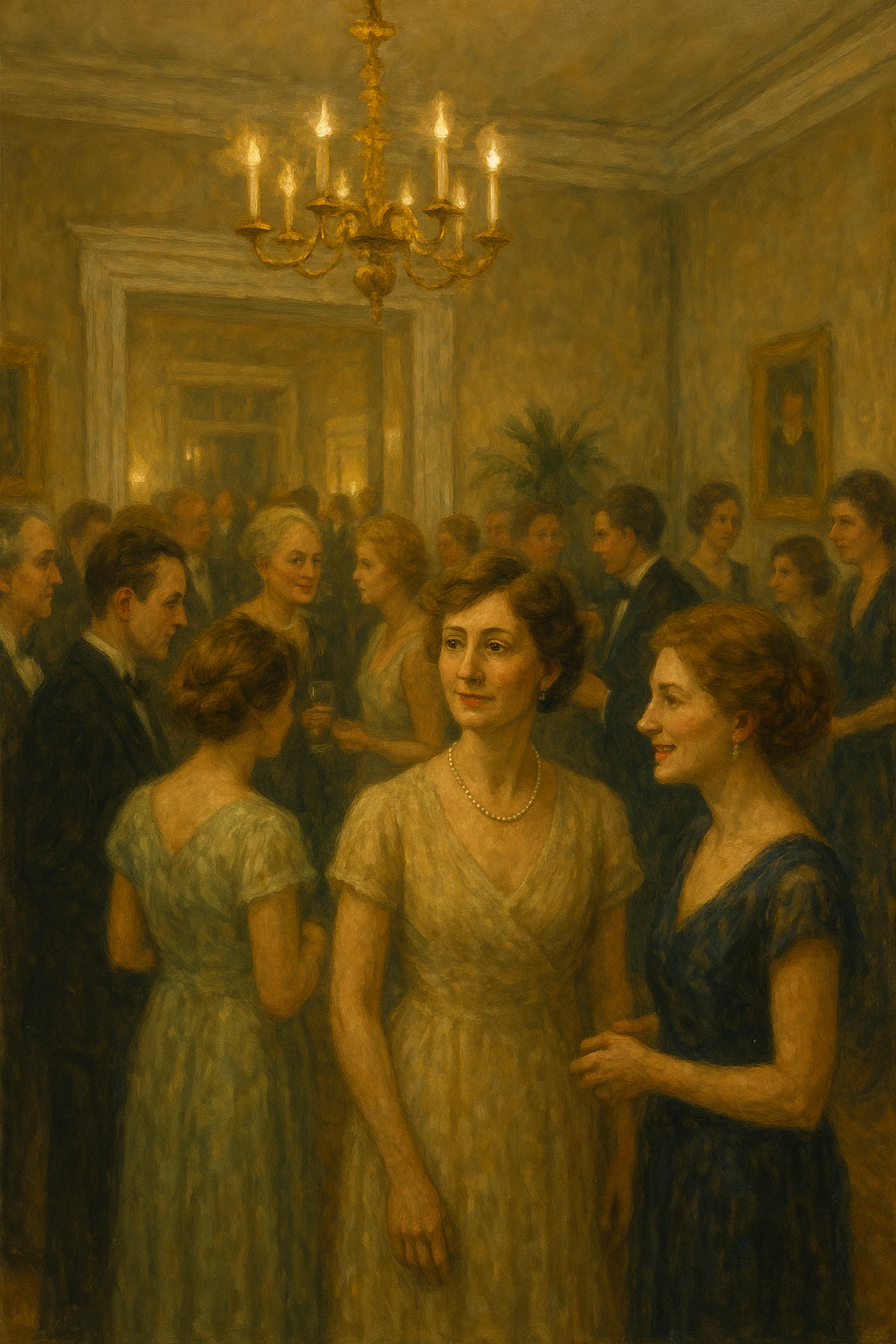
At Mystic Reads, the late afternoon light settles like memory. Dust drifts through the air in golden ribbons, and the scent of lavender and old paper clings to everything — even the silence.
Sylvia Moon is behind the counter, arranging a stack of pamphlets on lunar influence and Cornish weather deities, her fingers stained faintly with nettle and ink. Lillian Hartley, cardigan buttoned neatly, brows slightly drawn in her usual scholarly focus, pulls a worn paperback from the shelf.
“Mrs Dalloway,” she murmurs, almost to herself. “It’s extraordinary, really. The way Woolf lets life and death brush up against each other—Clarissa choosing the ordinary joy of a party, Septimus vanishing into silence. They never meet, but they echo.”
Sylvia doesn’t look up. “It’s a tempest in a teacup,” she says. “One woman worrying about gloves and seating plans, a war hero flinging himself out the window. Sounds like a waste of a day.”
Lillian closes the book slowly. “It’s not about what happens. It’s about how it happens. That inner terrain we all carry. Woolf turns that into landscape.”
Sylvia snorts. “She turns it into weather. Everyone’s drifting around like clouds, thinking themselves into paralysis.”
There it is — the familiar divide. Lillian, all reflection and reverence, shaped by years in academia and a lifelong belief in meaning beneath the surface. Sylvia, rooted in instinct and ritual, suspicious of too much self-analysis. She trusts her gut, the dirt under her nails, and the tug of the moon — not fragile meditations in drawing rooms.
But still, she listens.
And Lillian, for all her ideals, never pushes too hard.
“You say it’s clouds,” Lillian replies, gently. “But you’re forgetting the storm. Septimus couldn’t survive his experience. Reflecting on her own, Clarissa chooses to live. That contrast—it’s everything. Not a plot, maybe. But a heartbeat.”
Sylvia doesn’t respond right away. Her hands are busy folding a tea towel, but her mind lingers. She’s buried people. Sat beside friends who wouldn’t speak of their sorrow until it broke them. She knows what it is to choose to stay.
Just then, the doorbell chimes.
A young woman enters — wind-blown, uncertain, her coat askew and her eyes holding some unnamed ache.
“Do you have Mrs Dalloway?” she asks. “I read it in school. But something’s pulling me back.”
Sylvia hesitates, then points. “Second shelf. Between the ghosts and the revolutions.”
She catches Lillian’s glance and gives the faintest shrug. Not a concession — more of a recognition.
Later, as they close the shop, the street outside is nearly dark. The sea is murmuring to itself just beyond the rooftops, and the first scent of rain hangs in the air.
Sylvia turns the key in the door. “Next time, I’m picking du Maurier,” she says. “At least her ghosts do something.”
Lillian smiles, pulling her scarf tighter. “Fine. But I’ll be arguing for Rebecca.”
And they walk down the hill together, side by side — two women shaped by different lives, drawn by different truths, bound by a love that knows no need for sameness.
The argument was never really about Virginia Woolf.
It was about what we hold onto — and what we let go.
And maybe, just maybe, there is a kind of magic in a teacup, after all.
Author’s Note
Sylvia Moon and Lillian Hartley have long been at the centre of my stories — first in The Heart of Shadows, and now in The Mirror’s Wake. Their differences — mystical intuition and grounded scholarship, earthy ritual and reflective logic — create the quiet tension that drives their investigations, their arguments, and their deep, hard-earned love for one another.
This imagined debate over Mrs Dalloway feels like a moment that might have happened between books — a brief lull between hauntings, rituals, and unravelled secrets. Yet it also reveals something essential: both women are grappling, in their own ways, with what it means to choose life in the face of grief, mystery, and change. Just like Clarissa and Septimus, Sylvia and Lillian stand on either side of a fragile threshold — not divided by belief, but joined by care.
In The Heart of Shadows, they confronted the reawakening of an ancient artifact buried beneath Falmouth’s folklore — a force that threatened not only the living but the veil between worlds. With the help of Ethan Hartley, a skeptical nephew drawn into their circle, they uncovered a tangled web of murder, magical inheritance, and the haunting cost of secrecy.
Now, in The Mirror’s Wake, they face what lingers after the Veil has thinned. A series of unsettling reflections, vanishing landmarks, and a return from Faerie with consequences no one fully understands. As Lillian and Sylvia attempt to restore balance, they must confront the echoes of choices made — and discover that some thresholds, once crossed, leave no path back.
Whether in Falmouth or Faerie, tea shop or mythscape, they continue to walk beside one another. And sometimes, a storm in a teacup is exactly where the truth hides.
— [Thanks for reading – Best, Debra]
Leave a Reply