
by Sylvia Moon and Lillian Hartley
It opened, of course, on Samhain Eve. Cassandra had planned it that way from the start, though she pretended otherwise when the local paper asked. “It’s purely a scheduling coincidence,” she said with her usual poise, but the faintest smile betrayed her.
Falmouth was a shiver that night — fog sweeping off the harbour, lamps blooming in halos, and the museum windows aglow like watchful eyes. Inside, people gathered with a mixture of curiosity and caution: townsfolk, historians, a few of the university crowd, and at least one uneasy vicar standing near the door as though expecting the roof to fall in.
The Curator in the Candlelight
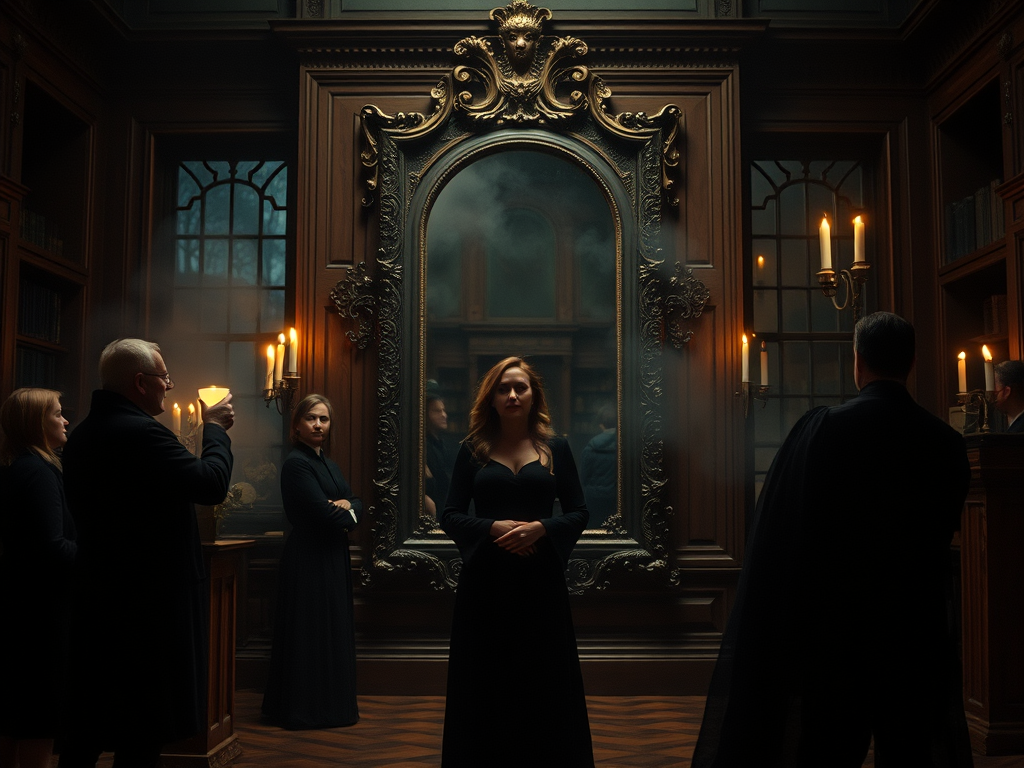
Cassandra stood beneath the carved lintel of the main gallery, dressed in black silk that caught the candlelight like water. Around her hung the relics she had gathered: charm bottles filled with pins and milk, fragments of carved slate etched with moon symbols, a bowl of Cornish sea glass labelled “Offerings to the Tides.”
She had asked us both to come — Lillian for her notes on folk healing and myself for “moral support, in case the dead decide to RSVP.”
I could feel them, of course — the stir beneath the surface, the breath of those who remember what this night means. Samhain is not sinister; it’s a hinge. The spirits don’t come to harm but to listen. Still, there was a pressure in the air — the hush before a wave breaks.
The Reverend Returns
Reverend Colby arrived later than most, his collar shining faintly in the lamplight. He greeted Cassandra with old-world courtesy, but his eyes were wary, as though he’d stepped into a confession he hadn’t intended to make.
“You’ve filled the house again,” he said softly, and she inclined her head.
He meant the Blackwood house, not the museum. I saw it in his expression — that flicker of inherited dread.
We stood near him as Cassandra unveiled her central display: a single, restored artifact from Pendrim Moor — Edward Blackwood’s mirror, said to have survived the 1837 fire. The glass was imperfect, rippled like the surface of water, and framed by darkened brass engraved with faint sigils.
“Please note,” Cassandra said, her voice steady, “it is merely a historical object. What one sees in it depends entirely on the viewer.”
But even she did not look directly into it for long.
The Moment
The crowd drifted forward. Lillian was taking notes when she touched my arm.
“Do you feel that?”
I nodded. The air had grown dense — not cold, but full, as if the room had drawn a breath and forgotten to let it go. Somewhere beyond the glass, a whisper rippled through the reflection, low and familiar.
“Still stirring the waters, are we?”
I didn’t need to look. Edward had come.
For a heartbeat, the light shifted — not bright, but clearer, as though the shadows themselves were adjusting their focus. A few guests blinked, others crossed themselves. Reverend Colby stepped back so sharply he nearly upset a display case.
Then Cassandra spoke again, her voice smooth as silk on stone:
“This exhibition is not about fear. It is about listening to what history refused to hear.”
The mirror stilled. The air exhaled. The room remembered itself.
After the Lights
When the guests had gone, Cassandra locked the museum doors and leaned against the wall, breathing deeply. “Well,” she said, “that went better than expected.”
Lillian smiled faintly. “That depends on what you expected.”
And I — I could still feel Edward hovering, amused and pleased with himself. I murmured, “You behaved tonight.”
From somewhere near the mirror came a soft, delighted chuckle.
Postscript
Later, walking home through the fog, we saw Reverend Colby standing alone at the end of the quay, staring out toward Pendrim Moor. He didn’t see us. Or perhaps he did, and chose silence.
Some doors, once opened, never quite close again. But perhaps — just perhaps — they were never meant to.
From the notebook at Mystic Reads — Samhain Eve, when the past speaks softly and the living are wise to listen.
Leave a Reply