
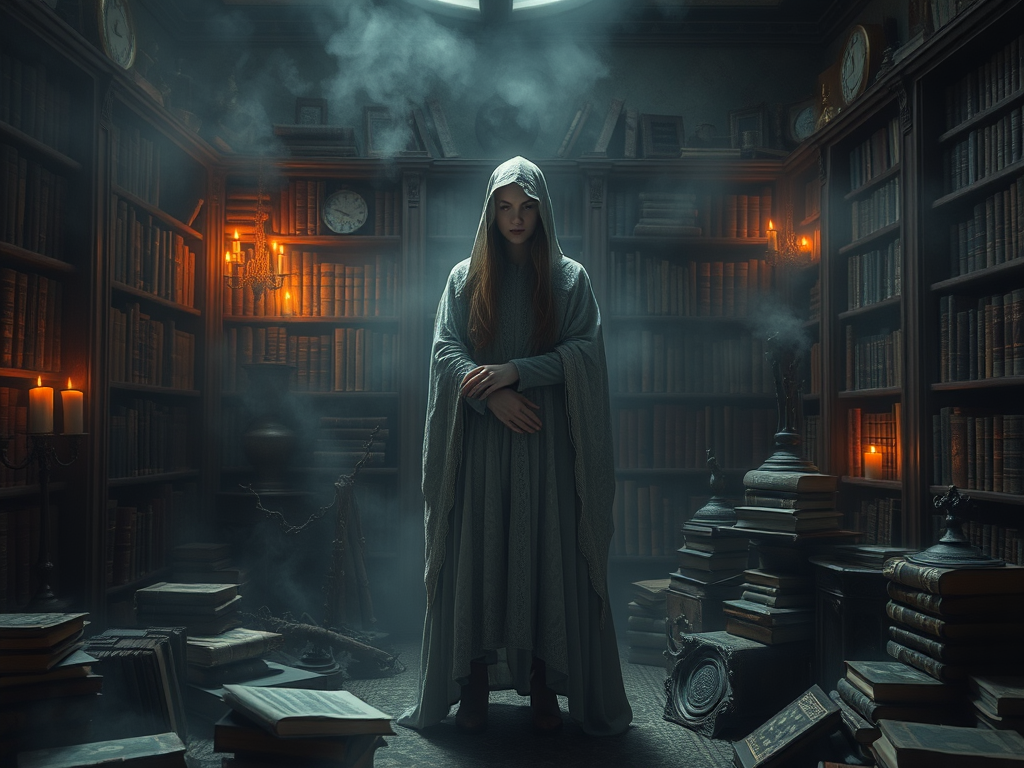
by Sylvia Moon and Lillian Hartley
Editor’s Note:
This week, as Falmouth’s Folklore Museum opens its long-awaited exhibition “Witches and Fair Folk: The Hidden Faith of Old Cornwall,” we at Mystic Reads have been reflecting on what it means to live among stories that were once punishable by death. Curated by our friend and colleague Cassandra Blackwood, the exhibition invites visitors to reconsider the word witch — not as curse or caricature, but as custodian of the world’s forgotten wisdom.
Yesterday, a visitor to the shop reminded us just how uneasy that word can still make people.
It began, as such things often do in Falmouth, with a whisper that turned into weather.
Reverend Colby from St. Euny’s came into Mystic Reads late in the morning, the sea-mist still clinging to his collar. He said he was looking for “some background” on Cassandra’s new exhibition.
At the mention of her name, even the dust in the air seemed to pause. Everyone in this town knows the Blackwoods — a family whose name still hums with old superstition. Edward Blackwood’s experiments in the early 1800s — séances, symbols, the vanished servants and that mysterious fire — left a residue in the town’s imagination, the kind that never quite fades.
Reverend Colby’s own family had lived in Falmouth then. His great-great-grandmother, a housemaid at Blackwood Manor, was there the night the house burned. She was found three days later wandering near the harbour, barefoot and trembling, unable to speak above a whisper for the rest of her life. The Reverend said that as a child, he’d often wake to hear his grandmother repeating the old woman’s final words in her sleep:
“He opened the door that shouldn’t open.”
He told us this as though reciting family folklore — yet the tremor in his voice betrayed something deeper.
What he didn’t say, though I’m certain he’s heard the gossip, is that I’ve spoken with Edward Blackwood myself — or rather, with what remains of him. He’s sassy as a fox and twice as proud, but helpful when approached with respect. On certain nights, when the air hums and the candle gutters sideways, he still answers. Whether the Reverend believes that or not, I suspect he feels it. Some people do.
“I just hope,” he added quietly, “that this exhibition doesn’t stir what was better left resting. The Bible is clear on such things — Thou shalt not suffer a witch to live.”
He smiled, almost apologetically, and left with a copy of Cornish Legends Retold — but his words lingered long after the bell above the door had fallen silent.
Sylvia Moon: The Wise Woman Misnamed
That verse — people wield it like a broom, sweeping away what they fear to understand. The Witch of Endor, for instance, was no demon’s accomplice. She was a seer, a listener between worlds. When King Saul could no longer hear his God, he sought her — the woman he had outlawed — and she answered. That, I think, is what unsettles them most: that the forbidden woman succeeded where the chosen man failed.
I sometimes think the Bible feared witches not for their wickedness but for their effectiveness.
The Blackwoods have always carried that same uneasy light — feared for hearing too much. I never met Edward in the flesh, of course. He is only an unsettled spririt now. But I’ve stood near the ruins of his old observatory on Pendrim Moor, and the air there still hums like a struck bell. Cassandra bears that inheritance whether she wants it or not. The Reverend’s fear smelled of memory, yes — but perhaps also of warning. After all, the past does remember.
Lillian Hartley: The Politics of the Sacred
Language tells on itself. The Hebrew mekhashepah, translated as “witch,” may simply have meant one who whispers charms — one who heals with words. When sacred authority depends on controlling interpretation, such women become dangerous.
Reverend Colby’s unease is part theology, part inheritance. When the Church canonized revelation, it drew a boundary — and those who heard beyond it became the Other: prophets without permission. The Witch of Endor became the prototype, not of evil, but of unauthorized wisdom.
Cassandra’s exhibition, like her ancestor’s defiant stargazing, unsettles that boundary. It dares to ask: what if the forbidden knowledge was never dark — only unacknowledged?
Epilogue: The Mirror and the Voice
What the Reverend doesn’t know — or perhaps suspects — is that Cassandra came to us months ago, when her exhibition was still nothing but sketches and candle wax stains. She’d spread her notes across the back table of Mystic Reads, asking how to speak of the unseen without making it monstrous.
Sylvia brought out Jonathan’s notebooks. I fetched the Malleus Maleficarum to quote against itself. Between us, the exhibition took form — a space where the witch would no longer be hunted, but heard.
So when Reverend Colby spoke his verse, I heard in it not condemnation but fear — the same fear that drove Saul to seek the woman he’d banished. The witch, after all, was not his enemy but his mirror.
Falmouth is full of such mirrors — the harbour water, the glass of the museum cases, the eyes of those who still believe listening is dangerous.
If the Witch of Endor could speak across centuries, she might whisper to us what Cassandra already knows: that listening is a form of faith.
And so we stand by our friend —
by the witch, the scholar, the questioner,
the one who listens.
Not against God.
But for the voices He forgot to include.
And somewhere — perhaps by the quayside, perhaps in the quiet between the turning tides — I could swear I heard Edward laugh.
Just once.
As if to say, “Still stirring the waters, are we?”
✧ Who Was Edward Blackwood?
A Note from the Archives of Mystic Reads
Edward Blackwood (1782–1837) was a Falmouth gentleman-scholar whose fascination with “natural philosophy and hidden correspondences” made him both admired and feared in his day. A man of independent means, he funded his own research into magnetism, dream states, and the symbolic properties of light. Locals whispered that he sought to “weigh the soul.”
His home on the cliffs above Pendrim Moor contained a glass-domed observatory, a laboratory, and what one surviving letter calls “a chamber for communion.” Servants spoke of lights at odd hours, music without source, and voices answering from nowhere. In the winter of 1837, a fire consumed the house. Only fragments of Edward’s journals survived — water-stained pages written in mirror script and sealed with wax bearing a crescent sigil.
Official reports called it an accident. Falmouth’s folklore remembers otherwise.
Some say he opened a door that should have remained closed.
Others claim he merely stepped through it.
His surviving heir, a distant niece, carries the family name forward — Cassandra Blackwood, whose work at the Folklore Museum now reexamines that troubled legacy with care and courage.
From the notebook at Mystic Reads — where old stories are never just old, and every superstition is an unopened letter waiting to be read.
Leave a Reply