
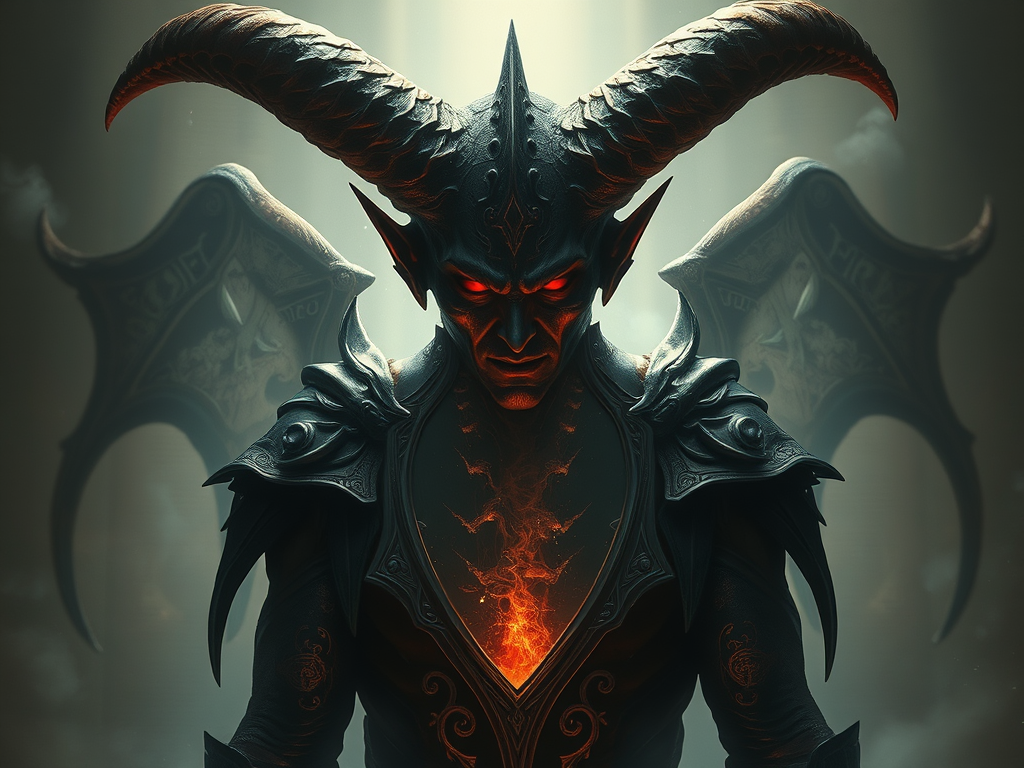
Foreword by Lillian Hartley and Sylvia Moon
Lillian:
We have often found, in our work, that evil seldom arrives with horns or smoke. It moves quietly — in pride disguised as reason, in fear dressed as virtue. To study the Devil is not to summon him, but to study ourselves: the uneasy dance between what we choose to see and what we cannot bear to know.
Sylvia:
Aye, that’s the truth of it. Folks talk of casting out darkness, but you can’t banish what lives in your own bones. The Devil’s just another name for what we’ve yet to make peace with. He’s been called tempter, trickster, and thief of souls — but mostly, he’s a mirror we’d rather not look into.
Lillian:
The essay that follows traces how that mirror took shape — how myth, theology, and imagination conspired to give the unseen a face. It reminds us that the Devil’s story is not a tale of rebellion alone, but of reflection.
Sylvia:
And of mercy, too, if we’re brave enough to look squarely at what we fear.
When modern readers picture the Devil, they often imagine a red, horned figure wielding a pitchfork — an image so deeply ingrained in Western culture that it feels timeless. Yet this theatrical villain is a relatively late arrival, the product of centuries of evolution in theology, folklore, and art. The Devil, as Christians came to know him, was not born fully formed in scripture. He was imagined into being over time — a synthesis of ancient myth, moral anxiety, and theological need.
As historian Jeffrey Burton Russell observed, the Devil’s story is also the story of Christianity’s struggle to reconcile a perfect God with an imperfect world. From the beginning, Christian theology had to explain how evil could exist within a creation declared good. By externalizing that contradiction into a single being — the Adversary — believers could preserve divine benevolence while acknowledging the persistence of suffering. The Devil became the necessary vessel for a question too dangerous to ask of God directly.
From Adversary to Enemy
The Old Testament contains no devil in the later Christian sense. The Hebrew word ha-satan simply means “the adversary” — not a fallen angel, but an agent of God who tests human virtue. In the Book of Job, it is the Satan who challenges Job’s faithfulness, but only with God’s permission. Evil here is not autonomous; it is part of the divine order, a means of trial and revelation.
It was only in the later Second Temple period, as Jewish communities absorbed Persian and Hellenistic ideas, that the adversary began to acquire autonomy. Zoroastrianism, with its cosmic dualism between the good god Ahura Mazda and the evil spirit Ahriman, provided a powerful imaginative framework: good and evil as cosmic forces locked in battle. By the time of the Dead Sea Scrolls, Jewish apocalyptic texts spoke of “the Prince of Darkness” and “the Spirit of Deceit.” Evil was no longer an internal weakness or divine test but a cosmic conspiracy against the divine order.
The Christian Recasting
Early Christianity inherited this apocalyptic vision and gave it dramatic focus. In the Gospels, Satan tempts Christ in the wilderness; in Revelation, the great dragon is cast down — the adversary made flesh and given narrative. Here, evil acquires not just agency but personality: a cunning intelligence opposed to God and humanity alike.
This personalization of evil served several theological purposes. It solved the problem of moral order: if God was good, then evil must originate elsewhere. The Devil became the necessary foil to divine perfection. He also served a pastoral purpose: temptation could now be blamed not merely on human frailty but on an external deceiver. “The Devil made me do it,” long before it became a joke, was an earnest spiritual diagnosis.
Russell traced how early theologians such as Origen and Augustine gave this adversary intellectual form. For Origen, Satan’s fall stemmed from the misuse of free will — a tragic choice that preserved moral freedom for all creation. Augustine refined the idea: evil was not a rival force but a privation of good, a hollow space where virtue should be. The Devil thus became the emblem of disordered will — a mirror of human pride rather than a cosmic equal to God.
Yet as historian Elaine Pagels revealed, this theological evolution also carried political stakes. Within the first Christian communities, Satan became a way of drawing moral boundaries — separating us from them. The Gospels’ portrayal of “the Jews” as children of the Devil (John 8:44) did not begin as anti-Semitism, but as intra-Jewish argument — a conflict between those who followed Jesus and those who did not. Over time, as Christianity moved beyond its Jewish roots and into Gentile territory, this rhetoric hardened into hostility. The Devil thus became a language of exclusion, defining not only evil but opposition.
The Political Devil
As the Church grew within the Roman Empire, the figure of Satan served a new function: resistance and legitimacy. Under persecution, Christians could cast Rome as the Beast, the great Babylon, the worldly power animated by Satan himself. The Devil explained their suffering and sanctified their endurance. But with Constantine’s conversion and Christianity’s rise to state religion, the metaphor inverted. The Church now wielded power — and the Devil became a way to brand heretics, pagans, and dissenters as enemies of God.
Pagels observed that this transformation marked a turning point: the Devil became a political instrument, the emblem of the Other. To oppose the Church was no longer a difference of conscience; it was rebellion against divine order. The figure that once consoled the powerless now empowered the institution — a theological weapon that turned spiritual conflict into moral absolutism.
The Medieval Imagination
It was in the Middle Ages that the Devil reached his cultural apotheosis. Preachers thundered of his snares, artists painted his claws, and theologians debated his metaphysics. He was not just the tempter in the wilderness but the whisperer in every tavern and hearth.
Part of this expansion was visual. The Christian imagination inherited from antiquity a menagerie of hybrid creatures — satyrs, fauns, and Pan among them. As Christianity sought to displace pagan religion, many of those rustic deities were repurposed as demons. The goat-like horns, the cloven hooves, and the wild hair that had once signified fertility and mischief were rebranded as emblems of sin and rebellion.
Russell noted that by the twelfth century, theology and popular piety had fused into a single drama: the cosmos itself divided between the City of God and the City of the Devil. Every sermon, play, and image re-enacted that struggle. The Devil was no longer merely a tempter but the anti-principle — proof that even corruption served the unfolding of divine providence.
Yet the medieval Devil was not purely grotesque. He was rhetorical and moral — a mirror for human corruption. In miracle plays and sermons, he became a moral pedagogue through fear. The grotesque images of Hell carved into church tympanums were not decoration but catechesis: sin was real, and the Devil waited to claim it.
Theologically, figures like Augustine had already sown the seed: evil as the absence of good. The Devil, in this sense, was not a creator but a corrupter, a hollow echo of divine will. This conception preserved monotheism’s integrity while allowing evil to take shape in narrative form.
The Devil as Psychological Reality
The witch trials of the fifteenth to seventeenth centuries marked the Devil’s most tragic inflation. No longer merely tempter or metaphor, he was imagined as the literal lord of an underground conspiracy. Fear of heresy, anxiety about social change, and misogynistic suspicion of women’s spiritual autonomy all found expression in the myth of the diabolic pact. The Devil became both scapegoat and explanation — a means of making sense of chaos by giving it a face.
This, too, had political resonance. To accuse someone of consorting with the Devil was not only to condemn them morally but to eliminate them socially. As Pagels showed, the ancient mechanism of defining the adversary survived: labeling dissent as demonic allowed societies — and Churches — to preserve unity by persecution. The Devil thus remained a political convenience, ensuring that difference could always be cast as danger.
Twentieth-century thinkers such as Carl Jung and Mary Midgley reimagined that face not as a supernatural being but as a mirror. Jung saw the Devil as the archetype of the shadow — the buried half of the psyche that contains everything we would rather not see. “No tree,” he wrote, “can grow to heaven unless its roots reach down to hell.” To become whole, the self must descend as well as ascend, must recognize the darkness from which its light arises.
Midgley, writing later, gave this insight moral form. In Evil: An Introduction she argued that our devils and demons are projections of our own denied energies — anger, greed, pride, and desire turned outward and personified. To call another person or being “evil” is often to refuse responsibility for what we fear within ourselves. The Devil, in this view, is not an intruder from beyond but a symbol of evasion: the shadow we cast when we cannot bear the fullness of our own nature.
The Decline — and Persistence — of the Adversary
The Enlightenment brought skepticism, but the Devil did not vanish. He retreated into literature and psychology — from Milton’s radiant rebel to Goethe’s sardonic Mephistopheles — and, in time, into the human imagination itself. Romanticism recast him not as the enemy of God but as the necessary shadow of divine order, the restless questioner who tests its limits.
In the modern world, as Russell’s Mephistopheles shows, the Devil slips from dogma into psychology and art — yet the moral need he once served remains. When faith in cosmic order falters, the figure of the Adversary survives as metaphor: humanity’s continuing effort to locate evil somewhere, anywhere, outside itself.
In modern thought, the Devil survives as symbol rather than dogma, a figure through which we still speak of alienation, conscience, and the dark undercurrents of desire. For Jung and Midgley alike, his kingdom is the inner world — that uneasy frontier where fear and imagination wrestle for dominion.
A Necessary Shadow
If the Devil began as God’s prosecutor and ended as God’s rival, his evolution mirrors humanity’s own deepening sense of moral complexity. Medieval Christians did not invent evil, but they gave it a face — one that could frighten, instruct, and, paradoxically, humanize the struggle between light and dark.
Pagels’ great insight is that every time the Church redrew the Devil’s face, it was also redrawing the map of belonging: deciding who was righteous, who was dangerous, and who could be cast out. The Devil’s image was never just about sin — it was about control, about who held the moral authority to name evil and to wield its opposite.
Between Russell’s theological inquiry and Pagels’ political one lies the same paradox: each generation remakes the Devil it needs — whether to explain evil in the cosmos or to identify it in the neighbor.
In the end, the Devil’s greatest trick may not have been convincing the world he doesn’t exist, as Baudelaire quipped, but persuading humanity to search for him only outside themselves. The adversary endures because he is ours — a necessary shadow cast by the light of self-knowledge, reminding us that redemption begins, as always, with recognition.
Author’s Note
by Lillian Hartley and Sylvia Moon
Lillian:
We wrote this piece because the Devil, however outmoded the word may sound, remains the oldest metaphor for what humanity fears to face — both in the world and within itself. To trace his history is not a lesson in superstition but in responsibility. Each time a culture imagines the Devil anew, it reveals what it cannot yet integrate, what it must project onto the Other to keep its conscience intact.
Sylvia:
And that’s still the trouble, isn’t it? We’ve new words for evil now — ideology, extremism, misinformation — but the same heartbeat runs beneath them. We cast our shadows farther, build higher walls, and call it progress. But no wall’s high enough to shut out what lives in the heart.
Lillian:
If our age has forgotten how to name its devils, it’s because it has forgotten how to recognize its shadows — the fear that wears reason’s mask, the pride that calls itself virtue. The task is not to banish the darkness but to understand its language.
Sylvia:
And maybe, just maybe, to speak to it kindly.
Selected Bibliography
Pagels, Elaine. The Origin of Satan: How Christians Demonized Their Opponents. New York: Vintage Books, 1996.
A profound study of how early Christian communities used the figure of Satan to define moral boundaries, turning theological struggle into social and political identity.
Russell, Jeffrey Burton. The Devil: Perceptions of Evil from Antiquity to Primitive Christianity. Ithaca: Cornell University Press, 1977.
— Satan: The Early Christian Tradition. Ithaca: Cornell University Press, 1981.
— Lucifer: The Devil in the Middle Ages. Ithaca: Cornell University Press, 1984.
— Mephistopheles: The Devil in the Modern World. Ithaca: Cornell University Press, 1986.
Russell’s four-volume history remains the definitive exploration of how Western thought has personified evil — from the adversary in the Hebrew Bible to the psychological shadow of modernity.
Jung, Carl Gustav. Answer to Job. Translated by R.F.C. Hull. Princeton: Princeton University Press, 1954.
Jung’s daring meditation on divine justice and the human psyche, interpreting the Devil not as an independent being but as the necessary counterpart to consciousness and spiritual growth.
Midgley, Mary. Evil: An Introduction. London: Routledge, 2001.
A moral philosopher’s lucid argument that our conceptions of evil are projections of what we fear in ourselves — and that reclaiming responsibility begins with integrating those shadows.
Further Reading
Forsyth, Neil. The Old Enemy: Satan and the Combat Myth. Princeton: Princeton University Press, 1987.
A sweeping study of the Devil’s mythic lineage, tracing his roots in ancient chaos myths and his transformation into the Christian adversary. Forsyth bridges mythology, theology, and literature with remarkable clarity.
Delbanco, Andrew. The Death of Satan: How Americans Have Lost the Sense of Evil. New York: Farrar, Straus and Giroux, 1995.
A poignant cultural meditation on what happens when societies lose a shared moral language for evil — and how the absence of the Devil leaves us morally unmoored.
Kieckhefer, Richard. European Witch Trials: Their Foundations in Popular and Learned Culture, 1300–1500. Berkeley: University of California Press, 1976.
Explores the fusion of theology and folklore that created the medieval image of the Devil’s conspiracy — a key background to understanding how fear became systematized as faith.
Clark, Stuart. Thinking with Demons: The Idea of Witchcraft in Early Modern Europe. Oxford: Clarendon Press, 1997.
Dense but masterful, Clark shows how belief in the Devil and witchcraft formed part of a coherent worldview rather than a superstition — a vital insight for reimagining how past societies understood evil.
Leave a Reply