
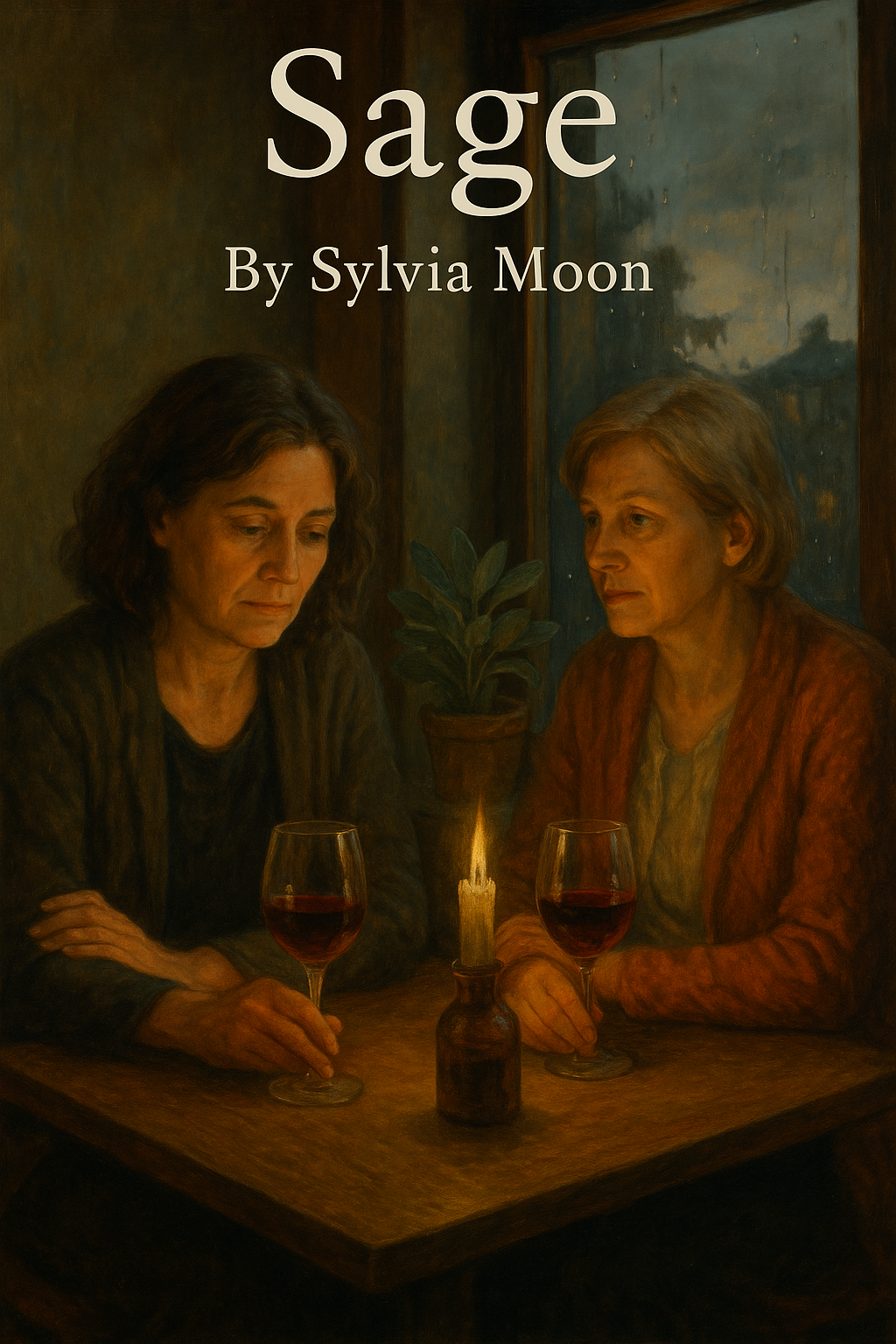
The first time she came to the wine bar on the corner of Quay Street, Sylvia almost turned back. It had opened a few months ago—one of those places she assumed would smell of varnish and ambition, not the deep earthiness she craved. Yet, this evening, with the sea light thinning to a violet hush and her heart too tired for solitude, she found herself stepping inside.
It was early evening, that gentle hour when conversation still floats softly above the clink of glasses and the world hasn’t yet decided if it will tip into melancholy or delight. She chose a small table near the window, its sill crowded with potted herbs—basil, rosemary, and, most prominently, sage. The scent reached her before the wine did: sharp, clean, and oddly familiar.
Lillian had joined her reluctantly—she never quite saw the point of “ambience,” as she called it—but once they’d ordered a carafe of the house red, even she began to soften. “It’s rather charming,” Lillian admitted, gazing at the soft candlelight flickering in old glass bottles. “Rustic without pretension.”
Sylvia smiled, her fingers tracing the rim of her glass. “You see, I knew you’d like it. The name drew me in—The Silver Leaf. Doesn’t that sound like something from one of Jonathan’s old grimoires?”
Lillian rolled her eyes, though fondly. “Only you would associate a wine bar with a spellbook.”
“Ah, but that’s what sage does,” Sylvia said, leaning closer. “It transforms the ordinary—smoke into cleansing, leaf into wisdom, bitterness into clarity. You can’t separate its uses from its stories.”
Lillian took a sip of wine, humoring her. “Go on, then. Tell me its story.”
And so Sylvia began.
The Story Within the Story
There once was a woman who lived on the edge of a salt marsh, where fog came and went like the breath of an old god. Her garden was small and stubborn—nothing thrived there except sage. Every season, she’d cut it back, hang it to dry, and wonder why it grew so fiercely when all else refused.
One winter, when loneliness pressed too close, she burnt a handful in her hearth. The smoke curled up and spoke to her in whispers she almost recognized. Remember what you know, it said. And forgive what you don’t.
From that night on, she tended the sage with reverence. She brewed it into tea when she needed courage, tied it into bundles when she feared forgetting, and carried a sprig in her pocket the day she walked away from everything that had once defined her.
Years later, she found herself by the sea, older, softer, her hands still faintly green from tending herbs. She realized the sage had followed her—not the plant, but its lesson. Wisdom doesn’t arrive as certainty, she thought. It comes as scent, as memory, as the quiet knowing that survival itself can be holy.
Sylvia stopped, smiling faintly at her own tale. “That’s what it conjures for me, Lil. Not just wisdom, but the scent of things that endured when nothing else did.”
Lillian was quiet for a moment, watching the reflection of the candles in Sylvia’s glass. “So the woman in your story… she’s you.”
Sylvia gave a little shrug, half-mischievous, half-tender. “Aren’t we all, in a way, the herbs we burn?”
Outside, the sea sighed against the quay, and a light rain began to fall, gentle as breath on the windowLillian turned her glass slowly between her fingers, watching the light refract through the wine. “You know,” she said after a pause, “I’ve never much liked sage.”
Sylvia raised an eyebrow, smiling. “You? The herbal cynic? I’m shocked.”
“It’s true,” Lillian replied. “It always reminds me of endings—the way people burn it after they’ve moved house, or lost someone, or want to scrub away what can’t be undone.” She took a sip. “It’s not so much cleansing as… admission, I think. You don’t light sage unless you’ve already lost something.”
Sylvia tilted her head, amused but cautious. “That’s rather bleak, even for you.”
“Realistic,” Lillian countered gently. “You told your little story beautifully. But I kept wondering—what did the woman lose before the sage began to grow? Because things that thrive like that, wildly, without reason… they usually grow from something that’s rotted underneath.”
Sylvia’s hand froze halfway to her glass. She tried to laugh, but it came out thinner than she intended. “You mean Jonathan.”
Lillian didn’t reply right away. She simply looked at her, not unkindly, and the silence between them was enough.
Sylvia leaned back, her expression tightening. “I don’t think about him much anymore.”
“Don’t you?” Lillian asked, softly but pointedly. “Then why do you still speak as though he’s listening?”
Sylvia stared down at the sage plant on the windowsill. The leaves were soft, silvery, furred like moth wings. For a long time, she didn’t answer. The sound of rain deepened, a gentle percussion against the glass.
“When he was alive,” Sylvia said finally, “I thought he carried light with him. He could make a room feel brighter just by walking in. You know that sort of charm that passes for warmth? That was Jonathan. People mistook it for goodness. I did, too.”
Lillian nodded once, quietly.
“I used to burn sage when he worked late,” Sylvia continued. “It made me feel he was still part of something sacred. But near the end…” Her voice faltered, then steadied. “He wasn’t coming home from the university at all, was he? Evelyn Ashcroft. God, even her name sounds like a sigh.”
Lillian said nothing, letting the admission settle like dust after a storm.
“They had a plan,” Sylvia went on, her eyes distant. “He told me it was a research trip to Mallorca—collaboration with the Ashmolean. I even packed his notebooks. Can you imagine?” She gave a dry, brittle laugh. “I ironed his shirts while he was planning to leave me.”
“You loved him,” Lillian said quietly. “That doesn’t make you foolish.”
“No,” Sylvia replied, “but it makes me human, and that’s harder to forgive.”
She reached out and plucked a sage leaf, rubbing it between her fingers. “You said it’s for endings. Maybe that’s true. But sometimes endings don’t arrive when they should. They linger in the corners, waiting for us to admit we’ve already crossed the threshold.”
“Perhaps that’s why you came here tonight,” Lillian said. “To admit it.”
Sylvia smiled faintly, the kind of smile that trembles just before it breaks. “Maybe. Or maybe I came because the scent reminded me that not everything that burns leaves ashes.”
Lillian raised her glass. “To what endures, then.”
Sylvia touched her glass to Lillian’s. “To what finally lets go.”
The rain eased to a whisper, and outside the window, the sea caught what little light remained—silver and still, like the leaf of sage on the table between them.
Leave a Reply