
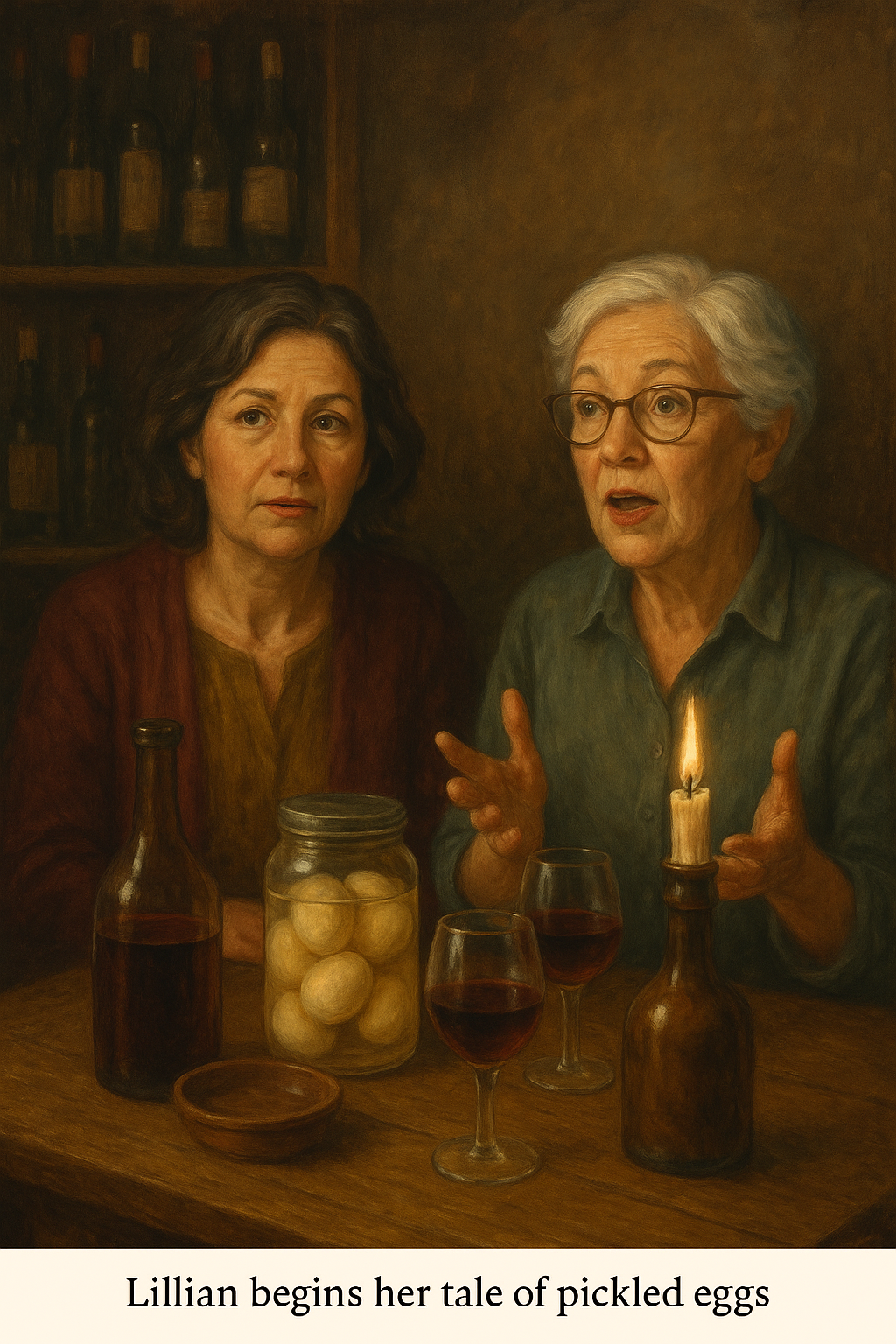
Sylvia was laughing now, her eyes bright in the candlelight. “Oh, why not?” she said, pushing the nearly empty carafe aside. “Let’s live a little. Another bottle, and—” she squinted at the blackboard above the bar—“pickled eggs. I haven’t had those since… actually, I’ve never had those.”
Lillian smirked. “You’re in for a treat then. Especially if they make them properly. Vinegar, mustard seed, a touch of sugar. Simple, but nearly impossible to find done right these days.”
“Are you serious?”
“Quite. They used to be a pub staple in England as early as the seventeenth century,” Lillian said, flagging down the young waiter with a flourish of her hand. “A poor man’s supper, really. Egg, bread, and ale. By the eighteenth century, it had become an art—each publican had their own secret brine. A good pickled egg could earn a tavern a loyal crowd.”
Sylvia chuckled. “An art form in a jar. There’s poetry in that.”
“Indeed,” Lillian said, straightening with the faintly tipsy air of a woman who’s about to tell a story. “All right then. You told a tale of sage; I’ll tell one of pickled eggs.”
Sylvia leaned in. “Oh, this I must hear.”
Lillian lifted her glass, eyes gleaming. “Picture it—London, 1764. A tavern near Fleet Street called The Goose and Barrel. A place that smelled perpetually of sawdust, gin, and ink. It was a haunt for printers, pamphleteers, and the kind of poets who shouted about freedom while dodging their creditors.”
Sylvia grinned. “So—your people, then.”
“Hush,” said Lillian, mock-stern. “Among them was a woman named Dorothea Pike. She wasn’t a writer herself—at least not publicly—but she ran the tavern with a sharp tongue and a sharper mind. Her pickled eggs were famous across three boroughs. Gentlemen from the Inns of Court came slumming just for a taste. But Dorothea—she added something secret to the brine. Some said juniper berries, others swore it was a touch of absinthe.”
“Absinthe! You’d have loved her.”
“Perhaps,” Lillian said, smiling into her wine. “But the secret wasn’t culinary—it was alchemical. Dorothea was what you’d call a cunning woman, a quiet practitioner. She believed the act of preservation—the binding of life into stillness—could trap intention. Each egg she pickled, she whispered a wish into it. Sometimes protection, sometimes punishment. There was one story of a magistrate who mocked her—ate three of her eggs and couldn’t tell truth from lies for a month.”
Sylvia laughed, delighted. “So she hexed them in vinegar!”
“Precisely,” said Lillian. “And when she died, the tavern closed for good. They said the barrels of brine in the cellar turned cloudy overnight. But here’s the curious thing: years later, when the building was torn down, the workers found one jar intact, sealed in wax, the eggs perfectly white, as if time hadn’t touched them.”
Sylvia’s amusement faded into wonder. “That’s rather beautiful. Do you think she succeeded—in preserving her intention?”
Lillian shrugged, her eyes soft now, unfocused with wine. “Maybe. Or maybe it’s just what we all try to do—preserve something before it spoils. Memories. Regrets. People.”
Sylvia was quiet a moment, then smiled sadly. “You sound like me now.”
“Careful,” said Lillian, topping off her glass. “I might take up tarot next.
They both laughed until the waiter returned with the eggs—pale and glistening in a small ceramic bowl. Sylvia leaned in. “They look innocent enough.”
Lillian speared one delicately. “They’re never innocent. Proper brine has a sting to it.”
Sylvia bit in, expecting the sharp tang of vinegar—and instead caught something else. Smoke, maybe. Ink. A faint trace of iron, like old pennies or the edge of a printing press. She blinked, her senses flooding with a scent she couldn’t place—oak shavings, gin, and hot wax. For an instant she saw a flicker of movement behind her eyelids: a woman’s hands, stained yellow from herbs, sealing a jar with wax.
It vanished as quickly as it came.
She set her fork down carefully. “That’s… stronger than I expected.”
“Perfect,” said Lillian, already reaching for another. “A proper pickled egg should remind you you’re alive.”
Sylvia managed a laugh. “Or possibly haunted.”
Lillian smiled, tilting her head. “Same thing, at our age.”
The candles sputtered; one flared higher than the rest, stretching its flame like a thread of gold before sinking back to a steady glow. Neither woman spoke of it.
Sylvia stared into the brine at the bottom of the bowl. The liquid caught the light oddly, silvering over for a moment like quicksilver, reflecting their faces faintly out of time. She thought she saw another pair of eyes among them—curious, steady, unblinking. When she looked again, it was only her own reflection.
Outside, the fog had thickened, soft as breath. Somewhere down by the quay, a ship’s bell tolled twice—low and resonant, as though struck underwater.
“Tell me,” Sylvia said at last, her voice a whisper between them. “Do you think Dorothea Pike was real?”
Lillian poured the last of the wine into their glasses, her movements slow, deliberate. “Does it matter?”
“No,” Sylvia admitted, smiling faintly. “But I think she just joined us for supper.”
Lillian raised her glass. “Then to her—and to all the ghosts that pickle themselves into memory.”
Their glasses touched with a soft, hollow ring. The sound hung in the air longer than it should have, fading only when the waiter passed by, humming a tune neither of them recognized.
Sylvia listened a moment, frowning.
“Do you know that song?”
Lillian shook her head. “No. But it sounds old.”
“Older than us,” Sylvia murmured.
And then they laughed again, the sound rolling softly through The Silver Leaf, mingling with candlelight and the faint scent of sage, as the night folded around them like the closing of a well-loved book.
Leave a Reply