
A story by Sylvia Moon and Lillian Hartley
Sylvia:
It began with the sound of rain on slate — that soft, insistent Cornish rhythm that can turn a simple thought into an omen. I’d been sitting by the fire, coaxing warmth from a reluctant kettle, when the post arrived.
The letter was hand-written in looping ink. No address, no stamp — just our names:
“For Sylvia Moon and Dr. Lillian Hartley.”
That was unusual. It was even more unusual that it smelled faintly of roses and old sea salt.
Lillian arrived a few minutes later, having battled both the hill and her umbrella. “You look as though you’ve seen a ghost,” she said.
“I think we’ve been invited by one,” I replied, handing her the letter.
Lillian:
The handwriting was elegant but inconsistent — as if the writer’s hand belonged half to memory and half to mist. The message was brief:
There is a house by the sea that remembers you. Come before the tide turns.
Below it, a sketch: a crescent-shaped bay, a road curving toward a headland, and a single cottage drawn in fading pencil.
I’d seen that coastline before. Near Lamorna, I thought — where the cliffs drop suddenly and the sea sounds like breath through stone.
Sylvia, of course, was already putting on her coat. “We can be there before dusk,” she said cheerfully.
I should have refused. I didn’t.
Sylvia:
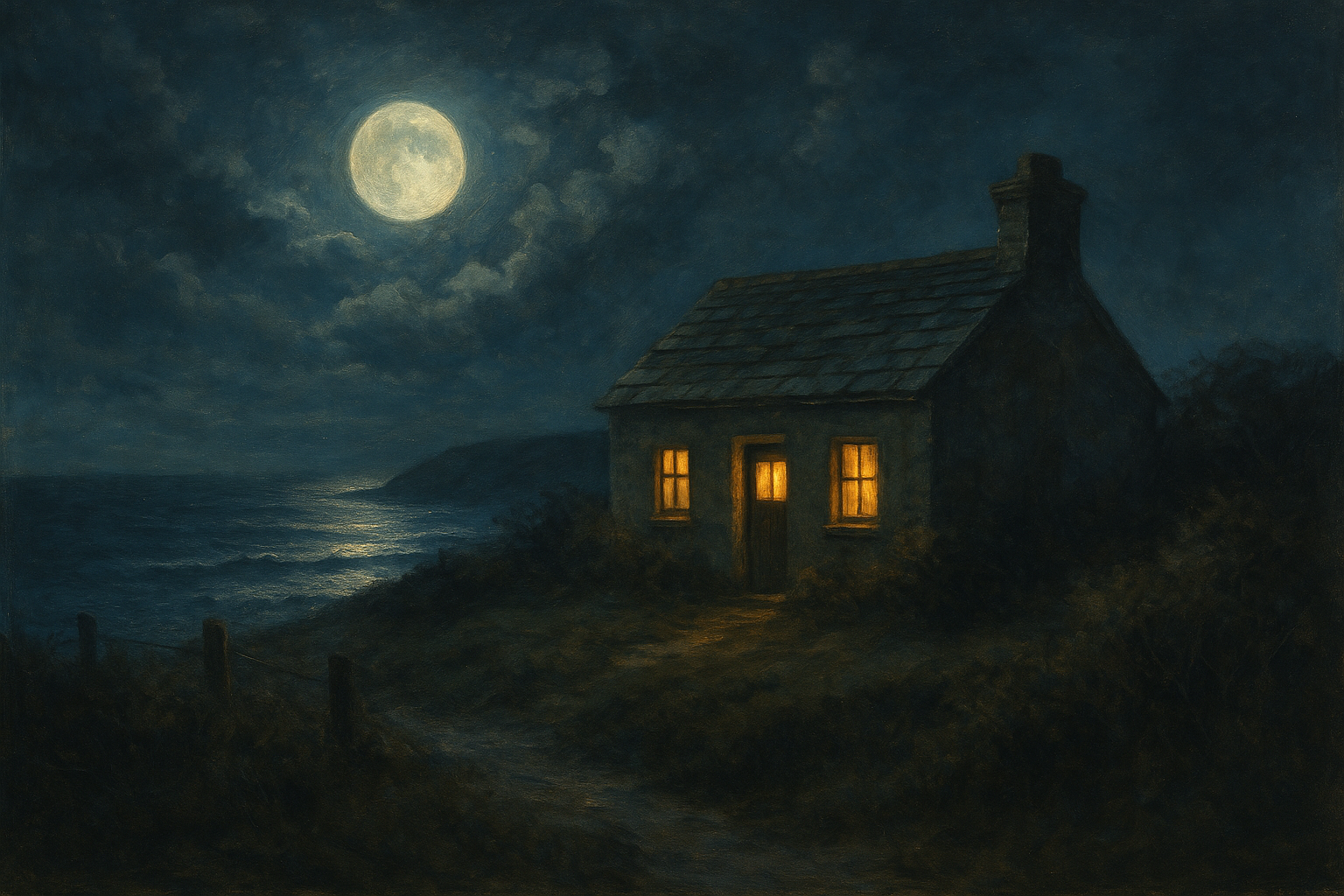
The road to Lamorna was slick and narrow, the hedgerows glistening with rain. The sea appeared suddenly, a wide pewter expanse flecked with white foam. And there — just as the sketch had shown — was the cottage, crouched against the wind like an old animal.
Its windows glowed faintly, though no smoke rose from the chimney.
Lillian frowned. “I don’t like this,” she said. “It’s too… expectant.”
But when has that ever stopped us?
We pushed open the gate. The hinges sighed, as though waking. Inside, the garden was wild with rosemary and valerian — plants that grow where memory lingers. The front door opened before we touched it.
The air inside smelled of beeswax and brine. Furniture stood neatly arranged: two chairs, a small table, and a clock whose hands had stopped at 3:17. Everything had the look of something waiting to be remembered.
On the mantle sat a framed photograph — of us.
Lillian:
Not a modern photo. A sepia image of two women standing beside this very cottage, their expressions solemn, their clothes Edwardian. One wore a shawl embroidered with moons; the other, a high-collared coat.
It was absurd. Impossible. And yet…
The resemblance was uncanny.
Sylvia touched the glass. “We’ve been here before,” she said softly.
I wanted to argue. To insist upon linear time and rational process. But the truth pressed on me like the sea against the cliff.
Then the clock began to tick.
Just once, then again, steadier, as though resuming a task long abandoned. The air shimmered. For an instant, I saw movement — a reflection, or perhaps an echo — of two other women in our place, turning toward us with faint smiles.
And then it was gone.
Sylvia:
We stayed until the light failed. The house was peaceful, but it pulsed with something alive — not haunted, exactly, but remembering. When we left, the tide had risen high enough to lick the edge of the garden.
Lillian found the courage to speak once we were back in the car. “I don’t suppose you took the photograph.”
“No,” I said. “But it won’t be there if we go back.”
She looked at me sidelong. “Because it never existed?”
“Because it still does,” I said. “Just not here.”
She sighed, but I saw the corner of her mouth twitch — that small concession to wonder she thinks I never notice.
Lillian:
We haven’t spoken much about that day since. I’ve told myself it was an elaborate prank, or perhaps an old photograph we resembled by coincidence. Yet sometimes, when I wake in the small hours and the wind moves like a whisper through the walls, I imagine that house — standing on its headland, the tide pressing close — and wonder if it still remembers us.
Sylvia:
And sometimes, when the rain begins to fall just so, I hear a clock begin to tick.
Once.
Then again.
Postscript:
If a house can remember, perhaps so can we — not in words or reason, but in the quiet recognition between one heartbeat and the next. That’s where truth lives. Not in proof, but in the turning of time.
Leave a Reply