
It had been Lillian’s idea.
Not the storm, obviously—though Sylvia would later say that ideas had a way of summoning their own weather—but the retreat. A weekend of rest, Lillian had called it. Fresh air. No interruptions. We’ll read. We’ll sleep.
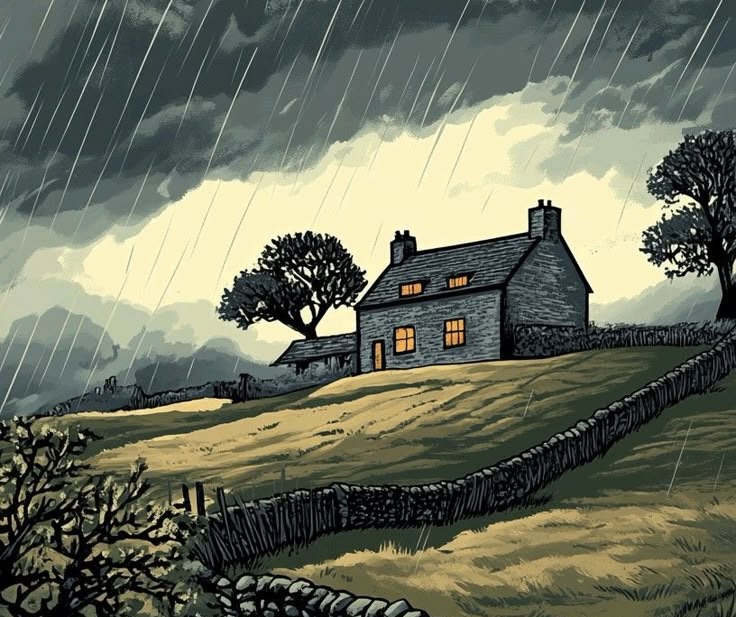
The farmhouse was kinder than Sylvia had expected. Recently restored, but without enthusiasm: whitewashed stone, deep windowsills, oak floors that still creaked with memory rather than neglect. It stood back from the cliff edge just enough to suggest prudence, though the sea below Maenporth Beach could still be heard breathing, even on a calm day.
By Friday evening, the wind had begun to rehearse.
“Are you sure about this?” Sylvia asked, watching the sky bruise itself purple beyond the kitchen window.
Lillian, unpacking groceries with academic calm, said, “We are perfectly safe. The Met Office said ‘gusty.’”
“Eighty miles an hour is not gusty,” Sylvia replied. “It’s personal.”
The electricity went sometime after midnight.
Not dramatically. No sparks. No theatrical blackout. Just the fridge clicking off and the lamps dimming into resignation, as though the house itself had decided not to struggle.
The wind arrived properly then.
It pressed against the walls with deliberation. It searched the eaves. It flung itself bodily at the chimney and then, offended by resistance, screamed along the cliff face instead. The sea below roared in reply, delighted.
Sylvia lit candles without being asked.
Lillian noticed this and did not comment.
They slept badly, in shifts. Not from fear—neither of them was particularly afraid—but because the night was busy. Something was happening. Not to them, exactly, but near enough to feel implicated.
At dawn, the wind eased just enough to make its absence conspicuous.
They went outside together.
A tree—old, ash, uprooted with a kind of weary dignity—lay clean across the drive. There would be no leaving. There would be no arriving. The farmhouse, temporarily, had become an island.
“Well,” Lillian said, after a moment. “That’s inconvenient.”
Sylvia touched the tree’s exposed roots, still slick with earth. “It didn’t fall,” she said. “It gave up.”
They returned indoors, wrapped in jumpers and inevitability.
Without electricity, time loosened. The kettle was boiled on the old range. The radio remained stubbornly silent. Mobile phones displayed one bar of false hope and then none at all.
By mid-morning, Sylvia began to feel it.
Not danger. Not exactly.
Attention.
The farmhouse, stripped of its modern distractions, was remembering itself. The beams hummed faintly. The walls held warmth in ways that felt intentional. Outside, the wind circled but did not intrude, as though a boundary had been acknowledged.
Sylvia sat at the kitchen table and said, “Someone lived through something here.”
Lillian looked up from her book. “That describes most places.”
“Yes,” Sylvia said. “But this feels… curated. As though the house learned what mattered and kept only that.”
The magic—if one insisted on calling it that—was unshowy.
The candles burned longer than they should have. The range held heat without fuel. A loaf of bread Sylvia had brought “just in case” proved inexhaustible, no matter how often it was cut.
And when Sylvia dreamed, she dreamed clearly.
Not symbols. Not omens.
Just people. Ordinary ones. A woman waiting out a storm. A child counting waves. A man who had once stood on the cliff edge and decided, at the last moment, to go back inside.
On Sunday afternoon, the wind released them.
A neighbour appeared, as though summoned by completion, with a chainsaw and no questions. The tree was cleared. The road returned. Power flickered back with a noise like apology.
As they packed to leave, Lillian paused in the doorway.
“That was… restorative,” she said carefully.
Sylvia smiled. “You don’t mean physically.”
“No,” Lillian replied. “I mean structurally.”
They drove away under a rinsed-blue sky, the farmhouse already receding into ordinary geography.
Behind them, the cliff stood.
The sea continued.
And the house, having done what was required, went quietly back to sleep.
Leave a Reply