
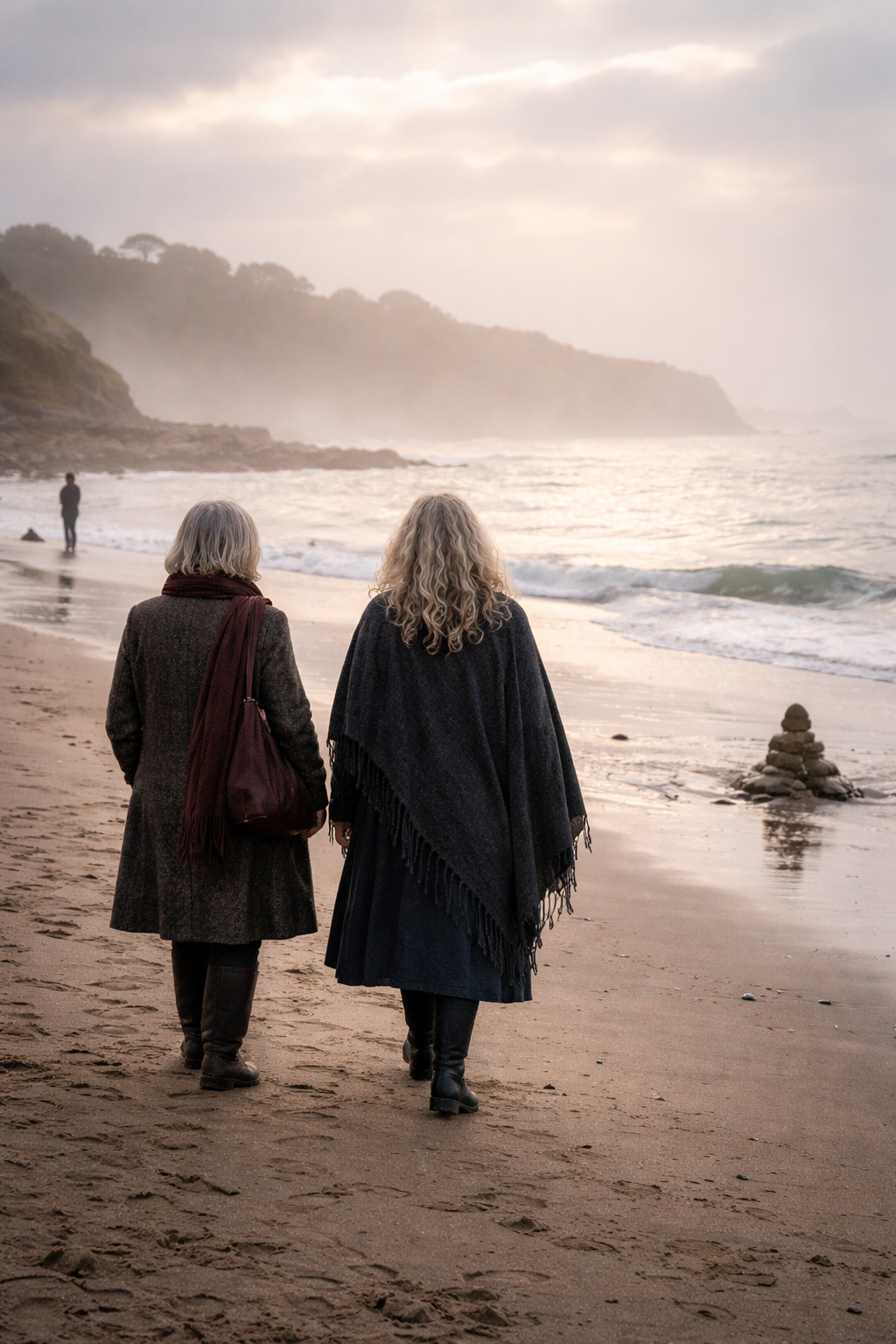
The beach was nearly empty when Lillian and Sylvia reached it—New Year’s Day, just after dawn, when the tide was still thinking about whether to come in or go out. The sand held the cold the way a book holds a secret: firm, quiet, unwilling to give itself away.
Lillian wore her sensible coat and a scarf knotted with academic precision. Sylvia had chosen a long, dark shawl that lifted and fell with the wind like a living thing.
“Resolution weather,” Lillian said, surveying the pewter sky. “People make promises in this light. Then forget them by lunch.”
Sylvia smiled. “Aye. But the sea remembers.”
They walked in companionable silence, boots leaving parallel lines that the tide would soon smooth over. Gulls watched from a distance, not curious, merely attentive.
Halfway down the strand they noticed the man.
He stood where the wet sand met the dry, shoes in his hand, trousers rolled, coat buttoned wrong. He was older than he looked—or perhaps younger—his face arranged in that particular way that comes from long practice at listening rather than speaking.
Between his feet lay a small bundle wrapped in oilcloth.
Sylvia slowed first.
“That’s not drift,” she murmured.
“No,” Lillian agreed. “That’s intent.”
They approached without hurrying. The man glanced up, startled, then relieved, as though he had been waiting for someone without knowing who.
“Morning,” Sylvia said gently. “Cold to be standing still.”
He nodded. “It’s meant to be.”
Lillian crouched, peering at the bundle. “May I?”
He hesitated, then stepped back.
Inside the oilcloth lay a bell—small, silvered once, dulled now. Old enough to have learned restraint. Its handle was smoothed by use, not polish.
Sylvia inhaled. “Ah.”
“You found it,” the man said, almost accusingly. “I was told someone would.”
“Told by whom?” Lillian asked.
He gestured at the sea. Not theatrically. As a matter of fact.
Sylvia touched the bell with one finger. It gave a sound—soft, apologetic, precise. The kind that doesn’t summon so much as gather.
“People think bells are for calling,” Sylvia said. “But the old ones? They’re for returning.”
The man’s shoulders loosened. “I was meant to throw it back,” he said. “That’s what they said. But I couldn’t. Not yet.”
Lillian straightened. “You don’t need to. Not today.”
He looked from one woman to the other. “Then what do I do?”
Sylvia smiled, the kind of smile that makes room for choice. “You walk. A bit. Let the day decide.”
The tide shifted, just perceptibly, as though eavesdropping.
The man wrapped the bell again, tucked it under his arm, and walked away along the curve of the beach. He did not look back.
For a moment the three sets of footprints ran together. Then only two remained.
Lillian exhaled. “You realise,” she said, “that we’ve just interfered with something.”
Sylvia shrugged. “We didn’t change it. We witnessed it.”
They continued on, the wind tugging at Sylvia’s shawl, the sky lifting by a shade.
At the far end of the beach, where the rocks rose and the path narrowed, they found a child building a cairn—stone upon stone, hands red with cold, expression intent.
“Morning,” Lillian said.
The child nodded, added one more stone, and stepped back. The cairn stood.
“What’s it for?” Sylvia asked.
The child considered. “So people know they can stop.”
Lillian and Sylvia exchanged a glance.
“That’s very wise,” Lillian said.
The child shrugged, already bored with wisdom, and ran toward the path, leaving the cairn to the tide.
They turned back together.
Behind them, the sea advanced, erased the footprints, spared the stones.
Sylvia slipped her arm through Lillian’s.
“New year,” she said.
“Yes,” Lillian replied. “I suppose it is.”
And somewhere down the beach, a bell that had not rung in years waited—patient, precise—until it was needed again.
Leave a Reply