
“It’s balance,” Lillian said, placing the book precisely in the centre of the table, as though symmetry itself might approve.
“Equal day and night. A moment of equilibrium. The Earth neither inclines toward light nor darkness, but holds—briefly—between them.”
Sylvia, who had been watching the light shift across the floorboards, did not immediately reply.
“Mm,” she said at last. “That’s what it looks like.”
To most people, the Spring Equinox is a beginning.
A softening.
Longer days. Warmer air. The first brave flowers pushing through soil that has held its breath all winter.
It is a time for cleaning, for opening windows, for believing—quietly or otherwise—that things might improve.
“It’s hopeful,” Lillian added. “Psychologically restorative. There’s ample research on seasonal affective—”
“Yes,” Sylvia said gently. “Hopeful.”
But her gaze had shifted to the far corner of the room, where the light did not quite reach.
“In Cornwall,” Sylvia continued, “we were always told to mind the equinox.”
Lillian looked up. “Mind it in what sense?”
“In the sense that you mind a door that’s been left open.”
Because the equinox is not simply balance.
It is threshold.
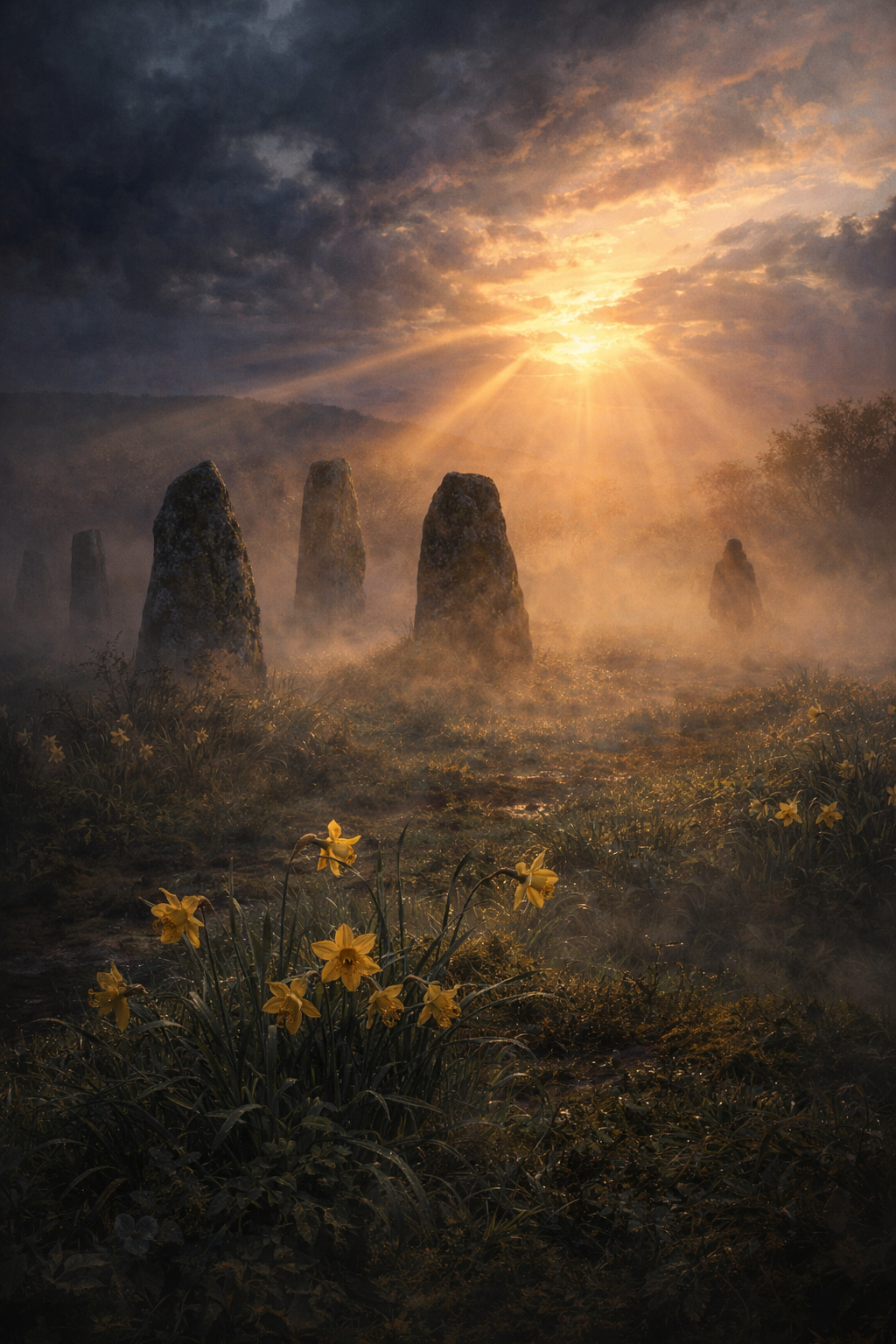
A moment when the world forgets, just briefly, which way it is meant to turn.The old stories say that on this day, the land does not belong entirely to the living.
Nor entirely to anything else.
“It’s a poetic way of describing seasonal transition,” Lillian said, though without much conviction.
Sylvia smiled.
“It’s a practical warning,” she replied.
There are places—quiet places, often overlooked—where the shift can be felt more keenly.
A path that seems slightly longer than it was yesterday.
A gate that does not quite close.
A line of stones on the moor that catch the light at an angle no one remembers noticing before.
“And what happens in these places?” Lillian asked.
Sylvia considered this.
“Nothing,” she said.
“Usually.”
But sometimes, if one is particularly attentive—or particularly unfortunate—one notices that the balance is not stillness at all.
It is hesitation.
A held breath.
And in that breath, something else may move.
Not boldly. Not dramatically.
Just enough to be seen, if one is looking sideways.
“Peripheral perception,” Lillian murmured. “The brain filling in incomplete visual data—”
“Yes,” Sylvia said. “That’s one way of putting it.”
To most people, the equinox invites forward movement.
Plans. Growth. Action.
A sense that the year has properly begun.
“And to you?” Lillian asked.
Sylvia’s expression softened, though not entirely.
“To us,” she said, “it’s a question.”
“A question?”
“Of which way the balance will tip.”
Because balance does not last.
It cannot.
The world must choose—light or dark, growth or decline—and it does so quickly, almost impatiently, once the moment has passed.
The equinox is not the triumph of light.
It is the last instant before the triumph begins.
“And if something else chooses?” Lillian asked, very quietly.
Sylvia met her gaze.
“Then you mind your doors,” she said.
“And you do not go looking for balance where it doesn’t belong.”
Lillian sat back, folding her hands.
“Well,” she said after a moment, “I suppose that rather complicates the usual narrative of renewal.”
Sylvia reached for her tea again, the faintest hint of amusement returning.
“Oh, renewal still comes,” she said.
“It always does.”
She paused, just long enough to let the thought settle.
“But it doesn’t always ask permission.”
Leave a Reply