
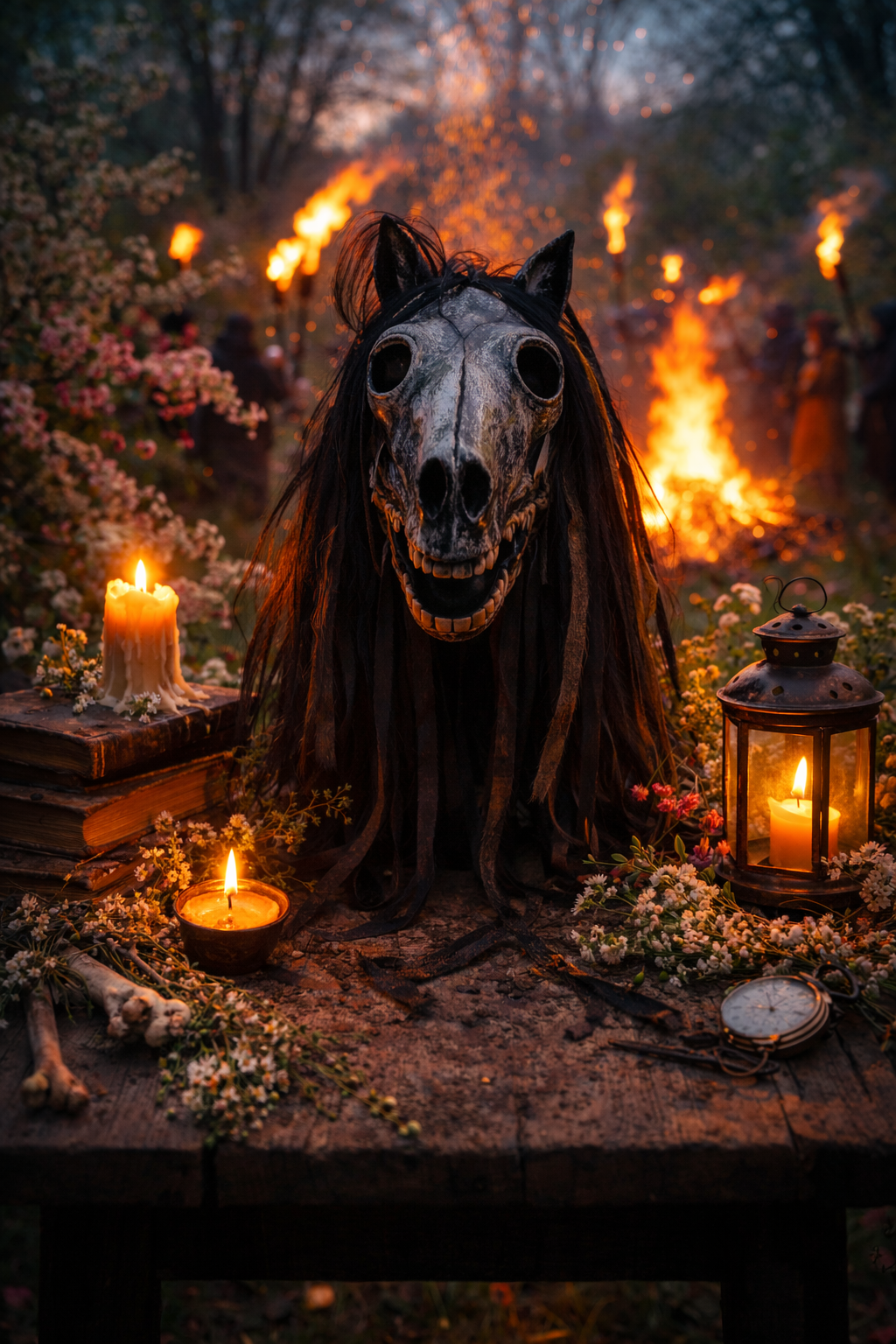
There is, perhaps, a philosophical difficulty at the heart of folklore that is not always acknowledged: we tend to imagine ourselves as observers of tradition, rather than as participants already shaped by it.
As Martin Heidegger suggests, we do not stand outside the worlds we inhabit, but are always already within them—formed by histories, patterns, and inherited meanings we rarely choose.
And as Carl Jung observed in a different register, the stories and symbols we inherit are not merely cultural artefacts, but expressions of deeper structures that persist within us, whether or not we consciously recognise them.
Yet, as Jean-Paul Sartre reminds us, even within such inheritances, we are not entirely absolved of choice, and must in some measure account for the ways in which we continue them.
There is, in the modern world, a tendency to speak of folklore as though it were something safely concluded: a story told, a custom observed, a tradition preserved. The language is reassuring. It suggests continuity without consequence, repetition without risk, and the comforting belief that what has survived must, by virtue of that survival, already be understood.
This is not, strictly speaking, true.
Folklore is not simply the memory of what a people once believed. It is, more often, the structure through which certain beliefs continue to be held—sometimes consciously, but more often not. It persists not because it is explained, but because it is enacted: a dance repeated, a mask worn, a route walked year after year without question.
In places such as Cornwall, where the past has a habit of remaining inconveniently present, these structures are not curiosities so much as habits of attention. People participate not always because they believe, but because they have always done so—and because not doing so would feel, if not dangerous, then at least… ill-advised.
The distinction matters.
Sylvia would tell you that there are things one does not abandon lightly—not because the thing itself demands it, but because repetition creates a relationship, and relationships, once formed, rarely dissolve without consequence. She would not claim that the Hobby Horse—the Oss—is anything in the sense a modern mind might wish to define. She would say, instead, that it behaves as though it were, and that the behaviour itself is the point.
“It’s not the mask,” she would say.
“It’s what happens when everyone agrees to look at it.”
Lillian would prefer to be more precise. She would suggest that folklore operates as a system—an arrangement of symbols, gestures, and shared attention that produces effects whether or not those participating in it understand how or why. The mask is worn, the route is followed, the music is played, and in that repetition something is maintained—not merely remembered, but held in place.
She would not say this implies the existence of anything supernatural. She would say, rather, that it implies the existence of patterns—psychological, social, perhaps even environmental—that are reinforced through ritualised behaviour.
“The question,” she would add, “is not whether it is real, but what it does.”
And what it does, at its most benign, is something we are rarely inclined to question. It binds a community. It creates continuity. It offers a sense of belonging that does not require articulation, only participation. A child raised within such traditions does not need to understand them in order to feel their effect; repetition provides a structure within which identity settles, and through which the individual becomes part of something larger—something that existed before them and will, presumably, continue after.
There is comfort in that. There is also stability. And, perhaps most importantly, there is a shared agreement—often unspoken—that certain things are done in certain ways, and that those ways matter, even if no one can quite say why.
But there is another aspect to this, and it is less frequently discussed.
If folklore is not merely remembered but enacted, then the act of enactment may carry consequences beyond those that are immediately visible—not because something external is responding (though some would argue that it might), but because the structure itself creates conditions in which certain perceptions are allowed, and others are excluded.
To participate in a ritual is to accept, however briefly, a particular arrangement of attention: to look where others look, to move as others move, and to accept that what is taking place has a meaning that does not require explanation.
That agreement is rarely complete.
But it is rarely absent.
Sylvia would say this is where one must be careful.
“Not frightened,” she would add.
“Just… not careless.”
Because there is a difference between observing a tradition and entering into it. The first allows distance. The second does not.
There are stories—quiet ones, not often told—of moments when that distinction has blurred: a festival altered not by intention but by small, accumulated change; a route shifted, a gesture forgotten, a timing misjudged. Nothing dramatic occurs. Nothing that can be named.
And yet, those present recall—often later, and not always consistently—that something felt misaligned. Not wrong, exactly. But not entirely right either.
A pause that lasted too long.
A movement that did not resolve.
A sense, fleeting and difficult to articulate, that what was being enacted had, for a moment, ceased to belong entirely to those enacting it.
Such accounts are rarely pursued. They resist investigation and do not lend themselves to comfortable explanation. They are set aside, explained away, or simply not mentioned again.
Life continues.
The tradition continues.
And whatever occurred remains unexamined.
Lillian would caution against drawing conclusions. Anecdote is not evidence, she would say, and the human mind is more than capable of producing patterns where none exist. Yet she would also acknowledge that patterns, once established, have a tendency to persist—not because they are true, but because they are repeated.
And here, perhaps, lies the more subtle danger.
Not that folklore conceals something hidden and active, waiting to be discovered, but that it creates a framework within which certain possibilities are entertained and others are not. To participate in a ritual is to enter into a shared agreement about how the world is to be perceived.
Most of the time, this is harmless. Often, it is beneficial. It binds, it steadies, and gives form to what might otherwise remain diffuse.
But it also carries a quiet implication: that the form itself matters—that the way something is done is not arbitrary, and that altering it, even slightly, may produce effects that are not immediately apparent.
Sylvia would not argue this.
“If something’s been done the same way for long enough,” she would say,
“there’s usually a reason.”
And Lillian, though more cautious, would not entirely disagree.
“The question,” she would say,
“is whether we understand the reason—or whether we have simply become accustomed to the pattern.”
Between them, there is no conclusion.
Only a recognition.
That the things we inherit are not always as inert as we imagine. That the stories we tell, and the rituals we repeat, do more than preserve the past.
They shape the present.
And, occasionally—though not often, and not always in ways that can be easily identified—they may do so in ways that invite us to consider whether what we are maintaining is merely memory…
or something that, in being maintained, continues to act.
Sylvia’s voice, very soft:
“It’s not about believing,” she says.
“It’s about noticing when something notices back.”
Lillian closes the notebook.
“And asking,” she adds, “whether one intends to continue.”
A pause.
For if we are already shaped by the traditions we inherit, and if those traditions in turn give form to something within us, then it may also be the case that our participation is not entirely passive—that we are, in some quiet but persistent way, choosing how far that inheritance extends.
And then, perhaps more quietly than anything that has come before:
When you take part in a tradition—whether by habit, curiosity, or belonging—do you ever stop to ask what, if anything, it might be asking of you in return?
Leave a Reply