
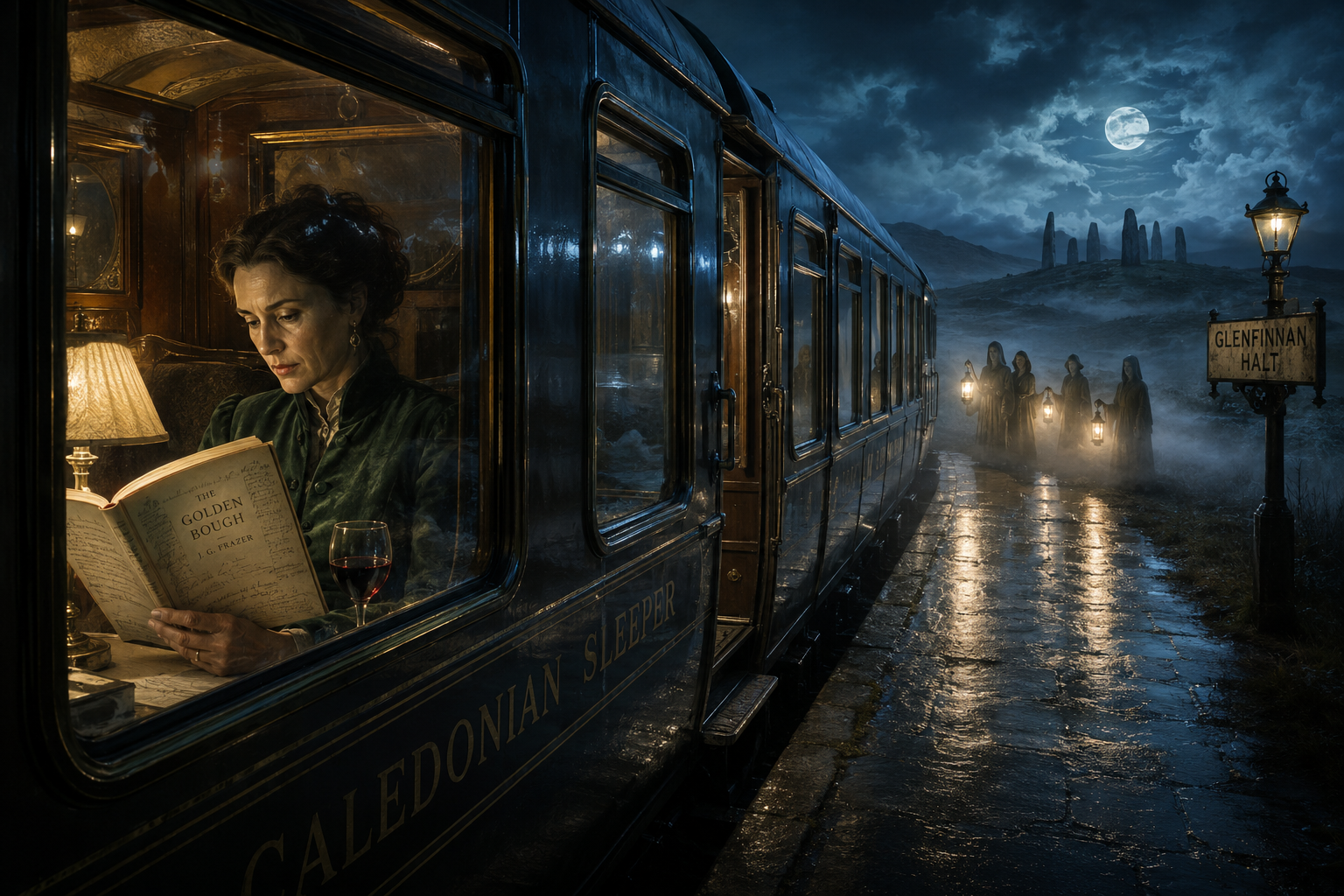
The sleeper train departed London Euston railway station beneath rain and amber station light, carrying its passengers northward through the long uncertain silence of a May evening.
The great iron canopy gathered the sounds of departure into a melancholy harmony that lingered long after the train itself had begun to move: the muted clatter of luggage trolleys across wet stone, the distant hiss of steam beneath the carriages, the blurred cadence of announcements dissolving into static overhead. Travellers drifted through the rain with the subdued inwardness peculiar to overnight journeys, each person already beginning the gradual withdrawal from ordinary life that darkness and distance encouraged.
Sylvia Moon had always distrusted journeys undertaken after sunset.
Not because she believed them inherently dangerous, though her grandmother in Cornwall had certainly maintained that roads travelled at night belonged less securely to the human world than those crossed by day. Rather, Sylvia sensed that movement through darkness loosened certain invisible boundaries. One left home carrying familiar certainties only to discover, somewhere between departure and arrival, that identity itself had become unexpectedly permeable. People confessed things on night trains they would never utter in daylight. Old griefs resurfaced. Forgotten selves emerged briefly beside rain-darkened windows before dissolving again by morning.
Beside her on the platform, Lillian Hartley maintained the composed practicality that years of friendship had taught Sylvia to expect in all moments of transition. While Sylvia stood momentarily distracted by rain threading silver across the carriage windows, Lillian had already identified their compartment, arranged the luggage, and resolved a territorial disagreement involving an oversized suitcase and an increasingly agitated solicitor from Surrey.
Yet even she seemed quieter than usual once they boarded.
The atmosphere inside the sleeper carriage altered at once. The noise of the station softened behind them as though a door had closed upon the ordinary world. Narrow corridors glowed with amber light reflected in polished brass and dark walnut veneer worn smooth by decades of passing hands. The air carried scents of rainwater, wool carpet, coffee, and the faint mechanical warmth rising continuously through the floorboards beneath their feet.
Their compartment lay midway along the carriage.
Though compact, it retained the faded elegance of an earlier age of rail travel: crisp white bedding folded with almost ceremonial precision, brass hooks gleaming softly beneath shaded lamps, a narrow washbasin concealed behind mirrored wood panelling, and a small vase containing a single stem of drying heather whose faint scent mingled curiously with the warmth of the carriage itself.
Outside the window, London drifted slowly away in reflections of gold and wet black stone.
Sylvia settled herself instinctively, arranging books beside the lamp and placing upon the narrow table a small pouch filled with pale fragments of sea glass gathered years earlier from beaches near Falmouth. Lillian watched these preparations with affectionate resignation. Long experience had taught her that Sylvia approached unfamiliar places with ritual attentiveness, particularly those associated with travel, thresholds, or old folklore.
As the train gathered speed beyond the suburbs, voices sounded faintly through the wall of the adjoining compartment.
A woman speaking softly.
Then silence.
A few moments later the same voice emerged again, though altered now by some subtle shift in cadence. The vowels carried traces of Highland inflection absent before. Lillian looked up almost immediately, aware of the inconsistency even if she could not have explained precisely why it unsettled her.
Almost at once the corridor door opened.
A woman stood outside holding a small black travelling case.
At first glance there seemed little remarkable about her appearance. She wore a long emerald-green coat belted neatly at the waist and dark gloves still damp from rain. Yet the longer one looked, the more difficult certainty became. Her age appeared unstable beneath the shifting carriage light. One moment she seemed elegant and perhaps middle-aged; the next older, carrying within her expression a fatigue that belonged not merely to the body but to something more profound and difficult to name.
Dark hair had been pinned carefully back from a pale composed face. Yet it was not her appearance that unsettled Sylvia most deeply.
It was the unmistakable sensation that the woman recognised them in some impossible and distant fashion, as though their meeting belonged not entirely to chance but to the slow convergence of patterns already long in motion.
She explained politely that her compartment adjoined theirs and apologised in advance should she disturb them during the night. Her voice now carried no trace of Scotland whatsoever. Instead it possessed the softened vowels of someone who had lived abroad for many years.
After she withdrew and the corridor fell silent once more, Sylvia remained standing beside the window listening to the sleeper train move steadily northward beneath the dark.
Something about the woman resisted coherence in the same way certain old stories resisted fixed interpretation. Every detail aligned imperfectly with the next, as though several overlapping selves occupied the same outline without ever fully resolving into one identity.
By the time they reached the lounge carriage later that evening, rain had thickened against the windows while northern England unrolled beyond the glass in long reaches of darkness broken occasionally by distant villages glowing faintly upon hillsides.
Inside, however, warmth gathered beneath brass lamps and polished wood.
The lounge retained an atmosphere almost impossibly untouched by modernity. Green velvet seating worn smooth at the edges. Crystal glasses chiming softly upon polished tables. Low jazz murmuring from hidden speakers overhead. Passengers had begun settling gradually into the temporary intimacy unique to sleeper trains, where darkness and movement encouraged strangers into the illusion of brief companionship before morning scattered them again across different destinations.
The woman in green sat alone near the far window.
Before her rested an untouched glass of red wine and an open copy of The Golden Bough whose margins had been densely annotated in green ink.
At first Sylvia noticed only the beauty of the scene itself: the solitary traveller illuminated by amber carriage light while darkness streamed endlessly beyond the glass. Yet gradually the inconsistencies surrounding the woman accumulated with increasing subtlety.
The steward addressed her as Mrs. August while refilling the untouched wineglass.
Not twenty minutes later, the younger ticket inspector apologised to Miss Carrick regarding confusion over her onward connection to Inverness.
Neither name appeared to surprise her.
More curious still were the varying impressions she left upon the other passengers. A retired schoolmaster described her casually as an American folklorist travelling north for a lecture series. Later, one of the students referred to a Scottish widow returning home after many years abroad.
Even her appearance seemed unstable depending upon who observed her. Under one light she looked no older than fifty; under another considerably more fragile, almost translucent with exhaustion.
Lillian attempted rational explanations with diminishing conviction. Sleeper trains distorted perception, she insisted. Fatigue altered memory. Enclosed environments encouraged projection and social confusion. Yet Sylvia sensed something else unfolding beneath the surface of events, something connected not merely to the woman herself but to the destination toward which they all travelled.
Several times Sylvia caught the woman studying the cream-coloured invitation protruding from her notebook — the embossed card that had summoned them northward to the midsummer Faerie festival on the Isle of Skye.
The festival itself had struck Lillian from the outset as faintly absurd. Its organisers described it as a gathering devoted to folklore, storytelling, music, and ceremonial acts of remembrance connected to what they termed “the older roads between worlds.” Sylvia, naturally, had accepted immediately.
Now, however, she began to suspect that the woman in green recognised the invitation for reasons reaching far beyond academic interest.
Near midnight Sylvia encountered her alone in the corridor outside the sleeping compartments.
The train swayed gently through darkness while narrow lamps cast elongated shadows across the paneled walls. Beyond the windows the land had become almost entirely invisible beneath drifting mist and moonlight.
The woman stood beside the glass as though listening intently to something beyond it.
For the first time Sylvia saw clearly the strain concealed beneath her composure. It was not ordinary weariness but the profound exhaustion of someone who had spent years holding themselves together against a slow invisible unraveling.
Very quietly the woman spoke of Skye.
Not directly at first. Merely fragments. Music carried across water after midnight. Fires burning between standing stones. Dancing that continued until dawn arrived unnoticed over the hills. Then, after a long silence, she admitted she had attended the same midsummer gathering more than twenty years earlier under another name.
At the time she had regarded the rituals as symbolic survivals of Highland folklore: ceremonies concerning memory, identity, and the ancient belief that names carried portions of the soul within them. Yet something had occurred during the final night upon the hillside beyond the festival fires, something she could not describe plainly even now except to say that afterward she had returned south with the persistent sensation that some essential part of herself had failed to leave the island alongside the rest.
Only gradually had the fractures begun.
Names slipping loose around her. Accents altering unconsciously. Strangers remembering her differently from one moment to the next. The terrifying discovery that no single self remained entirely solid.
As she spoke, the train began slowly to lose speed.
The change passed almost imperceptibly through the carriage at first: a faint sigh beneath the floorboards, the trembling of glasses upon distant tables, the soft opening and closing of compartment doors farther along the corridor. Then the brakes engaged fully.
The sleeper train stopped altogether.
Outside stretched only mist-covered moorland silvered beneath a rising moon.
No station lights appeared. No visible settlement interrupted the vastness of the landscape. Only standing stones emerged dark against the pale horizon while mist drifted low across the heather.
The silence that followed possessed a strange density, as though the train had paused not merely within geographical isolation but at the edge of some older and less visible boundary.
The corridor lights flickered once.
When they steadied again, Sylvia noticed with sudden unease that the compartment number beside the woman’s door had altered.
Moments earlier it had read Eight.
Now it bore the number Nine.
Lillian saw it too when she emerged from their compartment moments later, fastening her cardigan against the cold air now entering faintly through the carriage joins.
Beyond the windows, a narrow platform revealed itself gradually from the mist beside the halted train. It appeared weather-darkened and old enough to seem almost grown from the moor itself rather than constructed upon it. Lantern light moved softly within the fog, illuminating several waiting figures whose outlines remained indistinct and strangely graceful.
No one else aboard the train appeared aware of them.
The woman in green stared toward the lanterns with an expression Sylvia could only describe as exhausted recognition.
Very slowly she explained what Sylvia had already begun to suspect.
During the final night of the festival years earlier, she had crossed too deeply into one of the older rites preserved beneath the surface of the gathering. What visitors treated as performance or harmless symbolism concealed something genuinely ancient concerning invitation, remembrance, and exchange. The island still remembered certain pathways between worlds, and some ceremonies retained power precisely because modern people no longer fully believed in them.
Afterward she had returned to ordinary life believing herself unchanged.
Only later had she understood that some portion of her identity had remained elsewhere, held within whatever ancient current moved beneath the ritual fires and midnight dancing upon the hillside.
She had spent years attempting to repair the fracture through reinvention. New countries. New histories. New names. Yet each identity weakened eventually because none remained entirely her own.
The lantern-bearing figures beyond the mist remained motionless beside the platform, their stillness possessing neither menace nor mercy but the quiet inevitability of ancient obligations continuing long after the modern world had ceased recognising them. As Sylvia watched the woman beside her, she understood with growing certainty that whatever waited beyond the halted train had not come to punish or even reclaim her in any simple sense. Rather, some forgotten portion of her life had finally been remembered in a place where memory itself still possessed power.
Very quietly Sylvia withdrew the pouch of sea glass from her coat pocket.
The pale green fragments gleamed softly beneath the corridor lamps, each one shaped by salt and tide into something gentler than its original form. Her grandmother had once told her that sea glass remembered differently from stone. The sea erased sharpness but preserved essence.
Sylvia placed a single fragment carefully into the woman’s trembling hand and asked, not for the most recent of her many names, but for the earliest name she had once carried without fear.
For several moments the woman seemed unable to answer.
Then, almost inaudibly, she whispered:
Anna.
At once something altered within the corridor.
The oppressive tension eased perceptibly. Beyond the windows the lantern lights dimmed one by one while the waiting figures grew fainter within the mist, as though distance had suddenly reclaimed them.
The train shuddered violently beneath their feet.
Moments later it began moving once more.
By dawn the moorland had vanished behind them.
Rain-washed mountains rose beyond the windows beneath pale Highland light while rivers flashed silver between dark hillsides. Passengers emerged gradually from their compartments carrying newspapers, coffee cups, and the vague disorientation peculiar to overnight travel.
Yet when Sylvia and Lillian went searching for the woman in green, they found no trace of her.
The adjoining compartment stood empty.
No luggage remained. No record of occupancy appeared upon the steward’s manifest. Only the forgotten copy of The Golden Bough rested abandoned upon a lounge carriage table beside a cold untouched glass of wine.
Lillian opened the book carefully.
The annotations changed midway through. Earlier passages had been written in elegant green script beneath the name Anna. Farther in, the handwriting altered repeatedly, as though several women had spoken to one another across years within the margins of the same text.
Near the final pages, beside a passage concerning ancient rites of passage and ceremonial renaming, a final line appeared in trembling green ink:
You must never dance twice beneath the hill-fire if they ask your true name.
Leave a Reply