
Chapter 5
The rain had settled over Falmouth by eleven o’clock the next morning.
It was not heavy rain, not the sort that drove people indoors with dramatic complaints and dripping umbrellas, but a fine, persistent mist that silvered the pavements and blurred the harbour until the boats seemed to float in another world. Mystic Reads smelled of old paper, beeswax polish and the faint lavender Sylvia kept near the counter to discourage moths. Outside, gulls cried from somewhere beyond the roofs. Inside, the shop held the quiet expectancy of a place waiting for something to happen.
Sylvia had telephoned Oksana that morning.
She had tried to make the invitation sound gentle. Tea, she had said. A few questions, if Oksana felt able. Nothing urgent.
But of course, it was urgent.
The urgency wasn’t one of sirens or police tape, but of collapsing certainties. A strange doll and a frightened letter had led them to a Moscow museum and Bronze Age trade routes. A single phrase pointed to Cornwall, though Oksana insisted her brother had never set foot in England. Every answer only produced more unsettling questions.
When the bell above the door rang, Sylvia was already looking up.
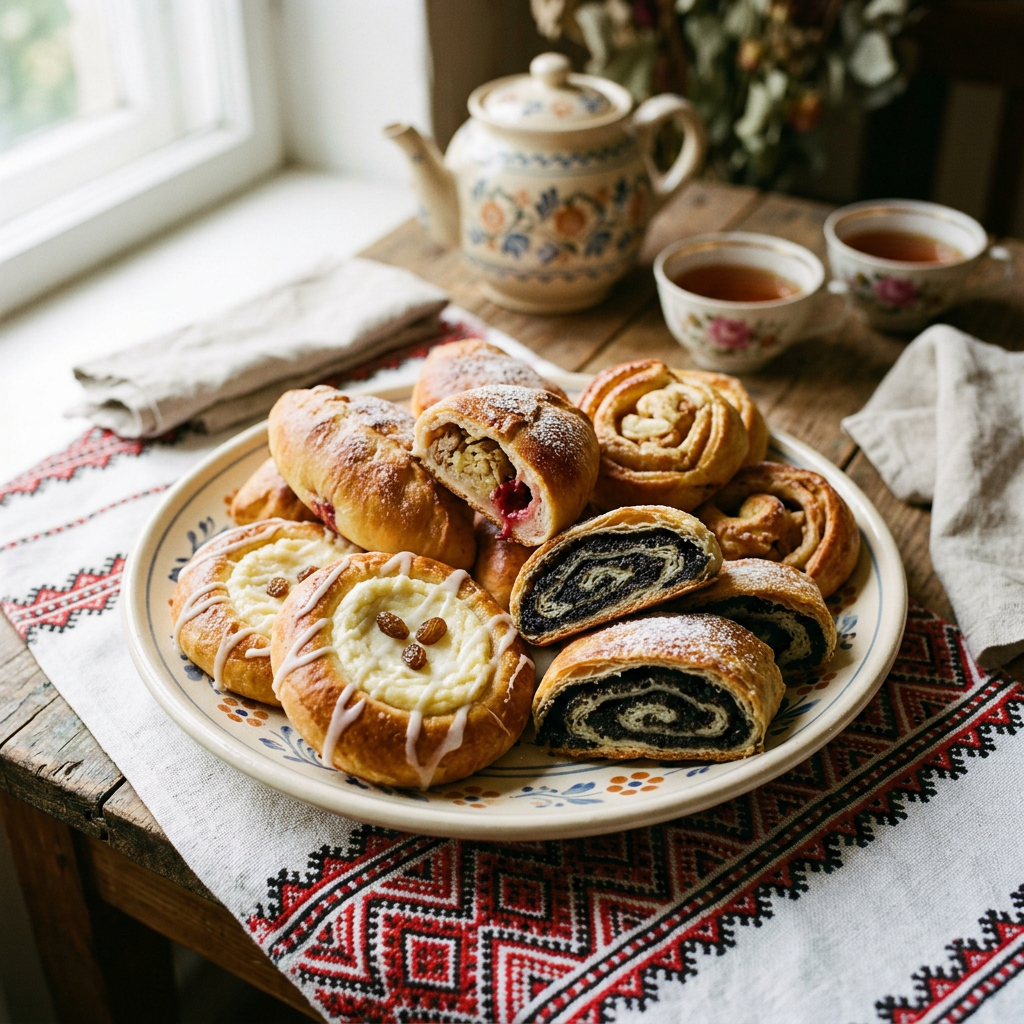
Oksana stepped inside carrying a round tin wrapped carefully in a tea towel.
Rain glistened on her coat. Her scarf had been pinned neatly at her throat, but a few damp strands of hair had escaped and clung to her cheek. She smiled when she saw Sylvia, though the smile came a little late, as if summoned by manners rather than ease.
“I brought pastries,” she said.
Sylvia crossed the shop at once.
“Then you have already improved the day.”
Oksana’s fingers tightened briefly around the tin before she surrendered it.
“In Ukraine,” she said, “one does not discuss worrying things without food.”
Lillian appeared from the back room with a ledger in one hand and a pencil behind her ear. She took in Oksana’s coat, the pastry tin, and Sylvia’s expression in a single glance.
“In that case,” she said, setting the ledger aside, “we are clearly about to discuss something very worrying indeed.”
Oksana laughed softly, and the sound, though small, eased something in the room.
Sylvia turned the sign to CLOSED FOR LUNCH, though it was nowhere near lunchtime, and locked the door without apology. A woman outside paused, frowned at the sign, and peered in hopefully. Sylvia pretended not to see her. There were days when the living required more attention than customers.
They settled in the reading area at the back of the shop, where a battered sofa and two armchairs stood beneath shelves of folklore, local history and occult philosophy. Rain whispered against the windows. The kettle steamed. The little lamp beside Sylvia’s chair cast warm light over the low table as Oksana unfolded the tea towel and opened the tin.
The pastries were small and beautifully made, some filled with poppy seed, others with cheese or fruit. Their sweetness carried lemon, butter and something faintly floral that made the shop feel, for a moment, less like Falmouth and more like a kitchen remembered from an East European childhood.
Oksana poured the tea herself. Sylvia let her do it. The careful arranging of cups and plates seemed to give Oksana’s hands a task and her thoughts a temporary shelter.
Oksana arranged the pastries on a small plate.
“My daughter makes these when she has time. She insists baking relaxes her.”
Oksana smiled and adjusted the plate slightly, as though the pastries required a more pleasing arrangement.
“I’ve never believed her. She comes home from a twelve-hour shift looking exhausted and immediately starts making food for people.”
“That sounds familiar,” said Sylvia.
“It should. Mothers are impossible in every country.”
The remark earned a laugh.
“My granddaughter claims her room at university is smaller than a cupboard,” Oksana said, sharing a small, weary smile. “She is convinced the landlord is a thief.”
“Bristol landlords,” Lillian murmured into her cup. “A special category of criminal.”
The laughter faded naturally.
As good conversations often do, it found its way back to the thing everyone had been avoiding.
“My brother loved them both,” Oksana said quietly.
Neither Sylvia nor Lillian spoke.
Her voice had lost it lighter note.
“He liked to pretend he wasn’t sentimental, but nobody believed him. My daughter could persuade him to do almost anything. My granddaughter was worse.”
A small smile touched her face.
“When she was six, she convinced him that fairies were stealing single socks from washing machines.”
“An entirely reasonable explanation,” Sylvia observed.
“That was his conclusion as well.”
The smile lingered for a moment before slowly fading.
“He wrote to me.”
Oksana looked down at her teacup.
“He never wrote to my daughter.”
Rain tapped softly against the shop window.
“He never wrote to my granddaughter.”
Lillian waited.
Oksana’s fingers tightened slightly around the handle.
“At first I thought it was because he didn’t want to worry them.”
She shook her head.
“No. That isn’t right.”
The silence that followed had room in it.
“My daughter would have tried to solve the problem.”
A faint smile appeared.
“She always does.”
“And your granddaughter?” asked Sylvia.
“She would have asked questions until he regretted telling her.”
That earned another brief smile.
Then Oksana looked up.
“But he wrote to me.”
For a moment the rain seemed louder.
“When we were children, our grandmother told stories.”
Neither Sylvia nor Lillian moved.
“He always argued with them. Wanted dates. Places. Sources. Proof.”
The affection in her voice softened the memory.
“He thought stories should behave themselves.”
“And you?”
Oksana laughed quietly.
“I remembered them.”
The words settled gently between them.
“He knew that.”
Her gaze drifted towards the rain-blurred street beyond the window.
“If there was something hidden inside all this…” she said slowly, “…something buried beneath records and archives and all the things he spent his life studying…”
She stopped.
When she spoke again her voice was softer.
“He would have known my daughter would look for facts.”
A pause.
“My granddaughter would look for answers.”
Another pause.
“But he wrote to me because I would remember the story.”
The shape of the mystery seemed to alter, not because a new piece had been added, but because they now understood the space on was meant to fill.
Only when tea had been poured and the first pastry had been properly admired did Oksana set down her cup.
“You found something,” she said.
It was not a question.
Sylvia looked at Lillian.
They had intended to approach the matter gently, but Oksana had spared them the fiction.
“Yes,” Lillian said. “We found several things. None of them is an answer. But they change the questions.”
Oksana nodded once, as if that was what she had expected.
“My brother never came to England,” she said.
“We know,” Sylvia replied. “That is what troubles us.”
For a moment Oksana did not move.
The rain continued softly against the glass.
Lillian leaned forward, not as an interrogator but as a woman acknowledging another woman’s knowledge.
“You told us he never came here, and I believe you. But the phrase he underlined — the coast where the black fort watches the western sea — seems to point towards something that looks very like Cornwall. If he never visited, then he must have reached it another way.”
Oksana looked down at her hands.
“Through records,” she said.
Neither Sylvia nor Lillian spoke.
Sylvia realised, with a start, that Oksana had somehow moved head of them.
“My brother did not travel much,” she continued. “Not in later years. But records travel. Copies travel. References travel. One archive speaks to another, even when governments would rather people did not listen.”
Lillian’s expression changed.
“What kind of archivist was he?”
Oksana considered the question seriously.
“The inconvenient kind.”
A brief smile passed across her face and vanished.
“He studied history first, then archival science. He believed records were not only paper. They were proof that someone had lived, owned land, married, prayed, been moved, been punished, been erased. He used to say a person without records could be made to disappear twice.”
Sylvia thought of the doll, of its stitched face and hidden mark. She thought of old stories surviving in changed forms because someone, somewhere, had refused to let them die. To Oksana’s brother, archives had not been academic repositories. They had been defences against obliteration.
“He wrote that facts were changing,” Lillian said. “Do you know what he meant?”
Oksana reached for a pastry and broke a corner from it, though she did not eat.
“At first, I thought he meant corrections. Archives are full of corrections. Dates change when better evidence appears. Names are standardised. Villages have Polish names, Russian names, Ukrainian names, sometimes Austrian names, sometimes names nobody uses anymore except old women who refuse to be corrected.”
There was a flash of humour in that, but it passed quickly.
“He was not frightened by ordinary correction. He lived with that. What frightened him was something else.”
“What?” Sylvia asked.
Oksana looked towards the shelves, though Sylvia doubted she saw them.
“He said the records were becoming clean.”
Lillian was very still.
“Clean?”
“Too clean. That was his phrase. He said old documents carry human damage. Ink blots. Margins. Crossings-out. Additions in a different hand. Anger. Fear. Bureaucracy. Stupidity. All the mess that proves people were there. But these new scans, these new entries, had no mess. They looked as if someone had made history behave.”
Outside, a van passed slowly along the street, its tyres hissing through rainwater.
Oksana continued before either woman could respond.
“You must understand. In the Soviet Union, history was never only history. It was weather. It changed according to who was in power. One year a man was a hero. Next year he had never existed. A village changed names, a church became a warehouse, a famine became poor management, a deportation became resettlement. Photographs lost faces. Books lost paragraphs. Families learned not to ask certain questions in front of children.”
Her voice had not risen, but something in it made the shop feel colder.
“My brother knew this better than anyone. He spent his life among records damaged by that world. When he saw the same habits returning, he would have noticed before others did.”
Lillian did not rush to fill the silence.
That restraint mattered.
Oksana wasn’t simply explaining history; her voice carried the unmistakable weight of someone who had lived inside it.
“And you think that is what he saw?” Sylvia asked at last. “A return?”
“I think he feared it.” Oksana folded her hands around her teacup. “Ukraine is fighting a war outside itself. Everybody sees that. Bombs, soldiers, cities ruined. But there is another war inside memory. If someone can change the records, then later they can say things were always different. That this land was always theirs. That these people were never Ukrainian. That this church, this family, this name, this grief, belonged to someone else.”
Lillian drew a slow breath.
The words seemed to reach beyond the room, beyond Falmouth, beyond even Oksana’s missing brother. The pastries and tea remained ordinary, gentle things, but Sylvia recognised the violence beneath the surface – a quiet erasure of memory itself.
“And the folklore?” Sylvia asked.
Oksana turned to her.
“The doll?”
“The doll. The story. The black fort. Anything your brother may have connected to old stories.”
Oksana looked uncomfortable for the first time.
“My brother did not respect folklore.”
Sylvia smiled faintly.
“Many sensible people make that mistake.”
“He said stories were unreliable. I said records were written by men who wanted salaries.”
Lillian gave a short laugh.
Oksana’s own smile softened the memory.
“We argued. Always. But he remembered everything. That was the trouble with him. Even things he claimed not to believe, he kept.”
“Such as?”
Oksana’s gaze lowered to the tea.
“There was a story our grandmother told. We heard it when we were children. I had not thought of it for years before the doll arrived.”
Sylvia waited.
The rain had lessened, but water still moved in thin threads down the window.
“It was about a place by the sea,” Oksana said. “A black place. Not exactly a castle. Perhaps a fort. Perhaps rock. In the story it watched the western sea, though I never understood why western. We were children. West was where the sun went to drown.”
Lillian looked up sharply.
“There was a woman,” Oksana continued, “and a mirror. Sometimes the woman looked into the mirror and saw the black place behind her, though she was far from the sea. Sometimes she made a doll to fool what was watching. Sometimes the doll was not a doll but the woman’s shadow. My grandmother changed the story every time she told it. My brother hated that. He wanted the correct version.”
“A future archivist,” Lillian murmured.
“Yes.” Oksana’s smile faded. “He would ask where the place was. My grandmother always said, ‘Far west, where the sea keeps what people forget.’”
Sylvia felt the words settle somewhere behind her sternum, changing the weight of things.
Far west.
The black fort.
The western sea.
The phrase was no longer an isolated clue from a letter; it had roots, a family history that reached back long before Cornwall was ever mention.
“Did your brother mention an Englishman?” Lillian asked.
Oksana’s head lifted.
The question had not been planned. Sylvia could tell by Lillian’s expression. It had risen from the conversation itself.
“Why do you ask?”
“Because if your brother never came to England, someone may have brought England to him.”
Oksana sat with that for a moment.
Then slowly, reluctantly, she nodded.
“There was an Englishman.”
The remark seemed to surprise Oksana almost as much as it surprised Sylvia.
“In a letter?” asked Lillian.
Oksana nodded.
“One of the earlier ones. Before things became… strange.”
“What did he say about him?”
For a moment she searched her memory.
“Not very much. Only that he kept asking questions.”
“What sort of questions?”
“Old questions.”
The answer earned a faint smile from Lillian.
“The best kind.”
Oksana considered that.
“My brother would not have agreed. He thought the man was wasting everybody’s time.”
“Why?”
“He wanted shipping records. References to old trade routes. Pilgrims, perhaps. Monasteries. Icons. Stories that travelled with people.” She shrugged lightly. “The sort of things archivists usually leave to historians.”
“And historians leave to folklorists,” said Sylvia.
“Exactly.”
For the first time, Oksana smiled.
“My brother found him irritating.”
“That sounds promising,” said Sylvia.
“It was. The more irritating he found somebody, the more seriously he tended to take them.”
The smile faded.
“He wrote once that the Englishman kept insisting that stories travelled along the same roads as goods and armies.”
Lillian exchanged a glance with Sylvia.
“My brother thought that was romantic nonsense.”
“And later?” asked Sylvia quietly.
Oksana looked down at her teacup.
“Later he stopped laughing about it.”
The rain tapped softly against the window.
For several moments nobody spoke.
“When the war began,” Oksana said at last, “he became very conscious of history. Not history as academics understand it. History as ordinary people understand it.”
Lillian leaned forward slightly.
“What do you mean?”
Oksana searched for the right words.
“When people are fighting over land, they are never only fighting over land. They are fighting over memory. Over who belongs somewhere. Over who arrived first. Over which stories are allowed to survive.”
The room seemed quieter suddenly.
“My brother used to say archives become dangerous whenever people start asking them to prove ownership of the past.”
Sylvia felt a small chill.
“And was that happening?”
Oksana nodded.
“Everywhere.”
She paused.
“That was when he began writing about records changing. About things disappearing. About references that should have existed and suddenly did not.”
“The Englishman noticed too?”
“I don’t know.”
For the first time uncertainty entered her voice.
“I only know that my brother stopped calling him eccentric.”
She looked towards the rain-blurred window.
“And when my brother stopped dismissing an idea, it usually meant he had found evidence for it.”
“Did he ever tell you the man’s name?” asked Lillian.
Oksana shook her head.
“If he did, I have forgotten.”
A shadow crossed her face.
“At the time it seemed unimportant.”
Sylvia recognised the expression immediately. It wasn’t the simple pain of forgetting, but the deeper ache of hindsight – the realisation that a trivial detail might have been a vital warning.
“You could not have known,” she said gently.
“No.”
Oksana’s voice softened.
“But I think he did.”
The telephone rang before Sylvia could answer.
The sound startled all three women, absurdly loud in the small room.
Sylvia rose.
“If that is someone asking whether we stock scented candles, I may become unreasonable.”
It was a weak joke, but it allowed Oksana to gather herself.
Sylvia went to the counter.
“Mystic Reads.”
Mrs Trevelyan’s voice came down the line with brisk satisfaction.
“I’ve found something.”
Sylvia reached automatically for the notepad beside the till.
“Have you indeed?”
“A parcel from Ukraine passed through Torquay a few months ago. My friend remembered it because parcels from Ukraine are not easily forgotten these days, and this one needed a signature.”
Sylvia looked back towards the reading area. Lillian had turned in her chair. Oksana sat motionless, her hands folded around her cup.
“Was it addressed to Oksana?”
“No. A man.”
Mrs Trevelyan gave the name slowly, spelling it twice. Sylvia wrote it down.
“And the address?”
“Waterfront apartment. Very expensive. My friend says the sort of place where people complain about gulls as if gulls were a recent development.”
Despite herself, Sylvia smiled.
“And the man himself?”
“Unmemorable, apparently.”
“That is unfortunate.”
“His parking was not.”
Sylvia paused.
“His parking?”
“He double parked outside the post office while he went in to sign for the parcel. A traffic warden had already begun writing the ticket. There was a dreadful row. My friend remembers that distinctly. The queue became involved.”
“Of course it did.”
“Half supported the traffic warden. Half thought the man should have been allowed to collect his parcel in peace. My friend said it was the most excitement they’d had all week.”
“That is very helpful.”
“I thought so.”
Sylvia looked at the name and address on the pad.
A parcel from Ukraine, sent not to Oksana but to a man in Torquay. A man wealthy enough to live on the waterfront and impatient enough to quarrel over a parking ticket in front of an entire post office queue.
It was ridiculous, ordinary, exactly the sort of detail people remembered when more important things vanished.
“Mrs Trevelyan,” Sylvia said, “you are a marvel.”
“Yes,” said Mrs Trevelyan. “I know.”
When Sylvia returned to the reading area, the warmth of the shop seemed thinner than before.
She placed the notepad on the low table.
“Oksana,” she said carefully, “Mrs Trevelyan has found another parcel from Ukraine.”
Oksana looked down at the name.
At first her face showed no recognition.
Then something moved behind her eyes.
Not certainty. Not memory fully recovered. Something more fragile and more painful: the awareness she had forgotten something ,and that the forgetting itself was the wrong shape.
“The Englishman,” she said.
Lillian leaned forward.
“You know the name”
“I don’t know.” Oksana touched the paper with one finger. “But when my brother wrote about that Englishman, the one asking about old shipping records, I had thought he was only another researcher.”
Sylvia sat opposite her.
“And now?”
Oksana stared at the name Mrs Trevelyan had supplied.
“Now I wonder if he was the beginning.”
Outside, the rain had almost stopped. Water dripped from the shop awning onto the pavement below. Somewhere in the distance a gull cried over the harbour.
Lillian reached for her notebook.
“We need to know who he is.”
“Yes,” Sylvia said. “But carefully.”
Oksana looked from one woman to the other.
“If he was asking the same questions as my brother, he may know what frightened him.”
“And if he doesn’t?” asked Lillian quietly.
The question hung in the room for a moment.
Outside, the rain had begun to ease. Water still threaded down the windows, but the steady drumming had softened to an occasional patter from the eaves.
Oksana lowered her eyes.
“Then perhaps he knows something else.”
No one rushed to answer.
The name on Sylvia’s notepad remained where it was, surrounded by crumbs and cooling teacups. An ordinary name. An ordinary address. Yet somehow it had altered the shape of the entire conversation.
At length, Lillian reached for the museum correspondence she had brought from the Greenbank the previous evening.
“I don’t think Torquay is the next question.”
Sylvia looked up.
“No?”
Lillian tapped the letterhead from Moscow.
“I think this is.”
For a moment neither woman spoke.
Then Oksana frowned.
“A Russian museum?”
“The delegation that Russian museum sent here.”
Lillian slid the photocopy across the table.
“They travelled halfway across Europe to spend three days in Falmouth examining records connected to that carving.”
“And left without explanation,” said Sylvia.
“Exactly.”
Lillian leaned back.
“We keep asking what the Englishman wanted.”
Her finger rested on the Moscow address.
“I think we should also be asking what they wanted.”
Oksana studied the letter.
“The same question from different directions.”
“Possibly.”
“Or the same answer,” Sylvia said softly.
Beyond the windows, the rain finally stopped.
The harbour remained hidden beneath mist, but the light had changed. The early afternoon seemed brighter somehow, as though the town had drawn a slow breath.
Lillian gathered the papers into a neat pile.
“I can find out who hosted the delegation.”
“You think the museum will tell you?”
“I think somebody will.”
“And the Englishman?” asked Oksana.
Sylvia glanced at the name on the notepad.
“We’re not forgetting him.”
“No.”
Lillian’s expression grew thoughtful.
“But before we travel to Torquay, I’d rather know whether we’re following the trail—or merely the latest footprint.”
Oksana nodded slowly.
The pastries sat half-finished on the table. The tea had gone cold. Notes and photocopies lay scattered amongst the crumbs.
Three women: a missing archivist. a forgotten story, a museum in Moscow. and an Englishman waiting somewhere in Torquay.
The next step was becoming clear.
Sylvia looked from the Moscow letterhead to the note bearing the Torquay address. Two threads led away from them, but they could only follow one at a time.
Leave a Reply