
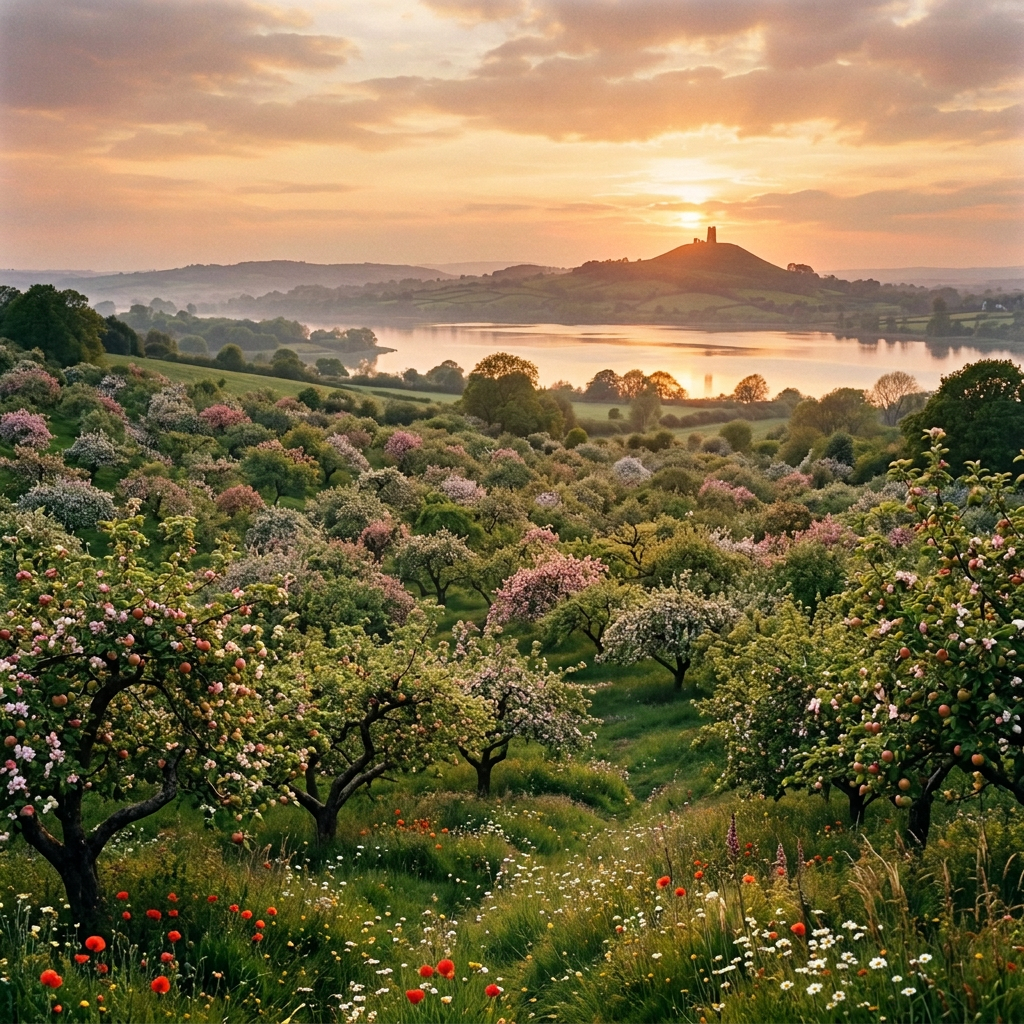
An observation on Cornish, Common Brittonic, and the rather troublesome business of interpreting the past.
“There’s something rather misleading about the way we speak of ancient languages,” Lilian observed, setting down her notes. “We imagine them as finished things, preserved intact until some unfortunate historical event causes them to disappear. But languages are not archaeological artefacts. They change every time someone speaks them.”
She glanced towards Sylvia.
“Cornish didn’t simply emerge from Common Brittonic as though someone had decided to invent a new language. It developed gradually, through generations of ordinary speech.”
Common Brittonic, she explained, was the Celtic language ancestral to Welsh, Cornish, and Breton, spoken across much of Britain before the spread of English. As communities because increasingly separated, their speech developed along different paths. In southwestern Britain, the varieties that would become Cornish acquired distinctive features of pronunciation, grammar, and vocabulary.
“The important point,” Lillian continued, “is that nobody woke up one morning speaking Cornish instead of Brittonic. There was no moment of transformation. The language changed incrementally, and only restrospectively do we impose boundaries upon its history.”
She turned a page.
“By the medieval period, Cornish was recognisably distinct. We have substantial surviving literature, including the religious dramas of the Ordinalia. Later, as English increasingly displaced Cornish, the language retreated from everyday use. By the eighteenth and nineteenth centureis, its traditional community transmission had largely ceased, although knowledge of it survived. The twentieth-century revival drew upon manuscripts, recorded vocabulary, grammatical evidence, and the work of earlier scholars.”
Sylvia stirred her tea.
“Then, the old tongue wasn’t truly lost,” she commented.
“Not entirely. But neither was it recovered unchanged. Modern revived Cornish is a product of both historical preservation and scholarly reconstruction. Its speakers have restored a living means of communication, which is a considerable achievement. But we mustn’t confuse reconstruction with an uninterrupted transmission of every original meaning.”
“Words have memories,” said Sylvia.
“People have memories, Sylvia. Words have histories. The distinction is rather important.”
Sylvia shrugged.
Lillian allowed herself a small smile.
“Take a word preserved in an ancient manuscript. We may establish its likely pronunciation, grammatical function, and meaning from the evidence available. But can we know precisely what emotional or spiritual associations it carried for the person who first used it? Not neccesarily.”
She leaned forward.
“And that brings us to Avalon.”
The Problem with Avalon
“The name Avalon is generaly associated with the medieval Arthurian tradition. Geoffrey of Monmouth describes an island associated with apples in his twelfth-century Vita Merlini, while earlier Arthurian matieral refers to Avalon as the place where Arthur’s sword was forged and where he was taken after his final battle.”
“An island of applies,” Sylvia murmred. “And apples have their own signficance in the Old Ways.”
“Indeed. The name is commonly connected with the Brittonic word for apple, reflected in Welsh afal and Cornish aval. But an etymological connection does not establish the existence of a particular island, much less identify an archeological site.”
Lillian tapped the excavation report.
“Suppose we discover an inscription at the site containing a word resembling a reconstructed Brittonic form. Suppose, too, that a medieval account describes a place with similar characteristics. We might reasonably investigate whether there is a history relationship.”
“And if the legnds agree?” mused Sylvia, drawing her tea cup closer.
“Then we have a more interesting hypothesis. Not proof.”
Sylvia sighed.
“You do have a talent for removing the romance from things,” she said.
“On the contrary,” said Lillian. “I find it rather more extraordinary that a word can survive centuries of linguistic change while the world in which it originated has disappeared.”
Sylvia nodded.
“But here’s what troubles me about the excavation,” continued Lillian. “We’re treating the ancient landscape, the medieval legends, and modern interpretations as though they were all describing the same thing.”
“And perhaps they are.”
“Perhaps. But they were produced in different centuries, by people with different languages, beliefs, and purposes. Similiarity is not identity.”
Lillian looked again at the report.
“If the site really does preserve evidence of something associate with the earliest traditions of Avalyn, we must be exceptionally careful not to read the later lengend backwards into the archaeological record.”
“You’re saying we might find Avalon and fail to recongise it?” suggested Sylvia before taking a sip of tea.
“I’m saying we might find something entirely different and persuade ourselves that it must be Avalon.”
What the language can – and cannot- tell us
“There’s another possibility,” continued Lillian. “A place-name may outlive the community that originally gave it meaning. Its pronunciation changes, its spelling alters, and later generations invent explanation for it. Sometimes those explanations become more influential than the original meaning.”
Sylvia nodded thoughtfully.
“Folk memory.”
“Yes, although folk memory is not an infallible recording device. It’s a process of selction, alteration, and reinvention.”
Lillian set the excavation report aside.
“Consider what that means for our investigation. The archaeological remains may be authentic. The linguistic connections may be plausible. The legends may preserve fragments of genuine historical memory. Yet the story we’ve constructed from those elements could still be wrong.”
“And how are we supposed to know?”
“We examine the eivdence, distinguish what we can establish from what we merely suspect, and resist the temptation to make everything fit.”
Sylvia gave her a doubtful look.
“That doesn’t sound very satisfying,” she concluded.
“Truth seldom arranges itself for our satisfaction,” Lillian countered.
For a moment neither spoke.
Then Lillian added, more gently, “the survival of Cornish teaches us something rather important. Continuity doesn’t require things to remain unchanged. A language can survive through transformation. A tradition can endure while acquiring meanings it s originators never imagined.”
“And Avalon?” prompted Sylvia.
“Perhaps Avalon is one of those traditions. Perhaps the name has preserved something genuine across the centuries. But if we want to understand what lies beneath that staircase, we must begin with what is actually there, not with what centuries of storytelling have taught us to expect.”
She smiled at Sylvia.
“Otherwise, my dear, we’re not investigating the past. We’re merely asking it to confirm our favourite story.”
Leave a Reply