
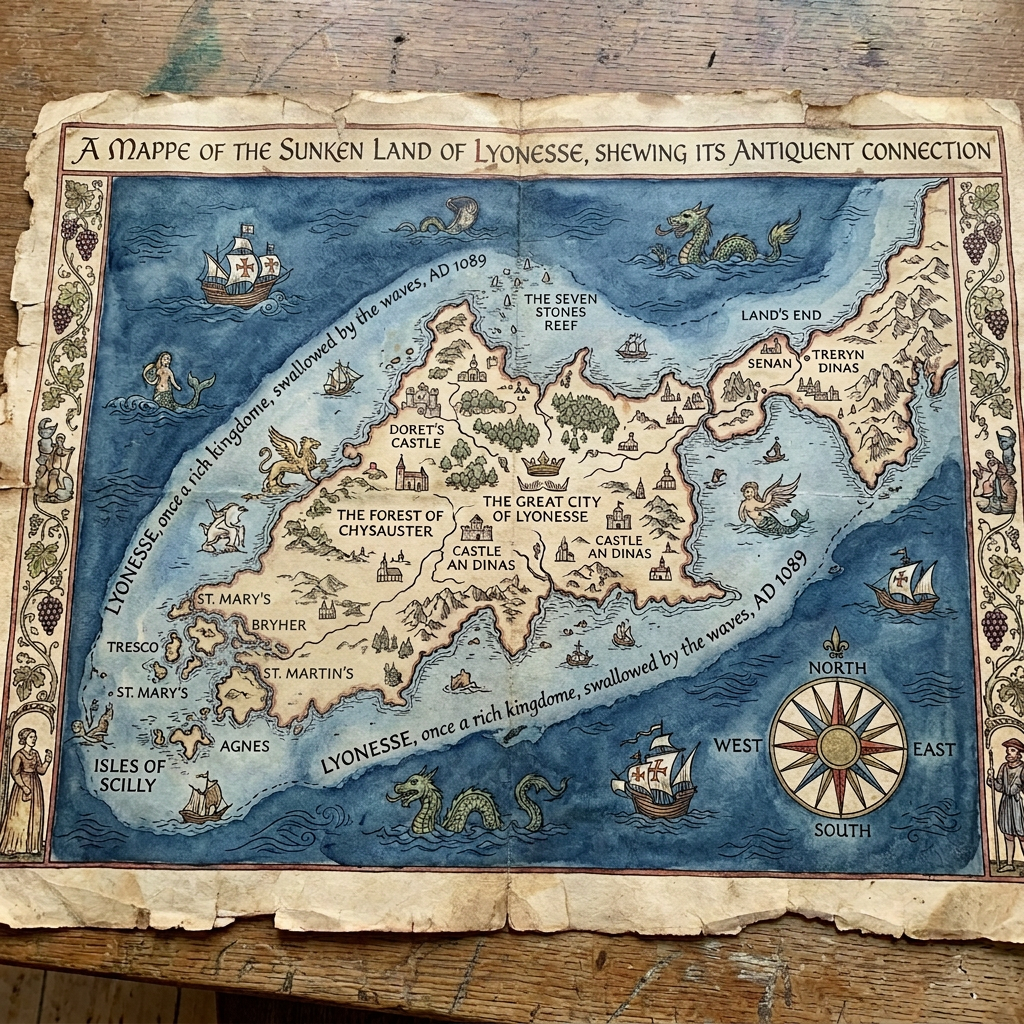
Concerning Lyonesse, The Once and Future King, and Those Who Dwell Beyond the Veil
There are places in Cornwall where the land remembers what the living have forgotten. I’ve always held that Lyonesse is one of them, though a body would be hard pressed to say precisely where it lies.
The old stories place it between Land’s End and the Isles of Scilly, a fair country of villages, churches, and fertile fields, swallowed by the sea in a single terrible inundation. Some say its bells can still be heard beneath the waves when the weather turns, though I’ve never heard them myself. But I’ve listened, mind you, on more than one occasion.
Now, the learned folk will tell you that Lyonesse belongs to the Arthurian romances, particularly the tales of Tristan and Iseult, and that the drowned kingdom of Cornish tradition owes something to older memories of the sea’s encroachment upon the land. Lillian would undoubtedly remind me that a legend is not a geological survey. She’s quite right, of course, though I don’t see why that should settle the matter.
For the old tales seldom tell us what became of those who vanished.
And therein lies the difficulty.
A land may sink beneath the waves, but must everything that belonged to it perish? The houses, perhaps. The roads and churches, certainly. But what of the names, the promises, the griefs, and the things that lived there before men thought to build upon it?
I’ve long suspected that Lyonesse was not merely a kingdom lost to the sea, but a place where the boundary between our world and the Otherworld grew perilously thin. Whether the waters swallowed the land or the land slipped beyond our reach, I cannot say.
Perhaps both are true, in their fashion.
The Fae have always been troublesome where boundaries are concerned.
They are not the pretty little creatures that decorate children’s books. The older traditions speak of beings who inhabit hills, pools, islands, and places where the ordinary rules of time and distance cannot be relied upon. Some are generous, others cruel, and many appear entirely indifferent ot the distinction.
A gift may become an obligation. A kindness may demand repayment. A promise, carelessly given, may bind the speaker long after its meaning has been forgotten.
And time, in their country, is a slippery thing.
A traveller may spend a single evening beneath an enchanted hill and return to find that generations have passed. Or so the tales would have us believe.
I do not claim that every Cornish account of the Fae is ancient, nor that the stories have come down to us unchanged. They have travelled through many mouths and acquired a good deal of embellishment along the way. But there is a persistence to certain warnings that I find difficult to dismiss.
- Never accept a bargain whose terms you do not understand.
- Never assume that a beautiful thing is harmless.
- And never mistaken an invitation for permission to return.
Which brings me to Arthur.
The old king belongs to history, legend, and something that lies uneasily between the two. Scholars may argue whether he ever lived, but the stories have endured for centuries. They place him in battles, courts, enchanted forests, and finally upon a journey from which he does not return.
Avalon.
The island of applies. The place where Arthur is carried after his last battle, wounded but no necessarily dead. A land of healing, of waiting, and perhaps of eventual return.
I have sometimes wondered whether Avalon and Lyonesse are not two expressions of the same mystery.
Lyonesse is the land that was lost.
Avalon is the land to which the lost are taken.
One disappears beneath the water; the other lies beyound the reach of ordinary men. Both exist at the edge of the known world, and both preserve the possibility that disappearance is not the same as destruction.
But I must be careful here.
It is tempting to gather every legend of a vanished kingdom, an enchanged island, or a sleeping king and declare them fragments of a single forgotten truth. I’ve done something very like it myself, and Lillian has never allowed me to forget the occasion.
The stories may resemble one another because they arose from the same ancient belief. Or they may resemble one another because human beings, faced with loss, have always imagined somewhere beyond the horizon where what they love might continue to exist.
There is comfort in the thought.
And danger, too.
For it we persuade outselves that everything lost must be waiting somewhere to be recovered, we may spend out lives searching for doors that were never meant to open.
Still, I cannot quite dismiss the old connections.
The sea around Cornwall has taken land, ships, and lives beyond counting. The moors conceal ancient stones whose purposes remain uncertain. There are places where the mist settles strangely, where familliar paths appear altered, and were a person may experience the peculiar sensation of being watched by something that has no intention of revealing itself.
Are these entrances of the country of the Fae?
I cannot say.
But if the old stories preserve any practical wisdom, it is that the Otherwold does not necssarily welcome those who seek it.
Arthur was carried to Avalon. He did not conquer it.
Lyonesse was lost. No king restored it.
And the Faie, if they exist as the tales describe them, have never shown much inclination to explain themselves to mankind.
Perhaps that is the lesson hidden beneath all three traditions.
We humans are forever demanding explanations. We name things, map them, catalogue them, and imgaine that in doing so we have brought them under our authority.
Yet the sea continues to rise and fall without troubling itself over our histories. The stones remain silent. And the old stories change a little with every telling.
I should like to believe that somewhere beyond the western horizon there is a country where nothing truly loved is ever lost.
But belief is not knowledge.
And longing, however sincere, is not proof.
I shall leave the matter there for tonight.
Though I may yet walk down to the shore when the tide is low. There is a particular stretch of water beyond Pendennis where the mist sometimes gathers in a most pecular fashion.
Written beneath a waning moon, with the wind rising from the west:
What the sea takes, the heart remembers.
(a note in the margin, added later)
What the Fae keep, no mortal measures.
But not every door that opens is an invitation.
And not everything that is lost is waiting to be found.
Leave a Reply