
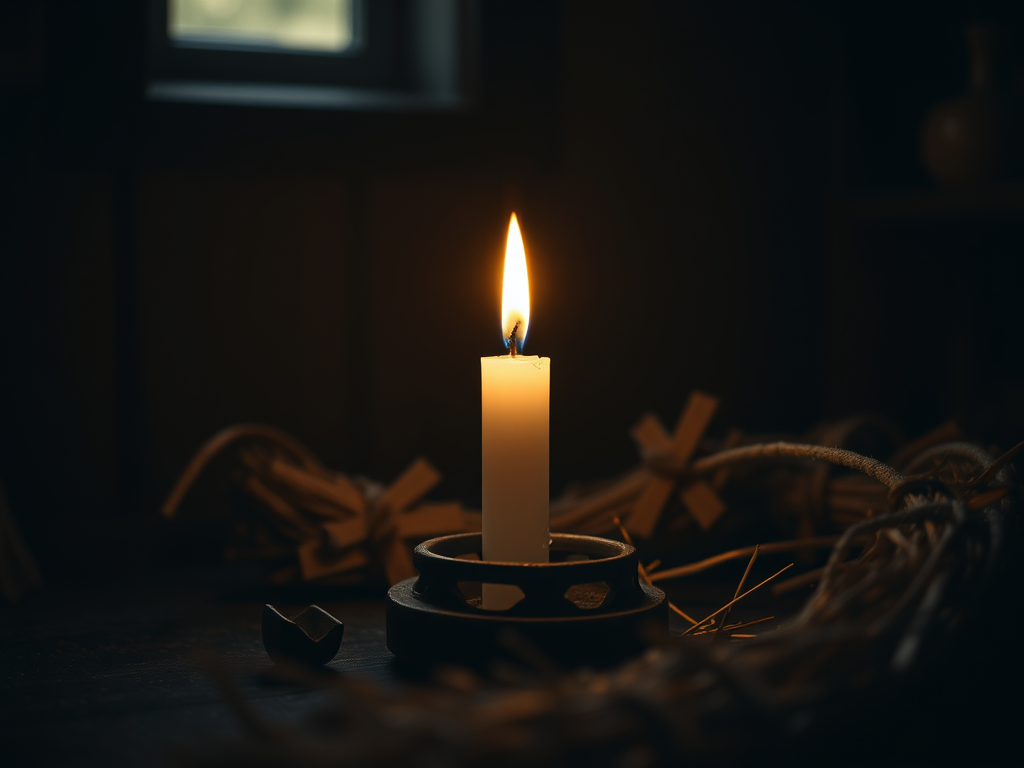
The ancient festival of Imbolc celebrated around February 1st, marks a time of purification, hope, and the return of light. Associated with the Celtic goddess Brigid, this midway point between the Winter Solstice and the Spring Equinox has long been a celebration of renewal and the first stirrings of spring. However, for those familiar with the Heart of Shadows, the energies at play during Imbolc are far more complex and unnerving. In certain folklore circles, the Heart of Shadows is believed to have thrived during this period, transforming the promise of new beginnings into a portal for manipulation, psychological influence, and the shadowy fringes of human belief.
The Psychology of Belief: Tanya Luhrmann’s Perspective
To understand how the Heart of Shadows may exert its influence during Imbolc, we turn to the work of Tanya Luhrmann, a renowned anthropologist and psychologist whose research explores how people come to experience the supernatural as real. In her book When God Talks Back, Luhrmann delves into how immersive practices and intentional cognitive framing shape religious and supernatural experiences. She argues that through focused attention, prayer, and ritual, individuals can train their minds to perceive invisible agents, making the supernatural feel as immediate and tangible as a physical presence.
Luhrmann’s research offers a lens through which we can examine the folklore surrounding the Heart of Shadows, an artefact said to enhance or distort the emotions and perceptions of those who come into contact with it. When linked to a festival like Imbolc—known for rituals that invite purification and illumination—, one can see how the Heart might twist these very intentions, using the focus and heightened expectations of participants to amplify darker emotions such as paranoia, fear, and self-doubt.
Imbolc and the Folkloric Influence of the Heart of Shadows
Traditionally, Imbolc rituals involve the lighting of candles, the making of Brigid’s crosses, and the cleaning of hearths—symbolic acts meant to cleanse away the old and make room for new growth. However, those who are aware of the Heart of Shadows’ legend are warned against participating too zealously, for it is said that when such rituals are performed in the presence of the Heart, they do not drive away darkness but instead attract it.
According to local Cornish folklore, a chilling incident occurred in 1873 when a group of villagers from Falmouth gathered for Imbolc. They reportedly invoked the blessing of Brigid to cleanse a piece of land that had been plagued by misfortune. Unbeknownst to them, a relic—thought to be linked to the Heart of Shadows—had been buried on the site. The rituals that were meant to dispel negative energies instead brought on a series of strange occurrences: crops withered overnight, livestock went mad, and several participants reported vivid hallucinations of shadowy figures moving through their homes. It is said that this encounter left a lingering darkness over the area that took generations to dispel.
Cognitive Influences and Imbolc Rituals: A Dangerous Combination
Luhrmann’s theories help to explain how such experiences might unfold, particularly during festivals like Imbolc that center around ritual and heightened expectations. She posits that when people engage in repeated acts of prayer or ritual, focusing their attention and deliberately altering their mental state, they may enter a sort of “absorption” where they become more receptive to suggestion and more likely to interpret ambiguous stimuli as supernatural. In this vulnerable state, even minor disruptions—a flickering candle, an odd shadow—can take on outsized significance.
Already primed to experience a sense of purification, participantsWhen applied to the folklore of the Heart of Shadows, this theory suggests that the relic’s alleged power to corrupt and manipulate perceptions could be an intensification of natural cognitive processes. Imbolc, with its promise of cleansing and renewal, becomes the perfect stage for this psychological manipulation. Participants, already primed to experience a sense of purification, may instead find themselves haunted by inexplicable dread, shadows at the edges of their vision, or an overwhelming sense that something has gone terribly wrong.
The Heart of Shadows and Modern Parallels
One only needs to look at recent history to see this dynamic. In 2022, New Age practitioners gathered in Falmouth for an Imbolc ritual designed to “reawaken” the town’s connection to its pagan roots. The ritual occurred at a site rumoured to be linked to the Heart of Shadows. What began as a simple ceremony quickly devolved into chaos. Several participants reported panic attacks, inexplicable chills, and vivid dreams of being pursued by a shadowy entity. In the aftermath, many blamed the incident on group hysteria. Still, those familiar with Luhrmann’s research suggest that the ritual itself—combined with the lore of the Heart—created the perfect psychological storm.
The Cornish Folklore Museum, which had recently hosted an exhibition on the Heart of Shadows using Professor Bruce Hood’s research to illustrate the psychological power of belief, became a focal point for renewed interest in the artifact. Hood’s work, which explores how supernatural beliefs can influence behavior and perception, echoes Luhrmann’s findings. Both scholars highlight how belief, once seeded, can grow beyond rational control, leading people to act in ways they might never otherwise consider.
Imbolc’s Dual Nature: Renewal and Danger
Imbolc is a time of hope and new beginnings, but in the presence of the Heart of Shadows, it becomes a time of perilous transformation. Luhrmann’s research reminds us that the line between belief and reality is often thinner than we think, and that when powerful symbols like the Heart are introduced into the ritual space, they can amplify fears and desires to dangerous levels.
For those who wish to explore this eerie intersection of folklore and psychology, a visit to Mystic Reads, a popular occult bookshop on Falmouth’s Old High Street, is recommended. There, Sylvia Moon—a hereditary West Country witch whose own husband, Jonathan, disappeared under mysterious circumstances connected to the Heart—offers insight and guidance. But be warned: engaging with the Heart of Shadows, especially during powerful ritual times like Imbolc, is not for the faint of heart. As Luhrmann and Hood’s work suggests, what begins as a simple exploration of folklore can quickly spiral into an encounter with forces far darker than we could have ever imagined.
Leave a Reply