
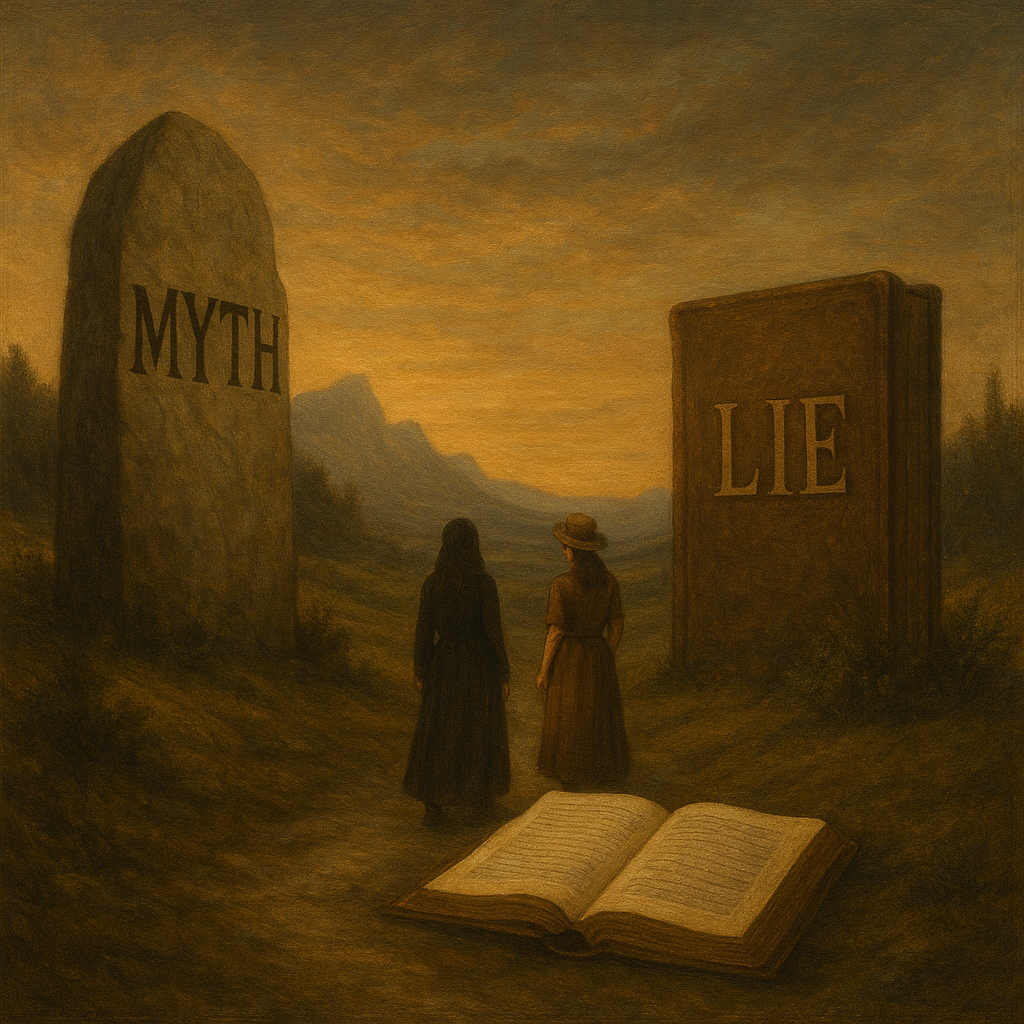
John Ruskin once wrote, “Never confuse a Myth with a lie.” With this single line, he opens a door onto something both ancient and urgent. What is a myth, really? And what harm is done when we mistake it for a lie—or a lie for a myth?
To Ruskin, a myth was a bearer of timeless truth. It might never have occurred in a literal sense, but it carried moral and spiritual resonance. A lie, in contrast, was hollow. It sought to deceive. In his view, a myth uplifts the imagination; a lie manipulates it.
This distinction is more than academic. It shapes how we live, how we love, how we make meaning of pain, and how we chart a course forward in a world full of both poetry and propaganda.
The Existentialists Respond
Kierkegaard might see myth as the theater of faith—the irrational yet deeply necessary leap into meaning. Nietzsche, ever the hammer, would treat myth as the forge of values: a self-made fire against the cold machinery of truth-as-fact. Sartre, the ironist of freedom, would say myth becomes a lie when we let it do our choosing for us.
Each of them agrees on this: the lie is not invention, but abdication—a surrender of the responsibility to choose, to interpret, to live.
Sylvia Moon: The Witch Who Knows the Veil Is Thin
Sylvia would take Ruskin’s warning to heart—and then mutter something about how he nearly got it right. To her, myth is more than metaphor; it’s membrane. A whisper from the other world. The tale of the Heart of Shadows isn’t a bedtime story—it’s a warning, a memory, a spell waiting to be activated.
Sylvia doesn’t believe in myths. She works with them.
She would agree with Kierkegaard’s reverence and Nietzsche’s instinct, but warn that both men undervalued the living presence of myth—the way it breathes through land, wind, bloodlines. Sartre’s concern about bad faith? A necessary caution, but he was too quick to sever soul from symbol.
To Sylvia, the lie is not in the telling of myth—but in pretending it’s just a story.
Lillian Hartley: The Scholar Seeking the Symbol’s Shape
Lillian, ever the pragmatic academic, would parse Ruskin’s line with precision. To her, the myth is a pattern—an echo in the psyche that reveals our longings, fears, and hope for redemption. She might quote Jung or Tarnas or even Ruskin himself in her book The Cosmic Dance of the Soul, arguing that myths give shape to the ineffable.
She would admire Kierkegaard’s passionate inwardness but wince at his theological absolutism. Nietzsche would fascinate her, but she’d challenge his dismissal of collective tradition. Sartre, she’d say, makes a vital point: we mustn’t let myth harden into dogma. But we mustn’t discard it either.
Lillian knows the mind can lie to itself more easily than the heart can. Myths, she believes, offer a way home—if you read them well.
Between Them: A Living Dialogue
Sylvia and Lillian walk the boundary Ruskin marks. Sylvia listens to the murmurs of the myth. Lillian deciphers its grammar. Together, they know the danger isn’t in the story—it’s in forgetting why we tell it.
When myth is used to justify cruelty, silence dissent, or cover up injustice—it’s no longer myth. It’s a lie dressed in robes.
But when myth reminds us that we’re part of a story too vast to see from the inside, it becomes an act of truth-telling. It becomes a way to live with meaning—not merely with information.
The Final Word
“Never confuse a Myth with a lie,” Ruskin wrote.
Sylvia would nod and whisper, “There’s truth with teeth behind that.”
Lillian would sigh, close her book, and add, “Yes—but we still have to teach people how to read it.”
And maybe that’s the point. The myth asks us to participate. The lie asks us to submit. One opens the soul; the other shuts it down.
So next time you find yourself drawn to a story—whether whispered by wind or broadcast by screen—ask yourself:
Is this myth or manipulation?
Is it calling me to become more human—or less?
Because Ruskin was right.
The difference is everything.
Leave a Reply