
“Learn to draw,” John Ruskin once urged—not to become an artist, but to become more fully human. He wasn’t talking about making pretty pictures. He was talking about learning to see.
Ruskin believed that the act of drawing trained our eyes to perceive with intention. Not to glance, skim, or project, but to perceive—to let the world reveal itself to us, on its terms. In that quiet but radical suggestion, Ruskin anticipated a whole philosophy of perception. One that Martin Heidegger, writing half a century later, would echo with urgency.
Both men wanted us to slow down. To attend. To stop treating the world like something to conquer or use, and instead regard it as something that is—and more importantly, something that is of something else.
This might sound simple. It is not.
A 2500-Year Problem
Heidegger believed that Western philosophy had gone wrong—very wrong—by asking the wrong question. For over two millennia, we’ve focused on “What does it mean to be?” when we should have been asking, “What does it mean to belong? To be of something?”
The culprit, in his eyes, was René Descartes. With his declaration “I think, therefore I am”, Descartes split the world in two—subject and object, mind and body, self and other. Since then, we’ve been trapped in that split. The ‘I’ observes, judges, uses; the world becomes stuff—things to be managed, measured, manipulated.
Ruskin disagreed—so did Heidegger. And in a quieter, stranger way, so do Sylvia and Lillian.
The Faerie Method of Looking
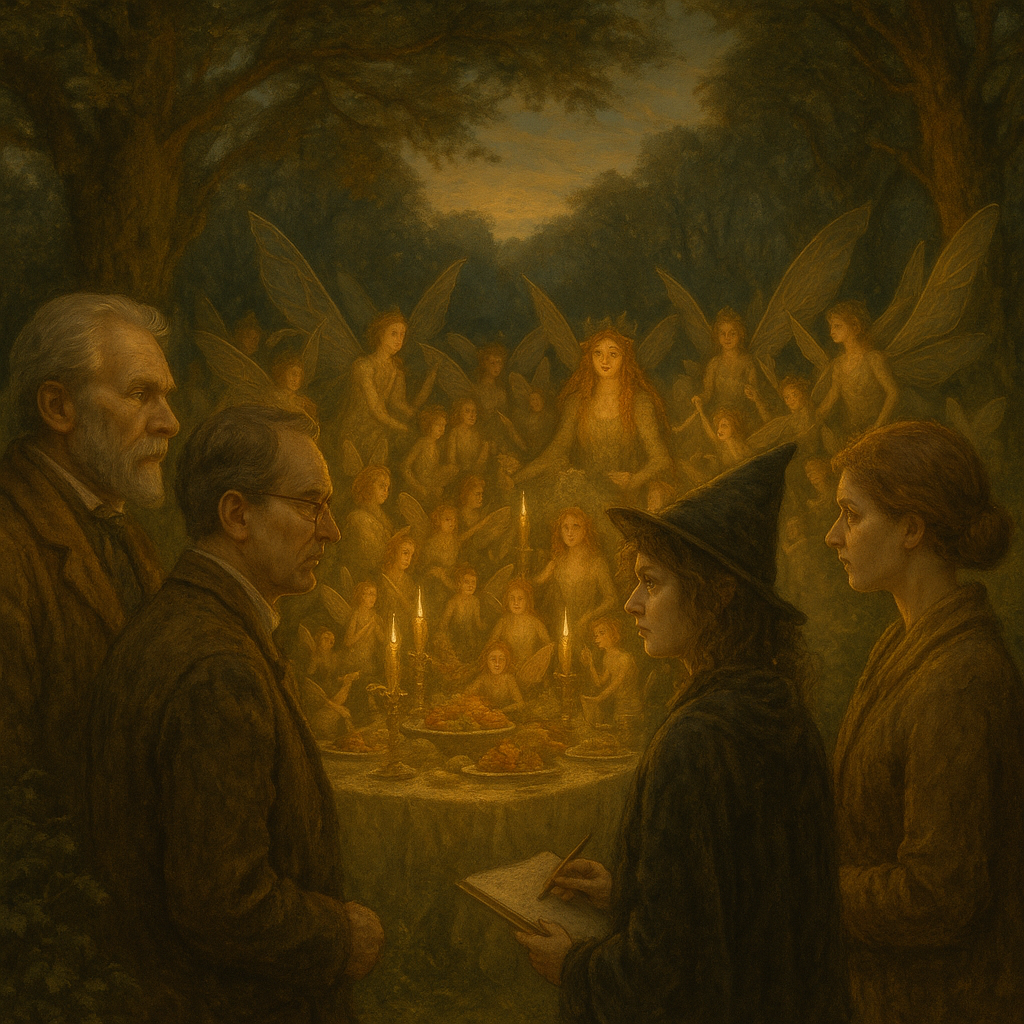
You might not expect a Cornish witch and a semi-retired scholar to join a philosophical conversation, but they do—on their own terms.
Sylvia, in particular, has never had much patience for the Cartesian worldview. She doesn’t draw lines between self and world; she listens to the land, the wind, the stones. In Faerie, where the boundary between thought and form is gossamer-thin, she once said, “You don’t find your way by pushing forward. You wait until the moss speaks.”
Lillian, the more methodical of the two, had always favored reason. But after encountering the Watcher of the Orchard—a being that could not be approached, only invited—she began to understand what Heidegger meant by Gelassenheit, or “letting-be.” The thing reveals itself when we cease to try to own it.
Drawing as Revelation
Ruskin advised students to draw not for technique, but for training the eye. “Every line you draw should mean something,” he wrote. That requires looking—not glancing, not categorizing, not assuming. Looking. Slowly. Honestly.
Heidegger would agree. He called this kind of attention phenomenology: the practice of setting aside preconceptions so the thing can appear as it truly is. Not what we think it is. Not what we want it to be. But what it reveals itself to be.
This isn’t Nietzsche’s will to power. It isn’t about bending the world to fit our story. Heidegger would call that yet another Cartesian trap: using force to extract meaning. In contrast, Ruskin and Heidegger both call us to receivemeaning.
The Cost of Not Looking
We live in a culture that confuses speed for intelligence and reaction for wisdom. The consequence? We no longer see. We scan. We label. We move on. The world becomes a blur of impressions and manipulations, and the soul goes hungry.
Sylvia once put it more plainly. “If you keep forcing the pattern, you’ll miss the message.”
In Praise of Stillness
Heidegger’s solution—like Ruskin’s—is deeply countercultural. He tells us to be still. To observe. To wait.
In Faerie, Lillian learned that some knowledge cannot be seized. It must be befriended. The most profound truths often appear sideways, not when we demand answers, but when we relinquish our hold.
Ruskin would have called that the artist’s humility. Heidegger would have called it being attuned. Sylvia just calls it common sense.
So What Do We Do With This?
We start where Ruskin told us to start: with seeing. We train the eye—and with it, the heart. We stop assuming that knowing means controlling. We stop drawing lines between “us” and “it.” We pick up the pencil, or the brush, or the silence—and we look.
Heidegger said we must jettison 2500 years of misunderstanding. Sylvia might say we just need to go out under the stars and listen.
And Lillian? She’s back in her study, sketching the branches of a tree she now understands is not merely there, but part of her, and she of it.
Seeing is not passive. It is revolutionary.
Ruskin and Heidegger both knew that.
So do Sylvia and Lillian.
And maybe—so do you.
Leave a Reply