
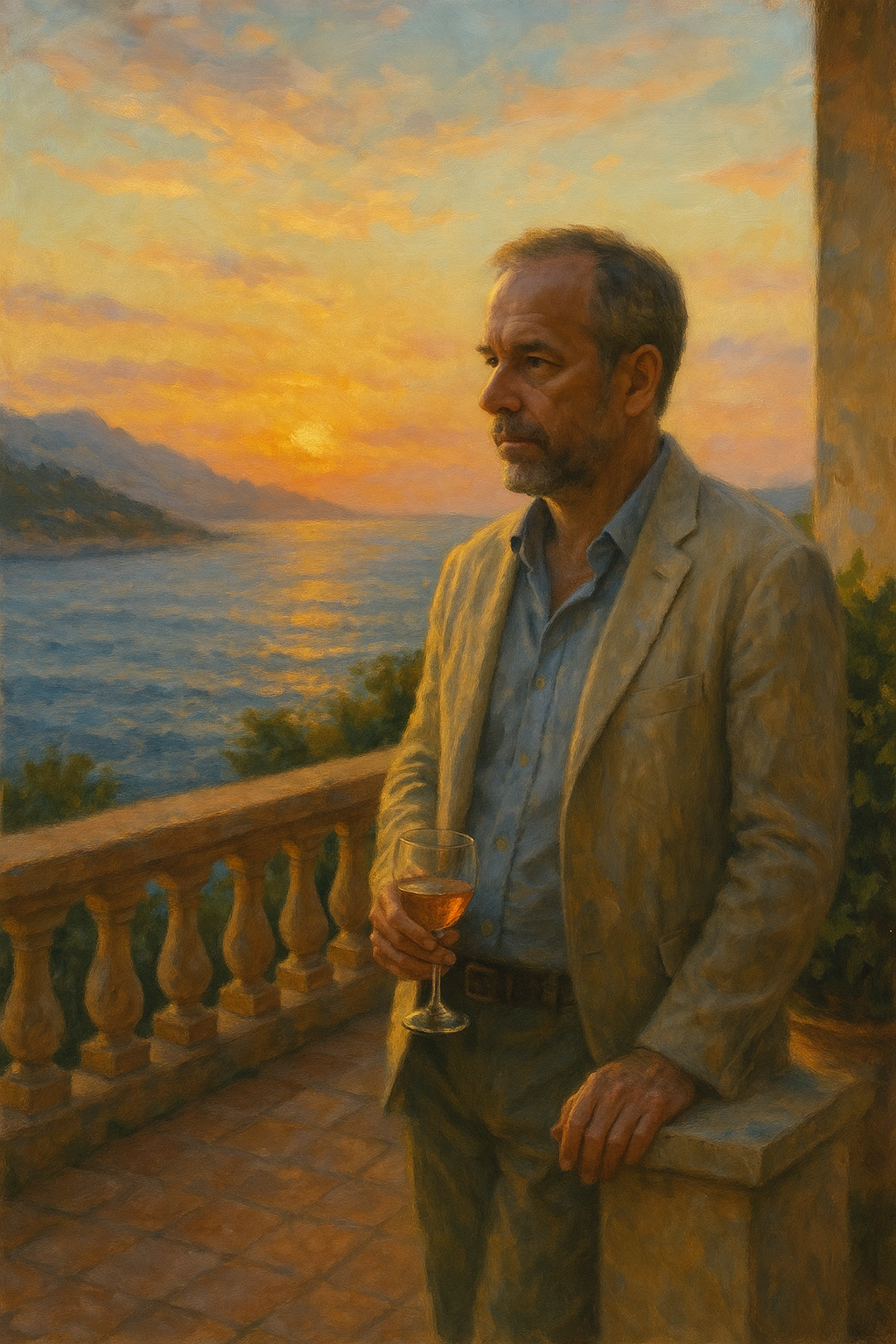
by Inspector Wren (ret’d, allegedly)
I’m writing this from a stone house on the north coast of Mallorca. It belonged to my Aunt Evelyn, who — depending on whom you ask — is either dead, missing, or “off the grid in Menorca.” No one has seen her in over two years. The paperwork suggests she’s gone. The neighbours insist she still sends postcards.
The villa came to me by way of her last will and testament (one of them, anyway). I didn’t contest it. What would be the point? Evelyn was always full of surprises — and frankly, after resigning from the Met and being hounded out of Falmouth, I had nowhere better to be.
And so, I find myself here. Sherry at six. A sea breeze that smells of thyme and salt. A balcony that looks out on the water like it’s expecting a ship that never comes.
The thing is — I don’t hate it.
I thought I would. But time moves differently here. And that, oddly, brings me to Virginia Woolf. Because apparently everyone I know — Sylvia, Lillian, even Veronica (from across the Atlantic in some windswept New York exile of her own) — has decided that Woolf is the map back to their souls.
And frankly, I refuse to be left behind.
Let’s get one thing clear: I don’t like Woolf. I didn’t like her at school, and I haven’t warmed to her in exile. The only thing that ever lingered was Orlando — not because I admired it, but because it annoyed me so thoroughly that it stuck.
A centuries-spanning love letter? A character who swaps genders, gallops across time, and ends up weeping in the rain? Indulgent. That’s the only word for it.
And yet.
There’s something in it I can’t shake. The idea that time is shaped by memory — that the years don’t really pass, they fold and unfurl according to what we remember, what we repress, what we can’t stop seeing out of the corner of our eye.
Here in Evelyn’s villa — and yes, I still call it hers — the past feels remarkably close. Her dressing gown is still on the back of the bedroom door. The garden grows as if she never left. The neighbours leave extra vegetables at the gate, “in case she returns.”
I sit on the terrace and drink sherry she probably stocked. And I think about Veronica. About Sasha. About all the Sashas — those people we’ve loved, lost, or tried to outlive. And I remember that moment in Orlando, when Woolf writes that “Sasha the memory” proves to be surprisingly real.
That line — that idea — haunts me more than I care to admit.
Evelyn may be dead. Or not.
Sasha may be memory. Or not.
Veronica may be gone. Or still watching.
I don’t know anymore.
But the sunset is coming on strong, and the shadows are pulling longer. It’s always sunset in novels, isn’t it? Woolf knew what she was doing. Time isn’t ticking — it’s pulsing. It remembers.
Another glass, then.
If memory builds time, then this moment — this ridiculous, quiet, golden moment — is mine to ruin or keep.
— Wren
Wren is pouring his second glass of sherry. He’s reread his own blog post with a kind of amused detachment — never trust what you write after sunset, he tells himself. The light’s too golden. You forget things matter.
He stands to close the terrace doors — a chill rising from the sea — and notices a book on the small shelf in the corner of the sitting room. One he hadn’t seen before. It’s not his. He’s sure of it.
A slim, clothbound copy of The Waves by Virginia Woolf.
He frowns.
He picks it up. The spine cracks like it hasn’t been touched in years. There’s a pressed flower between pages 98 and 99. Sea lavender, maybe. Still faintly purple. Still fragrant.
There’s a note tucked behind it. One line. In Evelyn’s unmistakable looping script.
“Time only matters if you remember who you are inside it.” — E.
There’s no date. No return address. Just the flower. And the sense that this house may not be finished with him yet.
Comment on Wren’s Blog Post
Posted by: Veronica
You always did underestimate Woolf.
Or maybe it’s not Woolf you underestimate — maybe it’s yourself.
You write about Sasha and memory and time as if they’re ideas. Theoretical. Literary. But I knew you then. And I remember what you didn’t say.
We all walked away from something. I crossed an ocean. You inherited a ghost. But I never stopped looking back.
You left the Met for me, and I never said thank you. I’m not saying it now. Not quite. But I will say this: stop pretending the sunset is enough.
You’re not done. I know you. You’re still bleeding beneath that tan.
When you’re ready to say the rest of your sentence — you know how to find me.
— V
Leave a Reply