
by Veronica
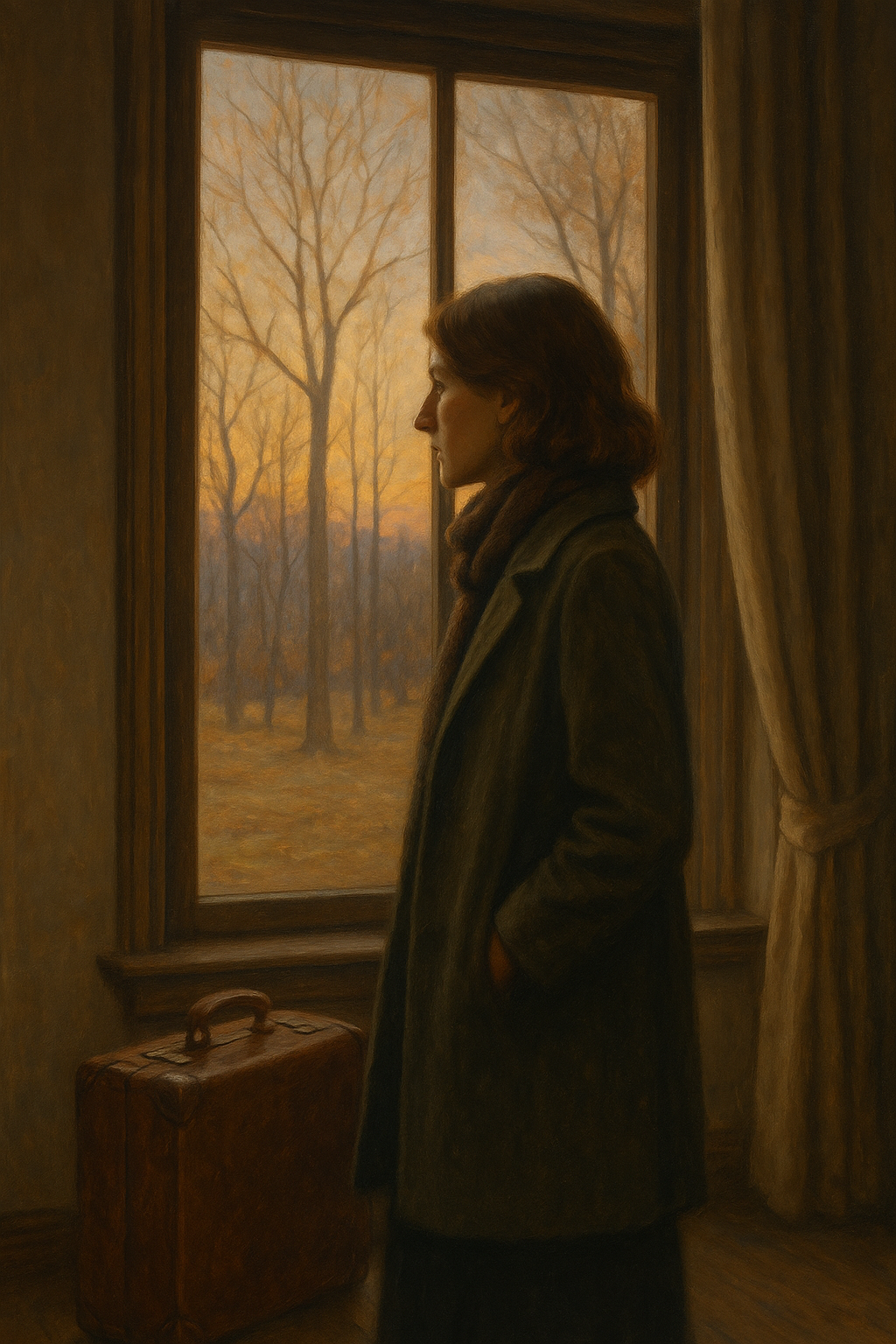
I’ve packed most of it. The notebooks. The teacups. The raincoat with the pocket full of pine needles I can’t explain. I’ll leave the iron kettle — it belonged to the bakery’s owner, and though she calls me “our mysterious boarder” with a wink, I suspect she’ll be glad to reclaim both attic and quiet. Nine months is a long time to hide in upstate New York above the scent of sourdough and cinnamon, even for me.
No, I’m not going back to London. Not yet. And I won’t be darkening the door of the flat in NYC where I apparently still have “more friends than I care to acknowledge” — their words, not mine. They’re welcome to brunch without me.
Christmas is coming sooner than anyone expects. I might spend it in Austria. Or Denmark. Somewhere with snow and the kind of windows that look like they’ve been waiting for a woman in a wool coat to pause beside them. I may stop in Mallorca. Just to check on Wren.
Yes, I’ve been writing to him. Sylvia gave me the address. She said he wouldn’t reply — that he’s “reflecting” — but that doesn’t stop me. Scrying, Sylvia says, can reveal certain truths. But so can two women in a Falmouth bookshop who’ve seen enough of the world to know when a man is holding a torch, even when he won’t admit it.
They say he reads my letters like they matter.
And maybe that’s enough, for now.
I tried the Virginia Woolf route. Everyone else seemed to find some holy map between her pages — Sylvia and Lillian, with their candlelit arguments and mystical comparisons. But for me? No. To the Lighthouse felt like an ache I couldn’t name, and Mrs. Dalloway like a party I’d already left. I needed something colder. More American. And oddly — older.
Enter Henry James.
Portrait of a Lady.
I’d read it once in university, when I still believed moral failure was a literary concept and not a day-to-day dilemma. This time, something shifted. Isabel — poor, brilliant Isabel — at the end of it all, walks back into the fire. Not because she must. But because she believes it’s what virtue demands. Duty. Reputation. Identity. That sword she’s trained to fall on.
But here’s what stopped me cold.
The door to that cage?
It’s always been open.
That’s what James gets right. Paradise Lost, indeed — but not because of some demonic fall from grace. No. It’s the moment a woman realises she’s been carrying a weight that doesn’t even belong to her. That her life has been inherited, not chosen. That the story she thought she was living was drafted by other people long before she ever arrived.
And she walks back into the cage anyway.
Not me.
No. I’m not Isabel Archer. I know I could be — I’ve rehearsed the lines. I could retreat. I could become the eternal witness, the penitent. I could go back and martyr myself on the altar of how things ought to be.
But I won’t.
The attic is cold now. The leaves outside have gone from golden to skeletal. I think I’ll leave before the first snow.
Whatever I do next — and I’m not quite sure what that is — I’ll do it knowing the score. I know how the story ends if I surrender. I know the shape of that death.
But what if the breakthrough — the real one, the one even my therapist (sweet man, bless his cotton socks, still terrified of women like me) never saw coming — comes not from atonement, but abandonment?
I’ll send a postcard.
Or not.
But I’ll be gone by morning.
And the door will swing shut behind me.
— V.
Front of the postcard:
A weathered stone chapel above a wild Cornish bay. Winter roses bloom against the wind. The path leading to it looks as though it appears only when you know to look for it.
Postmark:
Chapel Porth, Cornwall — 24 December, 10:03 PM
Message (written in Veronica’s spidery black ink):
My dear Sylvia & Lillian,
I meant to be in Vienna by now. Or possibly Copenhagen. But the train never came, the sky turned, and somehow I found myself here — back in Cornwall, though not quite anywhere I’ve ever been before.
I’m writing this from a shepherd’s hut behind an old chapel above the bay at Porth. It’s not on the map, and the woman who runs the pub in town swears it hasn’t been used in decades. But winter roses are blooming at the threshold, and the wind carries a scent like candle smoke and salt.
The odd thing is — the basin I brought to scry? When I set it down outside and poured in fresh water, the surface didn’t shimmer. It turned black. Not murky. Black. Just for a moment. I didn’t read it — I couldn’t. But I felt… watched. Or welcomed. I’m not sure which unsettles me more.
I’ve been thinking of Howard. And not just the man I murdered, but the legacy — the shadows he followed. I always thought the story ended with him. But what if it began long before he was even born?
This isn’t hiding. This isn’t repentance. This is something else.
Merry Christmas, you wild and glorious women. I’ll stay here through Twelfth Night. Maybe longer. There’s something about this place — something folded in time, something I may have been meant to find.
Whatever stirs next… I suspect we’re all in it.
With love from the edge,
V.
Leave a Reply