
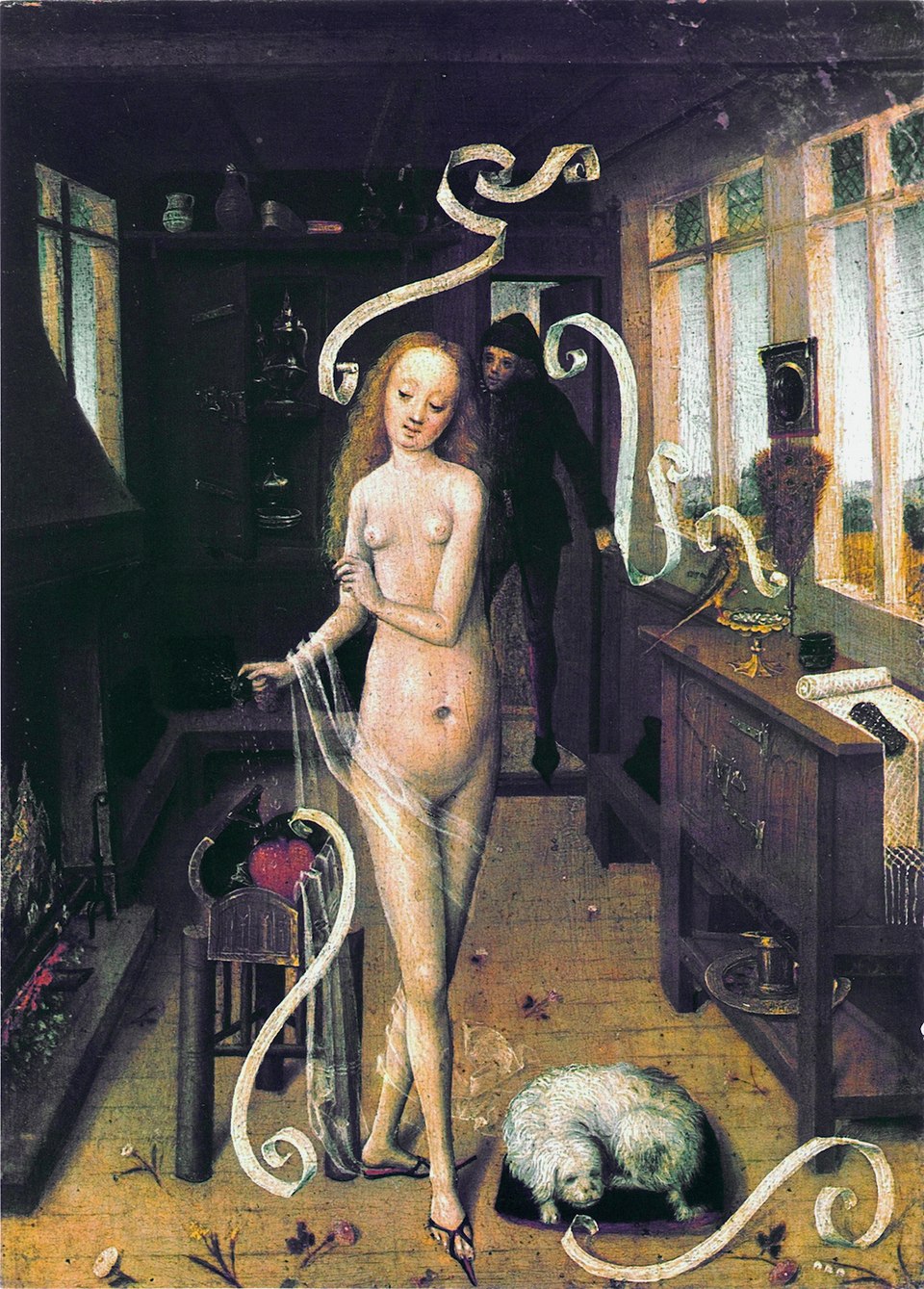
The painting Love Magic (1478–80), now in the Museum der Bildenden Kunst in Leipzig, offers a striking entry point into the medieval entanglement of science, religion, and magic. A young woman, nude but for delicate shoes and a transparent veil, sprinkles powder over what appears to be a heart in a casket. In the fifteenth century, the heart was no mere organ; it was the seat of the soul, conscience, and passions. Wealthy elites sometimes even had their hearts removed and buried separately, underscoring its symbolic weight. Here, the heart functions as a sympathetic substitute for the beloved.
The scene is drawn from a recipe for curing amor hereos—love sickness—preserved in a manual once owned by a Dutch priest. The instructions begin with a prayer to the Christian God for power over demons, then call upon Venus, the Roman goddess of love, and specify that the ritual be performed on Friday, her day. In one act, the practitioner invokes both Christ and a pagan deity. Already, this single ritual crosses three domains: medical treatment, magical operation, and religious invocation.
The painting is carefully staged to accentuate this ambiguity. Why is the woman nude, save for her veil and elegant shoes? Nudity here may signal vulnerability, purity, or ritual power, while the shoes root her firmly in the domestic world—this is no wild witch of folklore, but a young woman of refinement. The objects scattered around her double the message. Flowers on the floor evoke natural fertility and fleeting passion; the vessels of oils and ointments suggest medicine; the mirror, book, and blank scroll align her with clerical or scholarly forms of ritual. Together, these cues blur the line between household magic and learned magic. Even the composition invites us into this fusion: the viewer occupies the same position as the young man in the doorway, voyeur to a private act that could be read as healing, devotion, or transgression.
At her feet, the small white dog sleeps peacefully, symbol of fidelity and domestic comfort. Its presence highlights the irony: love’s faithfulness is being manufactured, or perhaps betrayed, through artifice.
It is worth remembering that much late-medieval and early Renaissance art and literature was not meant to be read as documentary but as provocation—allegory, fantasy, or moral puzzle staged for the viewer’s imagination. Love Magic may have offered little more than a playful fiction, an invitation to contemplate desire, deception, and devotion in equal measure. Yet the very fact that it was painted with such care and dignity suggests that the question of magic—real or imagined—mattered deeply. Viewers would have been left uneasy: were they looking at an impossible tableau of imagination, or a scene that someone, somewhere, might actually attempt? The ambiguity was the point.
Far from dismissing magic as marginal, the image dignifies it with artistry, situating it in the very heart of the home. This is not a grotesque witch but a graceful, vulnerable figure engaged in an act at once intimate and dangerous. The painter may have been inviting viewers to consider whether such rituals were dangerous folly, bold agency, or something subtler: a woman claiming power within the private sphere of love. And then there is her smile—coy, knowing, almost playful. It suggests not fear of failure but expectation of success, as though she trusts the mingling of powder, prayer, and passion will bind her lover to her will. In that small expression, the ambiguity deepens: is she healer, manipulator, or optimist? The answer lies in the eye of the beholder.
Already, then, we see the overlap: religion, medicine, and magic fused together. The question remains why such overlaps flourished in medieval society—and whether, as modern psychology suggests, they ever really disappeared.
Augustine and the Demon Question
The entanglement was not accidental. Its architecture came from theology. When Augustine wrote City of God in the early fifth century, he sought to explain Rome’s disasters and delegitimize pagan worship. He did so by redefining the daimones—spirits who in Platonic philosophy were morally mixed intermediaries. Augustine collapsed them into one hostile category: fallen angels, demons. Quoting the Psalm that “all the gods of the nations are demons,” he framed all non-Christian spirits as diabolic deceivers.
This move resonated through medieval Europe. It gave Church authorities a tool to criminalize amulets, charms, and invocations. What had once been folk remedies or Platonic mediators became evidence of diabolic commerce. In effect, Augustine built demons into the very definition of magic. To whisper over a herb or to draw a symbol was no longer neutral. It was either permitted by God—or tainted by Satan.
For villagers, this was both threat and reassurance. On the one hand, priests warned that charms risked the soul. On the other, belief in demons offered explanations for misfortune and cures for despair. Doctrine condemned, practice endured. Already, the “mix-and-match” dynamic was clear: medicine, prayer, and enchantment overlapped because people needed all three to survive.
Love Sickness as Medicine and Magic
The priest’s manual that contained the Love Magic recipe demonstrates how porous boundaries were. It included instructions for beekeeping, caring for vines, making wine, diagnosing illnesses, experimenting with alchemy, and even summoning a flying horse. Magic was not cordoned off from science or religion—it was embedded in a continuum of practical knowledge.
Amor hereos—love sickness—was classified as a medical condition, a form of melancholy produced by an imbalance of humors. Treatments ranged from diet and bloodletting to incantations and talismans. The painting reflects this overlap. The heart in the casket is both sympathetic magic and a medical substitution; the prayer to God is religious; the invocation of Venus is pagan. The dog, the flowers, the ointments, and the scrolls echo the same synthesis of natural, domestic, and clerical worlds.
This is how the overlap manifested in medieval society: not as confusion but as practice. One might pray, mix herbs, and chant in the same breath. Knowledge was bricolage, a hodgepodge system that combined whatever worked—because survival demanded it.
Witchcraft and Fear
The hodgepodge, however, carried risks. By the fifteenth century, ecclesiastical and legal authorities had hardened Augustine’s legacy into witchcraft theory. The Malleus Maleficarum (1487) declared that “all witchcraft comes from the Devil.” Ambiguous rituals could be recast as diabolic pacts. The serene young woman in the Love Magic painting might be interpreted as a healer—or condemned as a witch.
This demonstrates again how the categories were not neutral but contested. Whether an act was medicine, prayer, or sorcery depended on who judged it. And yet, for ordinary people, these boundaries mattered less than efficacy. If the ritual soothed desire, if the charm calmed fever, then it served its purpose.
Modern Echoes: Are We Still Medieval?
If this medieval world seems alien, modern psychology suggests otherwise. Sophie Page asks in her Spellboundcatalogue: “Do you have a lucky object?” Most people would answer yes—or at least hesitate before denying it. According to Bruce Hood of the University of Bristol, humans are hard-wired to develop beliefs as a way to make sense of the world, and these beliefs carry manifest consequences. Magical thinking, he argues, is not a medieval relic but a feature of the human mind.
To define magical thinking more clearly: it is the belief that actions, symbols, or objects can influence outcomes in ways not explained by direct causation. We are also hard-wired to impose order through rituals around those beliefs. Crossing oneself before travel, knocking on wood, or refusing to sit at table thirteen all function as ways to control uncertainty.
Consider paraskevidekatriaphobia: fear of Friday the 13th. More than twenty million Americans admit to it. Yet a 2008 Dutch study found Friday the 13th statistically safer than other Fridays—people either stayed home or acted more cautiously. Superstition not only shapes perception; it alters behavior, producing measurable effects. Just as the priest’s manual blurred medicine, prayer, and spell, our own rituals—carrying charms, avoiding unlucky days, reading horoscopes—blend psychology, culture, and belief.
Self-help books that promise to “manifest abundance” or “rewrite your destiny” function much like medieval charms. Some cloak themselves in psychology; others openly call themselves witchcraft. Both appeal to a sense of control in an unpredictable world. The overlap remains. We are not so different from the young woman sprinkling powder over a heart.
Conclusion
The Love Magic painting captures the entanglement of magic, science, and religion in medieval society. A ritual to cure love sickness invoked Christ and Venus, demons and medicine, prayer and symbol. It was neither wholly magical, nor purely medical, nor simply religious—it was all three, at once. The priest’s manual that recorded it reinforced the hodgepodge: bees, vines, alchemy, and incantations bound together in a single vision of knowledge.
The overlap, then, was not an accident but a necessity. Faced with illness, desire, and uncertainty, medieval people drew on every available resource. Theology defined demons as boundaries, but practice blurred them. Knowledge was bricolage.
And so it remains. Hood’s work suggests humans are hard-wired for belief; superstitions like Friday the 13th still shape lives. What Augustine called demons, we might call luck, energy, or psychology. But the impulse is the same: to stitch together medicine, ritual, and prayer into fragile bulwarks against uncertainty.
The young woman in Love Magic, watched by her lover and her dog, embodies this impulse. She is healer, sorceress, and supplicant in one. Her coy smile suggests she believes the ritual will work. Her act is a mirror. In her hodgepodge of powder, prayer, and passion, we glimpse not only the medieval past but our own enduring need to believe.
Leave a Reply