
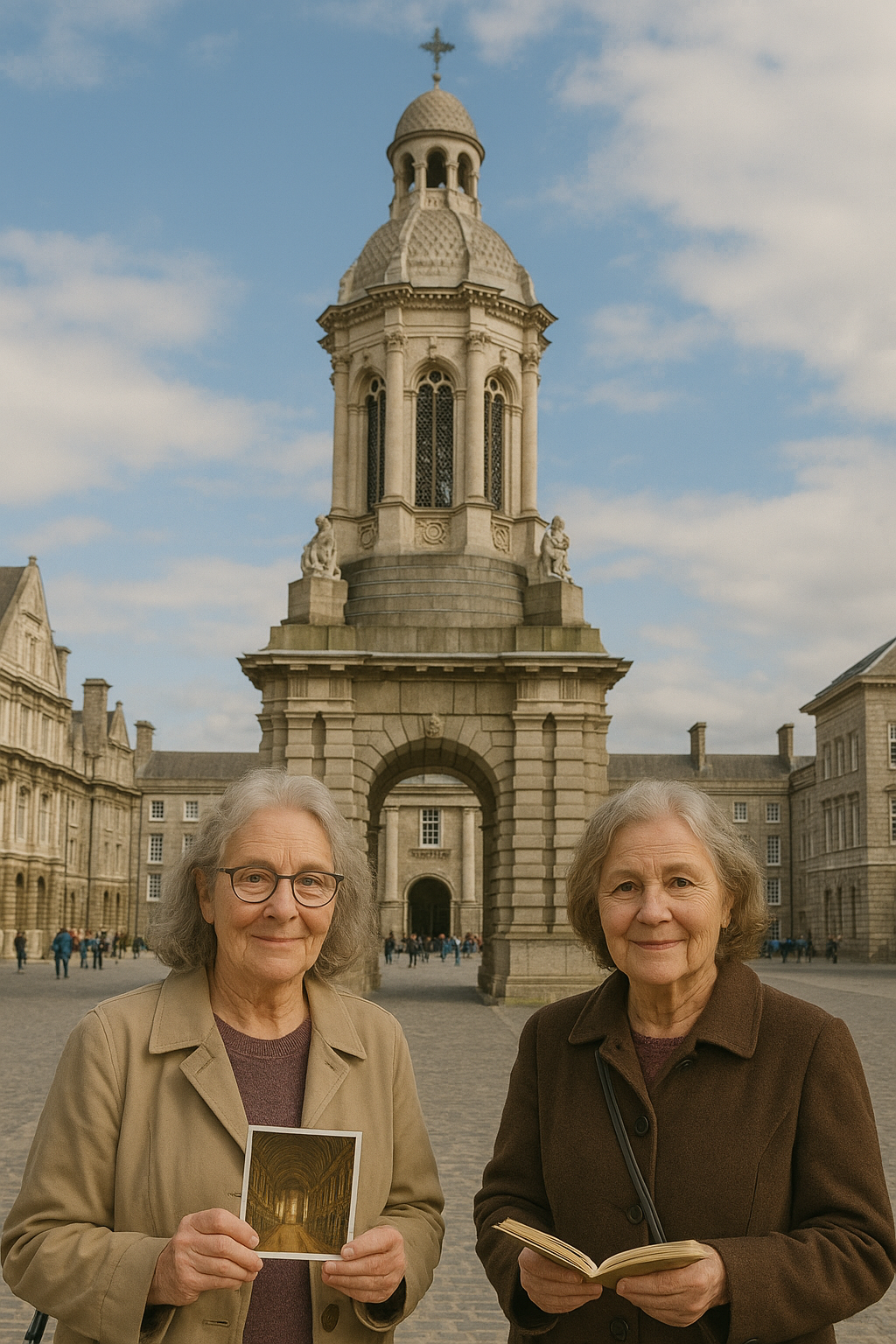
We had gone to Dublin for a quiet weekend. Or so we told ourselves.
Trinity College was meant to be the highlight — its venerable stone halls and the murmuring hush of the Long Room, where the air itself smelled of vellum and memory. I (Lillian) was eager to see the manuscripts in the Early Irish collection, and perhaps overhear a few words of Old Irish from the language students who crossed the courtyard like ghosts in jeans and hoodies. Sylvia, meanwhile, had fixed her heart on finding postcards — “the proper kind,” she said, “not the ones that sparkle when you tilt them.”
It was a blustery Saturday, the kind that made the Liffey glitter like metal. We checked into our boutique hotel, a narrow Georgian townhouse near St. Stephen’s Green. The wallpaper was peeling in a romantic way, and the lobby smelled faintly of turf smoke and jasmine tea.
After dinner — salmon and brown bread, a glass of red apiece — we took a small detour before turning in. Sylvia wanted to “walk off the hum of the city,” as she put it. I followed, reluctant but curious, notebook in hand, because I’ve learned never to dismiss her instincts outright.
We wandered toward the old library again, through a square that seemed to grow quieter with every step. The streetlamps flickered, and the night took on that peculiar texture — the feeling that the world is folding inward, becoming thinner at its edges. Sylvia stopped by an iron gate. Beyond it was a courtyard I hadn’t noticed earlier, though it must have been there all along.
“There,” she said softly. “Can you feel it?”
I could. The air was charged, vibrating like a struck chord. A group of students had gathered under the archway, whispering in Irish — or something older. One of them looked straight at us. His eyes were silver-grey, like moonlight through water.
“We shouldn’t be here,” I said.
“Then why does it feel like we’re meant to be?” Sylvia replied.
The boy smiled and beckoned. Behind him, the shadows seemed to open — not like a door, but like a thought you’d forgotten and suddenly remembered. We heard music: not the sound of instruments, but of wind passing through hollow bone, through harp strings strung on something not entirely human.
And then — just as suddenly — the courtyard emptied. The students were gone. A single page drifted across the cobbles, written in a spidery script that shimmered faintly in the lamplight. Sylvia reached for it. I stopped her, but too late. The paper dissolved in her hand, leaving only a trace of gold dust and the faint smell of heather.
“Old Irish,” she murmured. “A blessing. Or a warning.”
We hurried back to the hotel, neither of us speaking much. The city had grown watchful. Even the rain seemed to fall in patterns. That night, I dreamt of the Long Room — but the books were breathing, their bindings shifting like skin. From between their pages, pale faces stared out, whispering in a tongue I almost understood.
When I woke, Sylvia was standing by the window, her cardigan pulled tight around her.
“They followed us back,” she said. “The ones from the courtyard. I heard them singing under the streetlight.”
I looked. The street below was empty — except for three faint figures vanishing into the mist, leaving behind a faint glimmer on the wet cobblestones.
We left Dublin by noon, catching the first flight to Newquay. Neither of us bought a postcard. But when I unpacked that evening, I found one tucked inside my book from Trinity — a hand-painted image of the Long Room, with a line in shimmering script across the back:
“The veil thins wherever language remembers its own magic.”
Sylvia has since framed it, though she swears it sometimes changes — the colours shifting as though dawn were passing through it. I’ve stopped arguing. Some things, I’ve learned, prefer to be believed rather than understood.
Leave a Reply