
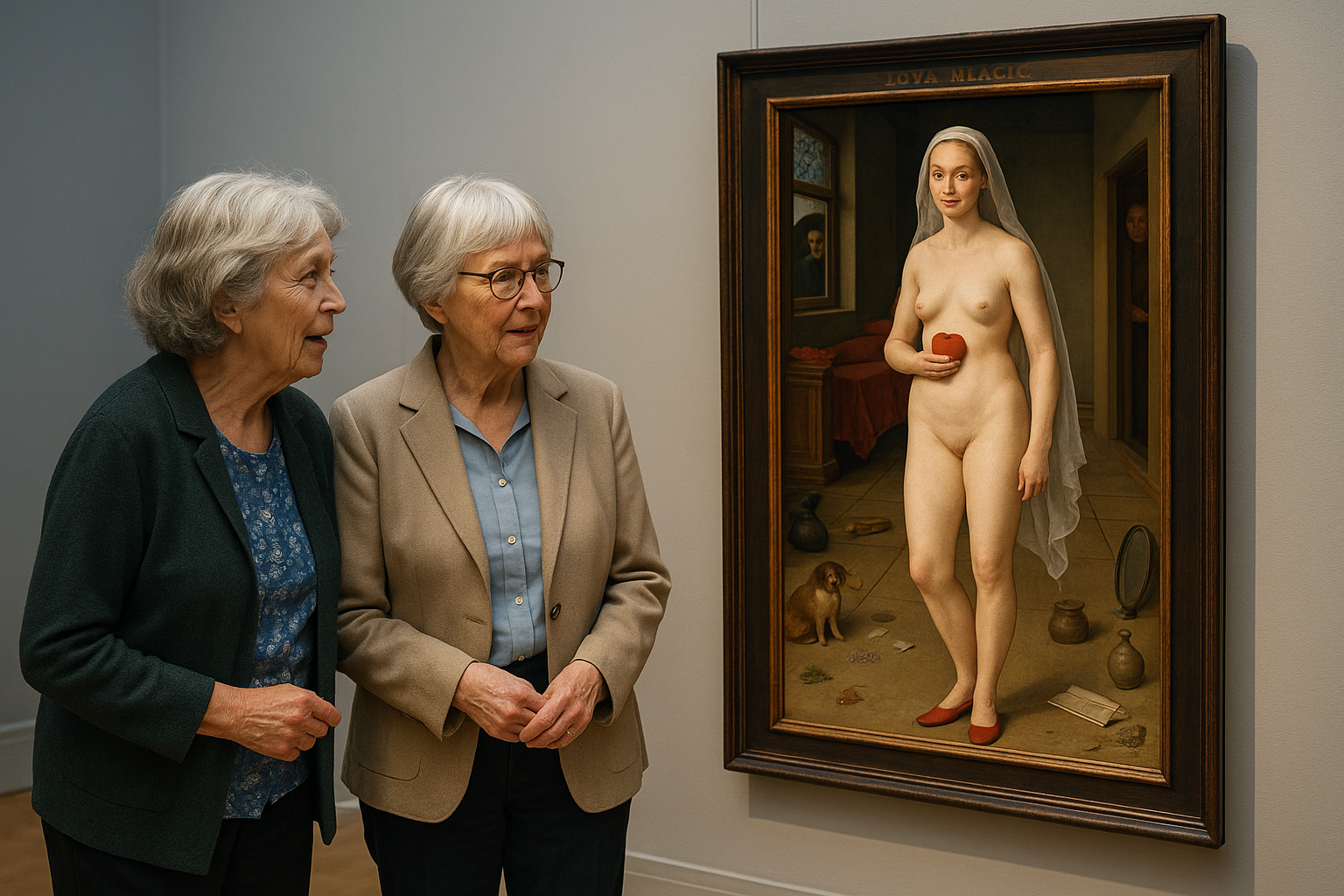
Museum der Bildenden Kunst, Leipzig
It was a cold, rain-pricked afternoon in Leipzig when Sylvia Moon and Lillian Hartley crossed the marble threshold of the Museum der Bildenden Kunst. Their coats were damp from the drizzle, the smell of wet wool and city rain trailing faintly behind them as they stepped into the hush of the galleries.
Lillian moved with the quiet focus of a scholar at home among the dead: eyes taking in wall labels, hands restless for her notebook, shoulders settling into that familiar tension of close looking. Sylvia, by contrast, regarded each painting as if it might suddenly wink at her.
“You can feel them,” she murmured, her soft West Country vowels rounding the words. “All these old souls, pressed into pigment, waiting for someone to notice.”
Lillian glanced over, the corner of her mouth quirking. “What you’re sensing is conservation-grade oil paint and a good lighting plan.”
“Mm,” Sylvia said, noncommittal. “We’ll see.”
They followed the gallery map past Italian altarpieces and German Madonnas until they reached a tall doorway opening into a quieter room. Outside, the rain had thickened, streaking the high windows in sheets of dim silver. It should have left the space grey, muted, a little dreary.
Instead, the room seemed strangely bright.
It was not the harsh white of track lighting nor the cool wash of a cloudy afternoon. The air in the gallery glowed with a warmth like late afternoon sunlight, but when Lillian glanced up at the fixtures on the ceiling, they seemed too ordinary to account for it. The rain outside dimmed the sky to pewter; no sunbeam could plausibly have slipped through that weather.
Yet everything shone.
The marble floor caught a soft, honeyed sheen. The gilt frames of the paintings seemed to hum with it. Even Sylvia’s silver hair, pinned up in its usual loose coil, held a faint halo.
“At last,” Sylvia whispered. “There she is.”
Love Magic (1478–80) hung modestly on the far wall, smaller than either had imagined. It was easy to miss at first glance, overshadowed by larger, more bombastic works. But the uncanny light seemed brightest around it, as if the painting were a quiet hearth and the rest of the room, the dark.
They stepped closer.
The woman at the centre of the composition stood nude, save for a pale veil and elegant shoes. At her feet lay flowers, fallen like soft confetti. Vessels of oils and ointments clustered near her; a mirror caught a sliver of her face; a book and a blank scroll rested on a low table. Beside her, a stylised heart hovered in that ambiguous medieval space that denied gravity but insisted on meaning.
“She’s not ashamed,” Sylvia said softly. “Look at her. That’s not seduction. That’s… concentration.”
Lillian leaned in, adjusting her glasses. “Her nudity could symbolise the soul laid bare before God,” she said. “Or a ritual state of purity. The shoes, though, keep her anchored in the domestic sphere. She’s no wild witch on a heath.”
“A refined young lady,” Sylvia agreed. “Summoning what she needs, in the only place she has.”
Other visitors drifted through the gallery: a pair of students with backpacks, an older couple arm in arm, a family with a bored teenager trailing behind. Some paused briefly at Love Magic, then moved on. But Sylvia and Lillian stayed, letting the silence stretch.
“See how the scroll sits between book and mirror,” Lillian went on. “That triangulation is significant. Book for learned ritual, mirror for moral reflection, scroll for text in the making. She’s poised between household piety and clerical knowledge.”
“And the heart,” Sylvia murmured. “It’s not just symbol. It’s target. A focus. You remember the Dutch priest’s manual? Prayer to Christ, then Venus, all on a Friday.”
“An operation crossing three domains,” Lillian said automatically. “Medical treatment, magical procedure, religious invocation.”
Sylvia smiled. “Exactly. That’s what she’s doing. That’s why her shoes are so pretty — she’s dressed to stand between worlds without losing herself.”
Lillian was about to retort that this was not, strictly speaking, how iconography worked, when she noticed something odd.
The light on the painting… moved.
It wasn’t the slow shift of a cloud passing over the sun; the sky outside remained uniformly iron-grey. Instead, the illumination seemed to well up from within the canvas itself, as though someone were holding a candle just behind the woman’s body. The flesh tones warmed, deepened. The veil grew more translucent. The flowers at her feet brightened to a sudden, impossible freshness.
“Strange,” Lillian murmured. “The spectrum’s wrong. That isn’t LED. And there’s no directional shadow.” She glanced around; every surface in the room — floor, frame, even the glass over a nearby painting — reflected that same subtle, golden glow. “Light that leaves everything bright but casts no shadow,” she said slowly. “That shouldn’t happen.”
Sylvia’s eyes were fixed on the woman’s face. “That’s because it isn’t light, my love,” she said quietly. “It’s recognition. She knows we’re here.”
Before Lillian could reply, a faint sound rippled through the air, like parchment gently torn in two. The hairs on the back of her neck rose.
The woman’s painted veil fluttered.
Lillian blinked. There was no breeze — the air in the gallery was still, climate-controlled. Yet the veil moved, as if stirred from within the picture plane. The woman’s hand shifted minutely on the glass vessel. Her painted gaze, already direct, seemed to sharpen.
A small gasp came from behind them. One of the backpacked students clapped a hand over her mouth. “Did you see that?” she whispered to her friend. “Tell me you saw that.”
Sylvia did not move. “All right, darling,” she said, very softly, to the painting. “If you’re coming, now’s your moment.”
The shimmer intensified. The boundary between paint and air wavered, like heat above a fire. For a heartbeat, the woman existed in both spaces at once — in oil and in light — and then she stepped forward.
Her bare foot touched the marble floor with a sound like the softest tap of porcelain. Pigment thickened into flesh. The pale veil settled around her shoulders, now fabric instead of glaze. She was as solid as anyone else in the room — more so, in some unnerving way, as though the world had abruptly redefined what “real” meant and she alone was fully compliant.
Phones were raised. Someone swore under their breath in German. A child began to cry, then quieted, staring.
The woman from Love Magic looked down at her own hands, flexing her fingers as if rediscovering them. When she lifted her head, her eyes found Sylvia and Lillian at once, as though she had been expecting them.
“Friday,” she said. Her accent was old, vowels elongated, consonants softened. “It is still Friday?”
Sylvia swallowed. “Yes,” she managed. “It is.”
“Then the rite is not broken.” The woman’s gaze slid past them to the far side of the room, where a young man stood rooted to the spot, his phone forgotten in his hand. His cheeks were flushed; his eyes were suspiciously bright, as though he had been very near tears.
Lillian followed her line of sight. “Who were you meant to heal?” she asked, more gently than she had intended.
The woman stepped toward the young man, the museum crowd parting instinctively around her. The uncanny light moved with her, throwing no shadows, only clarity. Standing before him, she lifted a hand but did not touch. The air between them vibrated, just slightly.
A faint scent of roses and something sharper — myrrh, perhaps — threaded through the gallery.
The young man exhaled as if he had been holding his breath for years. Whatever tightness had been in his face loosened. His shoulders dropped. Colour returned to his skin in a more natural shade. His eyes cleared, bewildered but suddenly unburdened.
“It is done,” the woman said.
She turned back to Sylvia and Lillian. For the first time, she smiled — not the mild, ambiguous smile of the painting, but something warmer, edged with mischief and fatigue and centuries of being misunderstood.
“You have argued,” she said to Lillian, “that women like me were not witches.”
Lillian faltered. “I… have, yes.”
“And you,” she said to Sylvia, “have spoken for our spells.”
Sylvia managed a shaky nod. “I try,” she whispered.
“Good.” The woman inclined her head. “Remember, then: magic is what we do with what we are given. Witchcraft is what they call it when they are afraid.”
Before either could respond, she took three unhurried steps backward. With each step, the world around her seemed to reclaim her: colour flattening, depth collapsing. By the third step she had dissolved completely into the painting, veil, shoes and all. The uncanny light faded back into ordinary museum illumination. Outside, the rain continued to stripe the windows, grey and indifferent.
The gallery fell into a stunned quiet. Then sound returned all at once: people speaking at once in several languages, guards hurrying in, one of the students explaining breathlessly that yes, she had seen it, she wasn’t insane.
Lillian realised her hand was gripping the edge of the information plaque. She let go slowly. “Empirical evidence,” she murmured. “But I have absolutely no methodology for that.”
Sylvia gave a shaky laugh and slipped her arm through Lillian’s. “Of course you do,” she said. “You write it up. You say: we came, we saw, the ontology of magic remains open.”
“And the part where a fifteenth-century love magician stepped out of her frame and cured a stranger’s heartbreak?”
Sylvia’s eyes were still fixed on the painting. The woman within it had resumed her former pose, but something in her expression had changed: the painted smile now looked undeniably like a secret shared.
“That part,” Sylvia said, her voice soft and certain, “you leave between the lines. It’s what footnotes are for, you know — the bits the world isn’t quite ready to read in the main text.”
Lillian snorted, despite herself. “Trust you to turn a haunting into a bibliographic question.”
“Someone has to,” Sylvia said. “Besides, my dear, you did come all this way to meet her.”
They stood together a moment longer, watching Love Magic settle back into silence. Then, as the guards began gently urging people on, Sylvia and Lillian turned toward the next gallery, damp coats brushing, heads bent close in quiet, incredulous conversation.
Outside, the rain fell steadily, as if nothing unusual had occurred at all. Inside, on the wall of a Leipzig museum, a painted woman looked out upon the world with eyes that had, for one strange Friday, remembered how to see.
Leave a Reply