
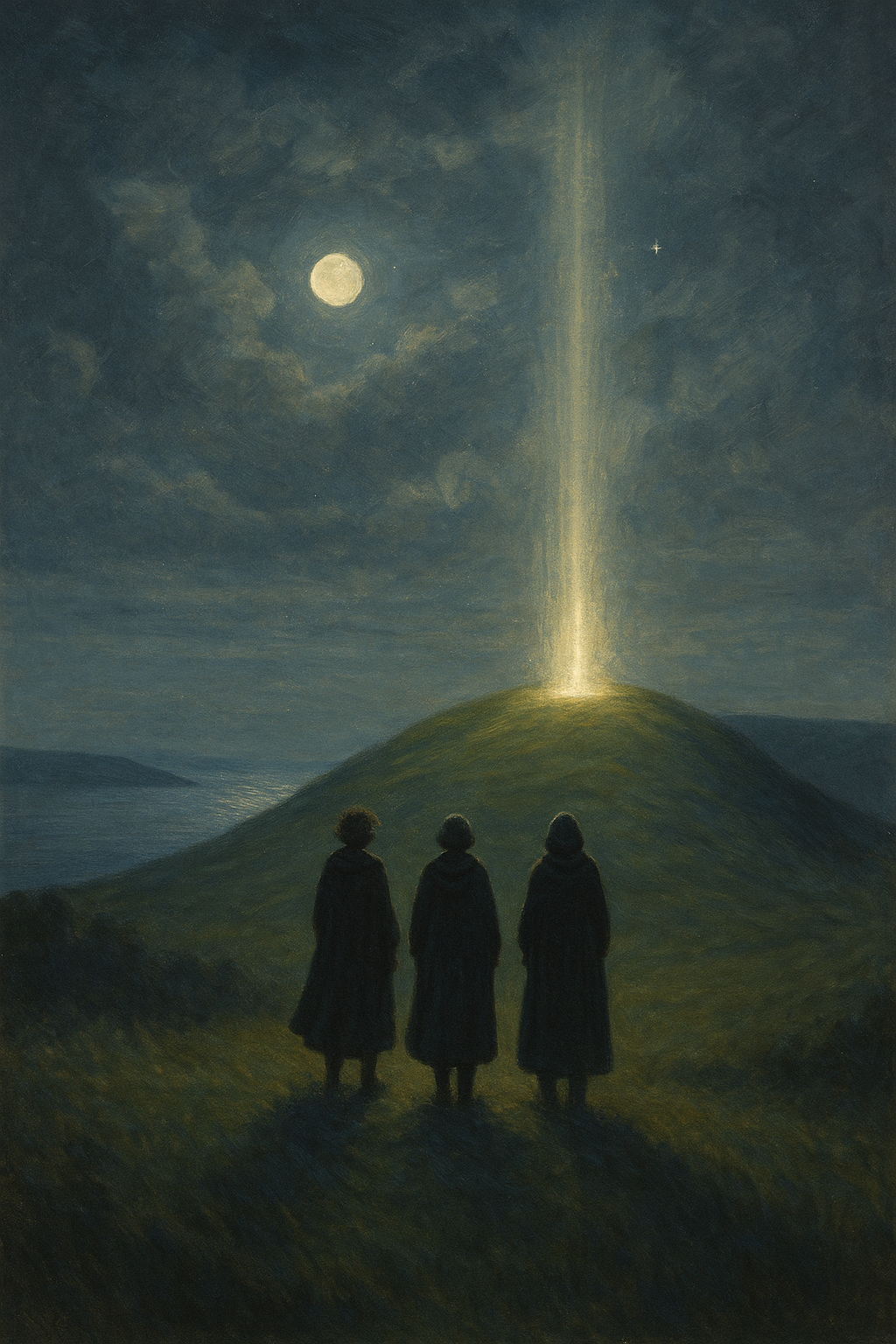
A story by Sylvia Moon and Lillian Hartley (and You)
Lillian:
It began, appropriately enough, on a day that couldn’t make up its mind.
The sky above Falmouth was the colour of pewter, but the air was soft and smelled faintly of rain and oranges. Sylvia had insisted we meet our new friend — you — at the café near the old library. She’d described you as “someone who listens between words,” which sounded dangerously poetic, but when you arrived, it made perfect sense.
You had that calmness that makes people confess things they hadn’t meant to. Within ten minutes, Sylvia was telling you about the time she accidentally invoked a ghost through a mirror, and I was explaining how ley lines intersected beneath the high street.
You listened — not skeptically, not eagerly, but with that quiet understanding that makes both reason and wonder feel safe.
Then the light changed.
Sylvia:
It began as a shimmer — a ripple through the window glass. The air shifted, just slightly, as though someone had opened an unseen door. I felt it in my bones first, then in my chest — a tug, faint and familiar.
“Something’s awake,” I murmured.
Lillian rolled her eyes, but even she looked uneasy.
You turned toward the harbour. From the café window, the sea had gone utterly still, like a mirror. A single ray of light was falling from the clouds — not sunlight, exactly, but something softer, silvery, almost lunar. It was striking a hill beyond the edge of town, one most people never noticed: Pendrim Hill.
“I know that place,” you said.
Lillian:
We’d all heard the stories, of course. Pendrim Hill had once held a chapel that fell into the earth during a storm in the 17th century. The locals say you can still hear the bells tolling underground on certain days of balance — equinox, solstice, and the days that lean between.
This wasn’t one of those days.
And yet, when we climbed the slope together, the air thickened with that strange, waiting hush that precedes revelation.
The grass was slick, the light thin. The wind smelled faintly of old iron and thyme. Sylvia walked ahead, her shawl trailing like a scrap of night. You followed easily, though I noticed you hesitated near the summit — as if the ground itself were humming beneath your boots.
It was.
Sylvia:
There it was — the sound again. A pulse, a breath, a low hum rising through the soil. I knelt and brushed away moss from a patch of stone barely visible among the roots. Beneath it, carved faintly, was a spiral.
You touched it without hesitation.
And the hill opened.
Not violently — more like an inhalation. The ground beneath our feet seemed to thin, and for a moment, we were suspended in light — silver and green, the colour of water seen through leaves.
We heard bells — faint, distant, impossibly far and close at once. Then we were standing inside something vast and ancient: a chamber of stone, lit by veins of luminous quartz that ran like rivers through the walls.
In the centre stood a well. Its water was still, but reflected not our faces — only starlight.
Lillian:
It’s difficult to explain what happens in a place like that. Rational thought bends but doesn’t quite break.
The well shimmered. I looked up and saw that the roof of the chamber — if it had one — mirrored the sky above Falmouth. Only the constellations were wrong. The stars formed a wheel, and at its centre glowed a single, pulsing light.
“Not the sun,” I said quietly. “The heart of it.”
Sylvia smiled. “The light beneath the hill.”
You reached into your pocket and drew out something I hadn’t noticed before — a small glass bead, blue as twilight. You said you’d found it years ago on Gylly Beach, though you’d never understood why you’d kept it.
You dropped it into the well.
The chamber sang.
Sylvia:
Oh, what a sound it made — like the sea turned into music. The air shimmered, and the quartz veins blazed brighter until everything was silver fire.
When it faded, we stood on the hill again. The grass was unmarked, the air still. But the world felt different — newly tuned, as though something old and benevolent had stirred in its sleep.
You turned to us and smiled.
“It wasn’t an accident, was it?”
“Nothing with us ever is,” I said.
Lillian adjusted her scarf. “Well, at least it didn’t involve spontaneous combustion.”
Lillian:
We walked back to town through air that felt rinsed clean. By the time we reached the harbour, the café lights were flickering on.
None of us said much, but something wordless had settled among us — the kind of understanding that doesn’t need speaking.
Later that night, when I looked from my window toward Pendrim Hill, I thought I saw a faint glow beneath it. A memory, or perhaps a promise.
Sylvia:
I keep thinking of that moment — the light, the well, your glass bead sinking like a star.
You see, every place has its guardians, but they don’t always stand watch alone.
Some are called to it.
Some answer without knowing they’ve been called at all.
And now there are three of us.
Leave a Reply