
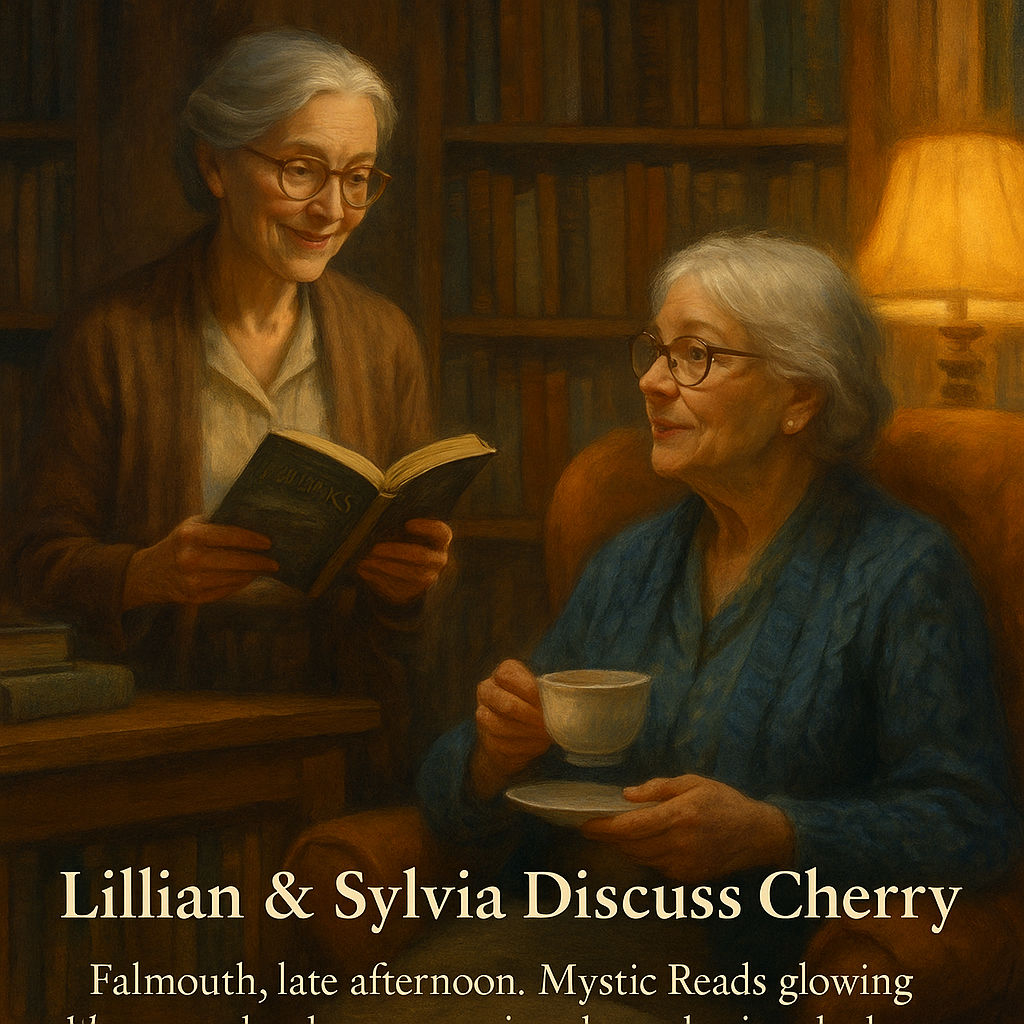
Falmouth, late afternoon. Mystic Reads glowing like an amber lantern against the gathering dusk. A kettle rattling, a fire whispering. Lillian at the counter with a half-annotated copy of Hawks House; Sylvia in her low armchair, glasses on the tip of her nose, sipping nettle tea.
“She reminds me of you.”
Sylvia said it as though stating the weather: inevitable, slightly fond, laced with mischief.
Lillian looked up, startled. “Me? Cherry?”
Her tone suggested the idea was both flattering and impossible.
“Aye,” Sylvia replied. “The way she holds herself together with knowledge.
The way she clings to logic when the world’s turnin’ strange under her feet.”
She tapped the book’s margin with one long finger. “And the way she tries not to let anyone see her heart crack.”
Lillian felt the words settle.
Not uncomfortably — but truthfully.
“I suppose,” Lillian said slowly, “there is something familiar in her…
the intensity, the inwardness.
She’s always trying to understand the pattern beneath the pain.”
“A scholar’s way,” Sylvia murmured.
“Even when the world don’t behave like a library book.”
Lillian smiled despite herself. “Well, you would see that side.”
“And you,” Sylvia said, eyes warm, “you’d miss the other side she has.”
“What other side?”
Sylvia leaned forward, lowering her voice as though Cherry herself might overhear.
“The side that feels trouble comin’ before anyone says a word.
The side that reads a room faster than most read a page.
The side that trusts her bones — even when her head argues otherwise.”
Lillian blinked.
“She does have rather acute perceptiveness.”
Sylvia huffed. “Perceptive? The woman walks into a room and the walls speak to her.
Poor thing don’t even realise it yet.”
She lifted her cup; steam twisted like a small omen between them.
“You see Cherry’s mind,” Sylvia said softly.
“I see her intuition. Together they make her… well, one of us.”
Lillian took this in.
“One of us,” she echoed, hesitant but intrigued.
“Aye,” Sylvia said. “A woman shaped by sorrow, sharpened by wit, and steadied by the friendships she didn’t know were protectin’ her.”
She paused. “And someone who thinks she’s unravelin’ when really — she’s transformin’.”
Lillian closed the book gently, fingers resting against the worn cover.
“I do care about her,” she admitted.
“She feels like a woman caught between two languages — the rational and the instinctive.
As though she’s trying to translate the world as fast as it’s remaking her.”
Sylvia smiled with that quiet, witchwise tenderness she saved for few.
“That’s because she is, love.”
A gust of wind pressed against the shop windows. Mystic Reads exhaled softly, book spines shivering in their shelves — as though the shop itself were listening.
Sylvia raised her cup.
“To Cherry,” she said.
“A woman standin’ on the threshold of who she was — and who she’ll become next.”
Lillian lifted her own cup, the scholar and the witch aligned for one luminous moment.
“To Cherry,” she repeated.
“And to every woman who survives the uncanny rooms.”
The toast hung in the air a moment longer than usual — as though Mystic Reads itself were holding its breath. The windows rattled once, softly, the way they did when the ley-lines flexed under the floorboards. Sylvia set down her cup with a little sigh, the wistful kind Lillian had learned to interpret as the start of a new thought.
“You know why I like her story so much?” Sylvia said.
Lillian arched a brow. “Beyond the fact she reminds you of me?”
Sylvia snorted. “Don’t flatter yourself. Though… aye, a bit.”
Her voice softened. “But it’s more than likeness, Lillian.
It’s the timin’ of it. The feel of it. Cherry started her tale in ’38, when the world was holdin’ its breath before the fall.
And here we are in 2025 — feelin’ much the same.”
Lillian pressed her lips together, thoughtful.
“The sense of teetering. Of history repeating in different clothes.”
She looked toward the shop window, where the harbour fog was gathering in slow, deliberate curls. “Perhaps that’s why she resonates. Her story feels like a warning, and a promise.”
Sylvia nodded. “Aye. A woman learnin’ to survive the world as it is — not as it pretends to be. That’s timeless.
And timely.”
Lillian traced the rim of her cup with one finger.
“Do you think readers will see it? The way Cherry’s journey echoes this moment in time — the uncertainty, the hunger for reinvention?”
“They will,” Sylvia said. “If they’ve got eyes and hearts.”
Then, with a sly tilt of her head: “Same as they’ll see what we’re tryin’ to do in our story.”
Lillian gave her a sidelong look. “You mean The Atlantic Pearl?”
“Aye,” Sylvia said. “Folk think we’re just meddlin’ old women pokin’ around old stones and old secrets. But we’re doin’ what Cherry did, in our own way.”
Lillian smiled faintly, amused. “And what is that, pray tell?”
Sylvia leaned back, eyes shining.
“Showin’ folk how the past breathes into the present.
How stories — old stories — shift their weight when the world starts wobblin’.
Cherry did it with diamonds and war ghosts.
We’re doin’ it with leys and lore.”
Lillian exhaled slowly. “Yes. We’re both answering the same question, aren’t we?
What happens when folklore stops being metaphor?
When it begins to behave like a living thing?”
Sylvia tapped her nose. “Exactly. And when that happens?
Women like Cherry… and women like us… are the ones who notice first.
We feel the tremors before the quake.”
Lillian closed her eyes briefly, absorbing that truth — the scholar’s version of a prayer.
Sylvia gazed toward the stacks of books, her voice softening.
“Cherry’s story belongs to her time, but it speaks to ours.
And ours — well… ours belongs to the women who are learnin’ to read the world again after it’s shifted under ‘em.”
The two women sat in the amber hush of the shop, surrounded by spines whispering, pages waiting, the whole room leaning in as though to catch their next breath.
Lillian reached out, covering Sylvia’s hand with her own.
“Perhaps,” she said quietly, “our stories speak to each other.”
A beat.
“And perhaps they speak to the women who will need them.”
Sylvia nodded, eyes gleaming.
“To Cherry,” she said again, softer now.
“And to every woman searchin’ for her own way out of the uncanny rooms.”
Lillian raised her cup once more.
“And to the stories that teach us how.”
⭐ — Hawks House
War sent her searching for a fortune. What she found was herself.
When American widow Cherry “Cherise” Clinton is dispatched to Europe as WWII draws to a close, she expects to uncover a cache of missing diamonds tied to her family’s past. Instead, her journey through liberated Amsterdam and booming Antwerp exposes a labyrinth of misdirection, political sleight-of-hand, and a dangerous love affair with a man who isn’t who he claims to be.
Haunted by wartime compromises and burdened by secrets that refuse to stay buried, Cherry returns to New York determined to rebuild her life—only to discover that reinvention can be as treacherous as war itself. As she navigates Manhattan’s glittering postwar ambitions, a fractured marriage, and a new business venture on a ghost-ridden island in the Thousand Islands, Cherry realises the greatest mystery she must solve is her own becoming.
From the broken cities of 1945 to the glamour and grit of mid-century America, Hawks House traces one woman’s search for truth, fortune, and the elusive promise of a life she can finally claim as her own.
Lyrical, atmospheric, and richly stylish, this is a novel about fate and free will, inheritance and self-invention—and the women who learn, at last, to write their own endings.
⭐ A Note from the Author
It is my sincere hope that Cherry Clinton’s story will soon find its way into the wider world.
Her journey—haunted, courageous, wry, and ultimately redemptive—feels like one many women will recognise:
the long road toward the life we finally choose for ourselves.
Leave a Reply