
A Christmas Story by Sylvia Moon (with commentary by Lillian Hartley)
It began, as these things often do, with compromise.
Lillian adores Christmas shopping — she finds it intellectually satisfying, like curating a private exhibition of gifts and intentions. I, on the other hand, find it exhausting. The jingling music, the queues, the relentless cheer — all that glittering insistence on joy. But this year, she persuaded me to accompany her to the Falmouth Christmas Market on the Moor.
“It’ll be festive,” she said.
“It’ll be crowded,” I replied.
“Hot chocolate,” she countered.
“Bribery,” I said — and we went.
The market was in full swing: strings of golden lights, cinnamon in the air, and the sea mist hanging just above the rooftops like a veil. Stalls spilled over with crafts, candles, woollen scarves, and ornaments carved from driftwood. A choir was singing near the bandstand, their breath rising in little clouds. Even I had to admit — it was charming.
Lillian was in her element, examining every stall with a scholar’s precision. I drifted after her, half-listening to the music, when something caught my eye.
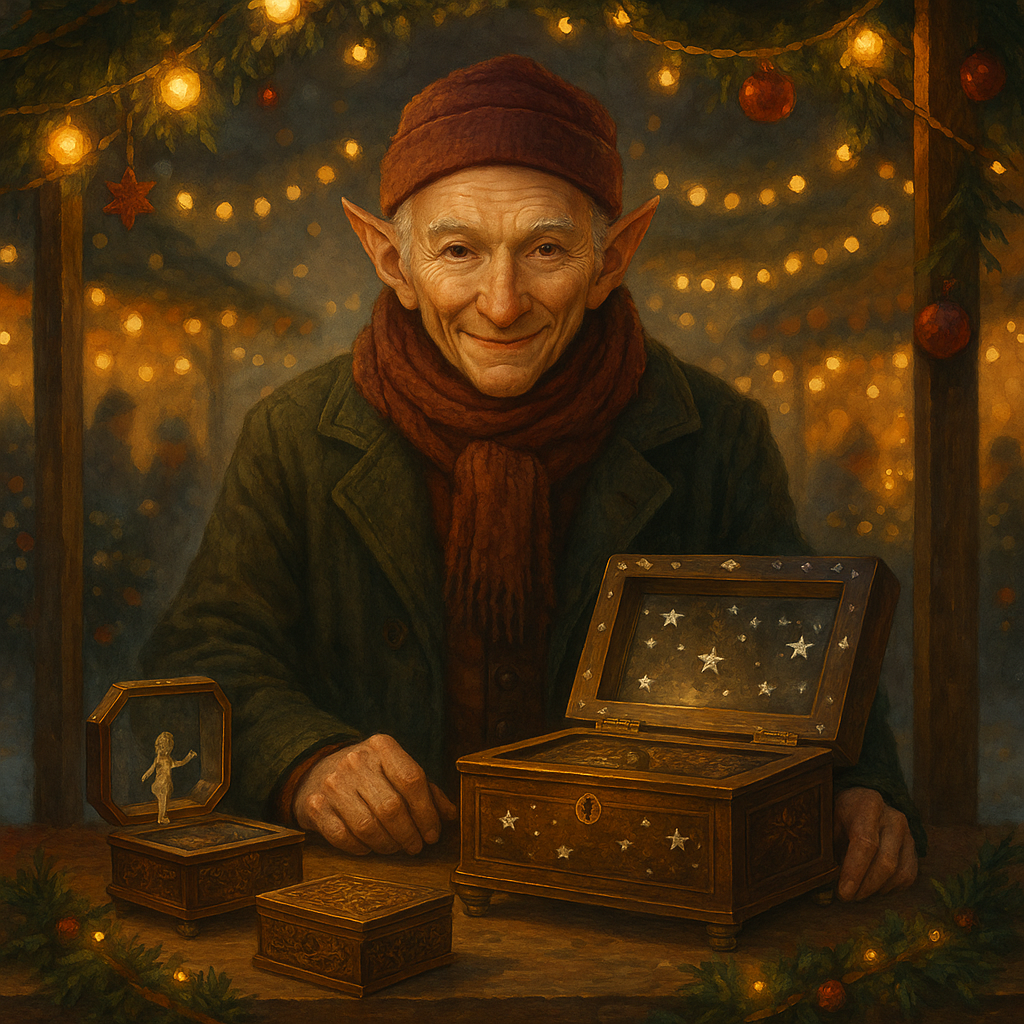
It was a small wooden stall tucked away near the church wall, its wares displayed under a string of mismatched fairy lights. An elderly man stood behind the counter — or perhaps not a man; his features were fine, too pale, and his eyes too bright for the dusk. On the table before him sat a collection of music boxes, each one intricate and peculiar.
One, in particular, drew me closer.
It was made of dark walnut, polished to a deep shine. The lid was inlaid with mother-of-pearl stars, and a faint scent of old lavender lingered around it. When I touched it, the man smiled faintly.
“Ah,” he said. “That one finds the right hands.”
Lillian appeared beside me, clutching a paper bag of mince pies. “What have you found now?”
I gestured to the music box. “Isn’t it beautiful?”
She studied it, her brow furrowing — that look she gets when she’s intrigued but doesn’t want to admit it. “Early Victorian, perhaps? Or a clever reproduction. The inlay work is… exquisite.”
“It plays,” the old man said. “But only once a year.”
Lillian snorted. “Marketing.”
Still, we bought it. The price was oddly reasonable — too reasonable, perhaps — and the man wrapped it carefully in tissue paper printed with silver holly leaves. When I turned to thank him, he was gone. The stall was empty, the fairy lights dark.
We carried the box back to my Georgian townhouse near the Old High Street, the one that creaks in storms and smells faintly of woodsmoke and rose polish. The evening had grown foggy, the kind that makes Falmouth look half-remembered. We brewed tea, lit the fire, and set the music box on the dining table.
Lillian insisted on examining the mechanism before winding it — “just in case it explodes or summons the Archangel Gabriel.” Then, satisfied, she turned the tiny key.
A soft click. A whir.
Then music — faint, crystalline, and impossibly delicate. A carol I’d never heard before, though it felt like something remembered from long ago.
And then the lid opened.
Inside was a tiny glass bird, perched on a silver branch. It moved as it sang — wings fluttering, throat pulsing — and the song deepened, the melody curling through the air like candlelight.
The room grew warmer, but the shadows danced strangely on the walls. From the corner of my eye, I saw movement — faint figures, translucent, drifting in the periphery. Not menacing, exactly. More… wistful. They moved in time to the melody, as if remembering how to dance.
Lillian, of course, noticed immediately. “Sylvia,” she said, very quietly, “do you see—”
“Yes.”
We both sat still. The air shimmered. The glass bird trilled its final note, a sound so pure it almost hurt. Then — silence. The figures faded. The fire crackled. The scent of lavender thickened and then was gone.
Lillian exhaled. “I suppose that’s why it only plays once a year.”
I closed the lid gently. “I rather hope it does again.”
She gave me a sideways glance. “I’m sure you do.”
We’ve decided to keep the music box for ourselves — though it now lives on a high shelf, and Lillian swears she hears it hum faintly every evening near Christmas. I pretend not to notice, but sometimes, when I walk past after dark, I could swear I hear the faintest flutter — like wings, behind the glass.
Postscript from Lillian:
The box has since been examined. No signs of tampering, no electrical components. Mechanically sound, if slightly peculiar. I remain unconvinced of its “spirits,” though I admit the air temperature fluctuated unnaturally. Sylvia insists the bird winked at her. I decline to comment.
Leave a Reply