
A short piece from Sylvia Moon & Lillian Hartley
It began, as most troubles do, with something small enough to overlook.
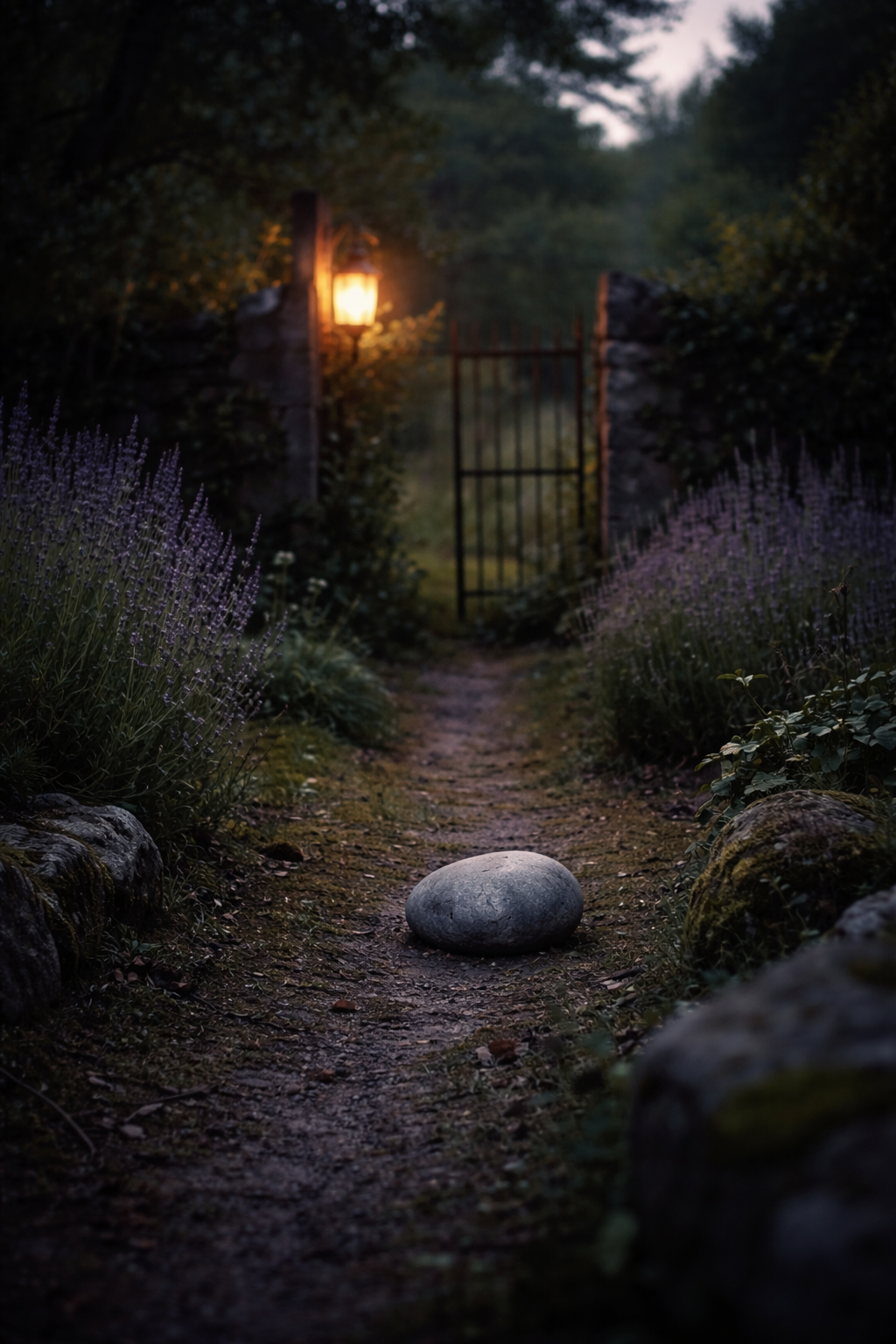
A stone.
It had appeared in the garden of Thimble Cottage overnight. Not large. Not dramatic. Merely placed where the lavender had once grown.
Sylvia noticed it first.
“Well now,” she said softly, hands folded in her cardigan sleeves. “That doesn’t belong to us.”
Lillian, who preferred to begin with evidence rather than intuition, knelt beside it. The soil was freshly disturbed.
“Someone put it there,” she said. “Quite deliberately.”
The stone was smooth, pale, and almost elegant. A pleasing object, if one did not ask why it had been moved.
They did not remove it.
One should never rush to disturb what has been placed with intention.
Over the following days, small inconveniences gathered like dust.
The post went missing.
A rosebush yellowed.
A neighbour, who had always been polite, stopped meeting Sylvia’s eye.
Nothing dramatic.
Nothing one could accuse.
“Curious,” Sylvia murmured, watching the tide withdraw from the harbour. “How quickly things shift when a boundary is crossed.”
Lillian did not disagree.
“The stone,” she said, “was not about weight. It was about territory.”
The truth, when it arrived, was almost banal.
A man from further up the lane had decided that the narrow strip of garden edging the path was, in fact, his. Or should be. Or might as well become so, since no one had objected before.
He had placed the stone as a beginning.
Not theft. Not yet.
Just suggestion.
Just claim.
Just the first, quiet rehearsal of possession.
“Greed rarely announces itself,” Lillian observed one evening, pouring a modest glass of wine. “It prefers to test the air.”
Sylvia nodded.
“It begins by moving something small,” she said. “To see whether the world notices.”
They considered the stone.
They considered the man.
They considered the peculiar human tendency to believe that wanting something makes it rightful.
They did not confront him.
Not immediately.
Instead, Lillian drafted a letter — courteous, precise, impeccably calm — clarifying the boundary lines as recorded in parish maps dating back two centuries.
Sylvia, meanwhile, moved the stone back to its original place in the lane.
Not aggressively.
Simply correctly.
The next morning, the man knocked.
He was flushed with embarrassment disguised as indignation.
“I only thought,” he began.
“Yes,” Lillian replied gently. “That was precisely the difficulty.”
There was no shouting.
No spectacle.
Only the slow collapse of a small, private narrative in which he had already expanded the borders of his life.
He apologised — though not entirely convincingly.
But he did not move another stone.
That night, Sylvia stood at the garden gate.
“Do you think he understands?” she asked.
“Understanding is not required,” Lillian said. “Only recognition.”
“Of what?”
“That the world keeps accounts.”
Sylvia smiled faintly.
“Aye,” she said. “It always does.”
Weeks later, the lavender was replanted.
The rose recovered.
The neighbour resumed her nod.
Nothing dramatic had occurred.
And yet something significant had been prevented.
For greed, they both knew, does not begin with empires.
It begins with a stone.
And what one does when it appears.
Leave a Reply