
An offering from Sylvia Moon, West Country wisewoman and excellent friend:
People imagine that wisdom arrives all at once, like lightning striking an old oak. In my experience it behaves much more like the tide. It comes quietly while you’re busy with something else, and by the time you’ve noticed it, the whole shoreline has changed.
I learnt that from the sea.
Living in Falmouth, you’d have to work quite hard not to.
One April morning a young woman came to see me carrying three notebooks pressed tightly against her chest. She looked as though she’d slept badly for weeks. There was nothing remarkable about that. Writers often arrive looking as though they’ve misplaced something they cannot name.
“I wonder if you could help,” she said.
“I can always put the kettle on.”
People sometimes laugh when I say that, but a kettle has solved more problems than argument ever has.
While the tea brewed she laid the notebooks on my kitchen table.
The first was filled with beautiful ideas. Little fragments of dreams, odd conversations, sketches of impossible places, quotations copied from books she’d loved, and sentences so lovely they seemed to glow on the page.
The second contained lists.
Lists of chapters.
Lists of research.
Lists of things to improve.
Lists of lists.
The third notebook was completely blank.
“I keep beginning,” she said quietly. “But I never seem able to continue.”
I looked at the notebooks for a long while.
Then I closed them.
“Come on,” I said. “Let’s take a walk.”
She looked puzzled.
“I thought we’d talk about writing.”
“We are.”
The harbour was waking as we reached it. Fishing boats rocked gently against their moorings, gulls argued over something invisible, and a soft mist still lingered beyond the headland where the sea dissolved into the morning.
I have always liked harbours.
They are places where dreams either become journeys or remain tied to the dock.
The tide was rising.
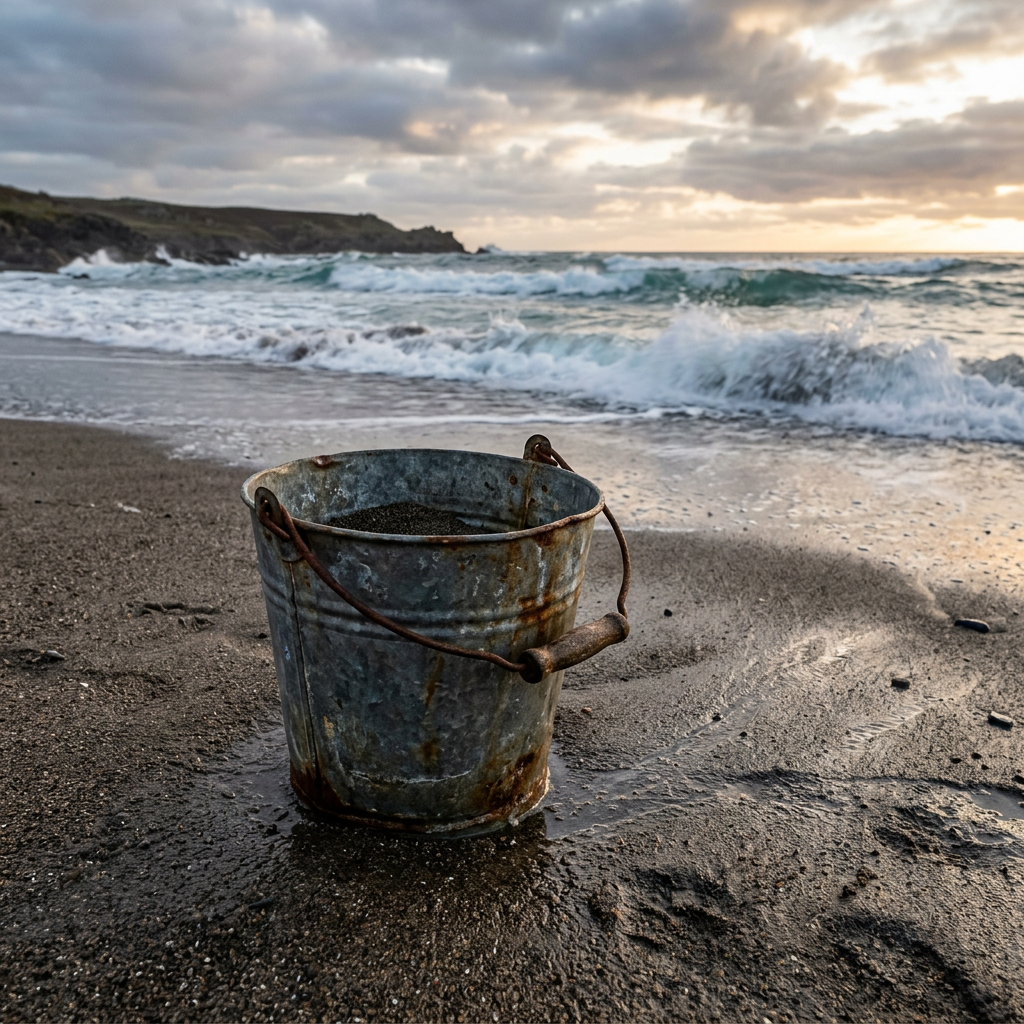
Without saying anything, I picked up an old bucket that someone had left beside the slipway.
“Would you fill this for me?”
She frowned but did as I asked, lowering it into the water until it brimmed.
“There.”
She smiled a little.
“I’ve done it.”
“What have you got?”
She looked inside.
“Seawater.”
“Is that what I asked for?”
“You asked me to fetch the sea.”
“And did you?”
She laughed.
“Well… no.”
We both looked out across Falmouth Bay. The water stretched towards the horizon, changing colour every few moments as clouds drifted lazily across the spring sky. No bucket, however large, could ever hope to contain it.
“No vessel was ever made that could hold the sea,” I said.
She nodded.
“I suppose not.”
“And yet every sailor who has ever crossed an ocean has carried a little of it home.”
She looked at me curiously.
“How?”
“In stories. In songs. In weathered faces. In salt that never quite leaves the skin.”
We stood quietly.
A cormorant surfaced some distance away with a fish clasped triumphantly in its beak.
“The mistake,” I said at last, “is thinking you’re meant to capture the whole ocean.”
She didn’t answer.
“Nobody can.”
A fishing boat eased away from the quay.
Its wake spread slowly across the harbour before disappearing into the wider water.
“I’ve known people who spent their lives chasing inspiration,” I continued. “Always waiting for the next vision. They’d stand staring at the horizon until the tide had turned beneath their feet.”
I didn’t tell her I’d once been one of them.
“And I’ve known others who never stopped repairing their nets. Every knot had to be perfect. Every rope coiled exactly so. Every hook polished. By the time everything was finally ready, the shoals had come and gone.”
She looked down at her notebooks.
“I think I might be both.”
“Most of us are.”
The gulls wheeled overhead, crying in voices that sounded suspiciously like elderly neighbours discussing everyone else’s business.
“My grandmother used to say the sea gives herself only to those who arrive prepared, but never to those who imagine preparation is the journey.”
She was silent for a long time.
The wind shifted.
Somewhere behind us a church bell struck eleven.
“I’ve always thought,” I said, “that God hid most of life’s important lessons inside ordinary things so we’d stop looking quite so hard.”
She laughed softly.
“You really believe that?”
“I believe bread teaches patience. Gardens teach hope. Dogs teach forgiveness. The sea teaches humility. That’s quite enough schooling for one lifetime.”
She looked back across the water.
“I keep thinking I have to write the perfect book.”
“No.”
“What then?”
“You have to write the true one.”
She breathed in sharply.
“They’re not the same thing.”
“No.”
The word settled between us like a gull feather.
“Perfection has very little imagination,” I said. “Truth usually arrives with muddy boots.”
She smiled properly then.
“I’ve spent years collecting ideas.”
“I know.”
“And years organising them.”
“I know.”
“But I’ve never trusted myself enough to begin.”
I shook my head.
“Oh, you’ve begun dozens of times.”
“What I mean is…”
“I know what you mean.”
The tide had crept several feet higher while we’d been talking.
Neither of us had noticed.
“That’s the thing about tides,” I said. “They don’t make a fuss. They simply keep coming until one day you discover the shore has become something else.”
She watched the water curl gently around the old harbour wall.
“So what should I do?”
I picked up the bucket.
Most of the water had already slopped away as we’d stood there talking.
Only a few inches remained.
“Take this home.”
She looked puzzled.
“It’s hardly anything.”
“No.”
“But it’s enough to remind you what the sea tastes like.”
As we walked back towards town, I found myself thinking how often people imagine life asks us to choose between dreaming and doing.
It never has.
The sea dreams in tides and moonlight, in distant horizons and impossible depths. The harbour answers with ropes, timbers, weathered hands and boats built carefully enough to survive another winter.
Neither is complete without the other.
One gives us the longing.
The other gives the longing somewhere to land.
And perhaps that is all any life is really trying to become: not an ocean imprisoned inside a bucket, nor an empty vessel polished to perfection, but something sturdy enough to carry a little mystery safely home.
Leave a Reply