
Lillian Hartley:
Looking back now, I think it is impossible to deny that the emotional and symbolic foundations of Brindlemark owe a profound debt to the Lyonesse traditions preserved by Robert Hunt.
Not directly, perhaps. We never set out to “retell” Lyonesse in any obvious sense. Yet certain mythic structures enter the imagination quietly and begin shaping stories long before one consciously recognises their influence.
Hunt’s Cornish Legends preserves Lyonesse not as polished mythology but as something stranger and more convincing: fragmented communal memory. That distinction matters enormously. The submerged bells, drowned roads, tidal disappearances, phantom remnants beneath the sea — all create the unsettling impression that the landscape itself remembers another order of reality hidden beneath the visible world.
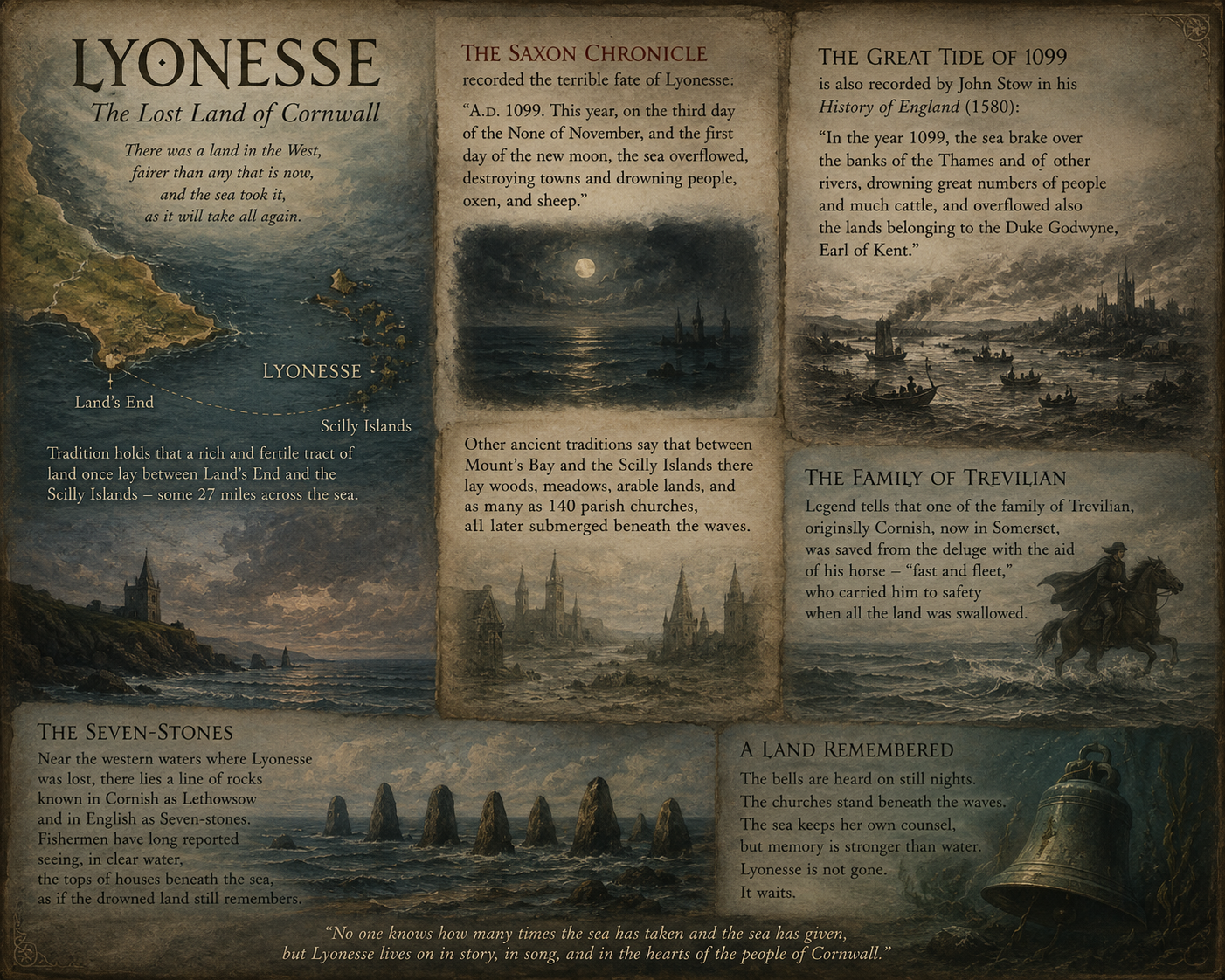
What fascinated us especially was the peculiar insistence — repeated across multiple sources — that Lyonesse was not merely allegorical, but historical in the minds of those preserving the stories. Hunt notes traditions claiming the lost land once stretched between Land’s End and the Isles of Scilly, a tract some twenty-seven miles across. The old stories speak not of a symbolic drowning, but of woods, meadows, arable fields, and no fewer than one hundred and forty parish churches swallowed by the sea.
The details lend the myth extraordinary psychological force.
Hunt cites the Saxon Chronicle, which records that on the third before the Nones of November in 1099 — upon the first day of the new moon — the sea overflowed, destroying towns and drowning people, oxen, and sheep. Later chroniclers such as Stow, writing in his History of England in 1580, also describe the catastrophic tide, noting that waters broke over the Thames and other rivers, devastating lands and livestock alike.
One begins to see how such events become mythologised across centuries, especially in places where sea and memory are already deeply intertwined.
The Trevilian story affected us particularly strongly. According to tradition, one member of the ancient Cornish family escaped the inundation only through the speed and faithfulness of his horse, fleeing eastward as the waters consumed the land behind him. It is difficult not to feel the archetypal quality of that image:
- the last survivor,
- the faithful animal,
- the doomed landscape vanishing beneath advancing water.
Such motifs linger in the imagination.
Indeed, Brindlemark increasingly came to revolve around precisely this sensation:
that the visible world rests atop drowned continuities.
The village behaves as though layered over submerged psychic terrain. One senses continuously that:
- older structures remain present beneath ordinary life,
- forgotten agreements still exert influence,
- and the visible settlement overlays another geography entirely.
This is very much how Lyonesse functions psychologically.
Hunt’s references to the Seven Stones — Lethowsow in Cornish — proved equally evocative. Fishermen spoke of seeing the tops of houses beneath the water near those reefs west of Land’s End. Whether one interprets such reports literally is almost irrelevant. Symbolically, they suggest that the old world was never wholly erased. It remains intermittently perceptible under certain conditions.
That idea lies near the heart of Brindlemark.
One could argue the novel’s central anxiety is precisely this:
that modernity has not destroyed the older world, merely buried it imperfectly.
And buried things, of course, rarely remain entirely silent.
Sylvia Moon:
Oh, I think Brindlemark absolutely grew out of Lyonesse.
Not consciously at first perhaps — stories seldom tell you where they truly come from until much later — but emotionally? Spiritually? Certainly.
Hunt’s stories carry that peculiar western sadness Cornwall does so well. Not tragedy exactly. More like longing after something beautiful that slipped away just beyond reach. Lyonesse in those tales is never merely “a kingdom that sank.” It feels more like:
- a world withdrawn,
- a covenant broken,
- or a road between realities that closed too suddenly.
And the details make it stranger still.
The new moon. The sea swallowing churches. Bells ringing beneath water where fields once stood. Horses racing the tide through drowning country. Those things do not feel invented in the ordinary sense. They feel remembered.
That feeling soaked right into Brindlemark.
Especially the sense that the land itself remembers.
There are moments in Hunt where one feels the old world pressing upward through cracks in ordinary reality:
- bells heard underwater,
- phantom paths,
- lights where no lights should be,
- voices carried strangely across fog.
That’s pure Brindlemark.
And those one hundred and forty churches matter terribly to me. Because churches mark community. Memory. Marriage. Burial. Naming. The rhythm of ordinary human life. The stories are not merely about land sinking beneath the sea. They are about an entire lived world — with all its prayers and griefs and harvests — slipping suddenly beneath perception.
Yet not entirely disappearing.
That’s the important part.
The village in our story behaves almost like the surviving edge of something older and half-submerged — not physically beneath the sea perhaps, but psychically submerged beneath time. The people living there sense it without understanding it fully. Some ignore it. Some adapt to it unconsciously. A few become dangerously entangled with it.
That structure comes very close to the emotional logic of Lyonesse.
And then there’s the question of thresholds.
Lyonesse exists perpetually on the edge between:
- memory and forgetting,
- presence and absence,
- land and sea,
- history and dream.
So does Brindlemark.
I think Hunt helped us understand that Cornwall’s deepest stories are rarely about monsters or magic in the modern fantasy sense. They are about permeability. About worlds touching briefly. About ordinary reality resting atop older, stranger foundations.
The bells beneath the sea matter because they suggest the lost world is still alive somehow.
Not dead.
Not gone.
Only hidden beneath the tide waiting for the right ears to hear it again.
That may be the true secret beneath Brindlemark as well.
Not that the old world vanished.
Only that most people stopped listening.
BTW, Brindlemark is a completed novel (85,000 words) currently seeking agent representation:
In Falmouth, Cornwall, two women who have built their lives on careful thinking rather than decisive action are drawn into a place that should not exist.
Lillian Hartley, a scholar who believes understanding must precede change, and Sylvia Moon, who has quietly organised her life around her husband’s long-ago disappearance, find themselves in Brindlemark—a place where time does not move forward, and lives persist in the state in which they were never fully chosen.
At its centre stands a young woman who has never left.
She calls herself Anna Marie Calder.
When Lillian and Sylvia attempt to bring her back with them, she refuses—choosing instead to remain and complete what has been left unresolved. They return to Falmouth expecting the experience to fade. It does not.
Nothing in the world acknowledges what has happened, yet ordinary life no longer holds. Familiar habits fail. Conversations no longer land. Archival records reveal that Anna Marie Calder—long dead—appears connected to present events. The boundary between Brindlemark and their own lives proves not to be spatial, but structural: it is sustained by delay, avoidance, and the quiet refusal to act.
Forced into a recognition they cannot intellectualise away, both women confront the patterns that have shaped them—Lillian’s reliance on understanding as a form of postponement, and Sylvia’s continued orientation around a loss she has never truly faced.
Brindlemark is not something they can escape.
It is something they have been maintaining.
In the absence of any external resolution, the novel moves toward a quieter but more difficult conclusion: whether they are willing to stop sustaining the conditions that allow such a place to exist at all.
Brindlemark is a literary novel combining psychological realism with the uncanny. It will appeal to readers of Rachel Cusk and Kazuo Ishiguro, exploring how lives are shaped not only by what is done, but by what is indefinitely deferred.
Leave a Reply