
Lillian Hartley:
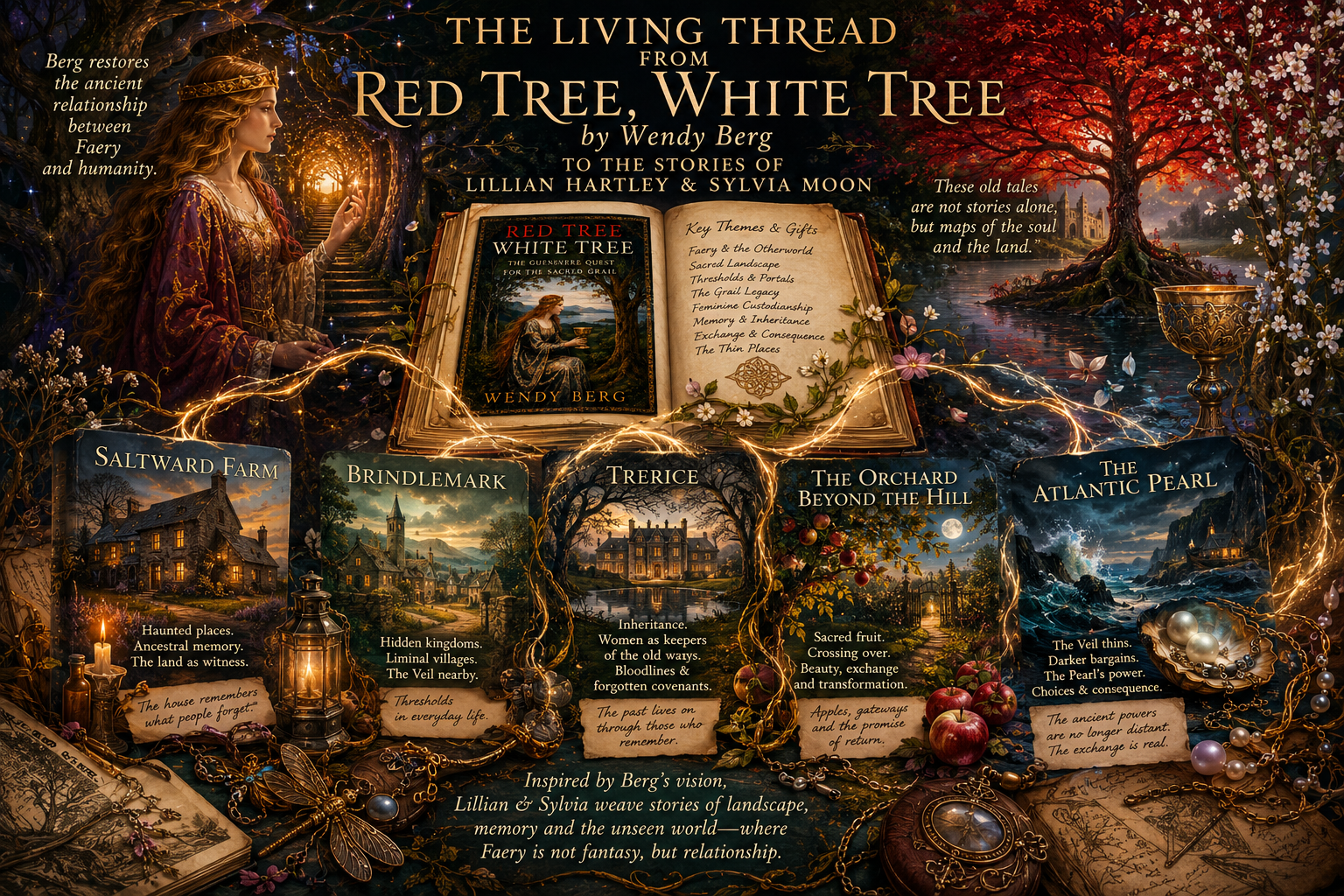
One of the things Wendy Berg accomplishes so beautifully in Red Tree, White Tree is the restoration of continuity — the sense that myth is not a dead thing preserved under museum glass, but a living current running quietly beneath landscape, bloodline, memory, and ritual. Reading it, I found myself recognising many of the same concerns that gradually emerged in our own stories, though perhaps we arrived at them from the opposite direction.
In Saltward Farm, for instance, the old house and its surrounding land are never merely setting. The land itself behaves almost as a witness consciousness. Berg’s work helped crystallise for me the idea that certain places become repositories of unfinished exchange between worlds. That sense — that the boundary between human life and something older remains active in isolated places — deeply informed how we approached the atmosphere of Saltward Farm.
Similarly, Brindlemark owes much to the kind of liminal thinking Berg encourages. The village exists not simply in geography, but in psychic relation to older powers beneath ordinary perception. Berg’s treatment of hidden continuities between Faery traditions and Christian symbolism was especially illuminating there. We became increasingly interested in the notion that communities often preserve ancient metaphysical structures unconsciously, long after they forget their origins.
By the time we reached Trerice, the influence became even clearer. That novel is perhaps our most direct meditation on inheritance — not simply familial inheritance, but spiritual and symbolic inheritance. Berg repeatedly returns to the idea that myths encode relationships rather than merely stories, and that proved enormously influential to us. The house at Trerice, much like Berg’s vision of Arthurian Britain, becomes a place where forgotten agreements continue exerting pressure upon the present.
And then, of course, there is The Orchard Beyond the Hill.
That book would scarcely exist in its current form without the imaginative permission Red Tree, White Tree grants the reader. Berg treats orchards, thresholds, sacred trees, and hidden pathways not as decorative symbols, but as active spiritual architecture. We found ourselves increasingly drawn toward the orchard as a liminal image: cultivated yet wild, domestic yet ancient, rooted simultaneously in nourishment and death. The orchard became, for us, a meeting place between memory and transformation.
By the time we arrived at The Atlantic Pearl, many of these themes had matured into something darker and more psychologically complex. Berg’s influence can perhaps be felt most strongly in our treatment of the Veil itself. We became less interested in “magic systems” and more interested in relationships of reciprocity between worlds — the idea that crossing thresholds always demands exchange, consequence, and remembrance.
What Berg restores — and what we continually strive toward in our own work — is the unsettling possibility that myth is not escapism at all, but an alternate mode of perceiving reality.
Sylvia Moon:
I think what Wendy Berg gave us, more than anything, was courage.
Courage to treat these old stories seriously.
Not literally perhaps — though sometimes I wonder — but spiritually. Symbolically. Imaginatively. She writes as though the old tales still breathe beneath the surface of things, and once you begin looking at the world that way, it changes how you write entirely.
In Saltward Farm, we began noticing how silence itself could become haunted. The fields. The hedgerows. The storm that knocked out our electricity. Berg helped us trust that atmosphere carries meaning long before plot explains it. That mattered terribly.
Brindlemark was where the old roads truly began opening for us. There’s a quality in Berg’s writing — especially when she speaks of hidden kingdoms existing beside ordinary life — that made us realise villages themselves can become thresholds. A place may look perfectly ordinary and still sit atop an older map.
And Trerice… ah, that one owes her a great deal. Especially the women.
Berg understands something precious and dangerous about women in myth: that they are often guardians of continuity between worlds. Not simply witches or queens or priestesses in the modern fantasy sense, but keepers of memory. Women who remember the old bargains after the men have forgotten them. That thread runs all through Trerice and later through Veronica, Evelyn, Cassandra, and even Lillian herself in The Atlantic Pearl.
But The Orchard Beyond the Hill is perhaps where her influence settles deepest. There is something profoundly Faery about orchards. Apples especially. Not in the childish sense — not pixies and flower crowns — but in the old way. The Avalon way. The Otherworld across the water. Fruit as knowledge. Fruit as invitation. Fruit as crossing-over.
Berg reminded us that landscapes in myth are never accidental.
And then came The Atlantic Pearl, where everything darkened and deepened. The Fair Folk there are no longer distant. The Veil weakens. The old powers begin reaching directly into human grief, longing, ambition, and desire. Yet even then, I think Berg’s influence remains visible because we never wanted Faerie to become merely monstrous. Beautiful things can destroy you too. Ancient things often do not hate us; they simply do not value us the way we value ourselves.
That idea — that the unseen world is not evil so much as profoundly other — lies at the heart of all our stories now.
And perhaps that is why Red Tree, White Tree lingers so stubbornly after one finishes it. Wendy Berg does not merely discuss myth.
She re-enchants the reader’s way of seeing.
Leave a Reply