
Lillian Hartley:
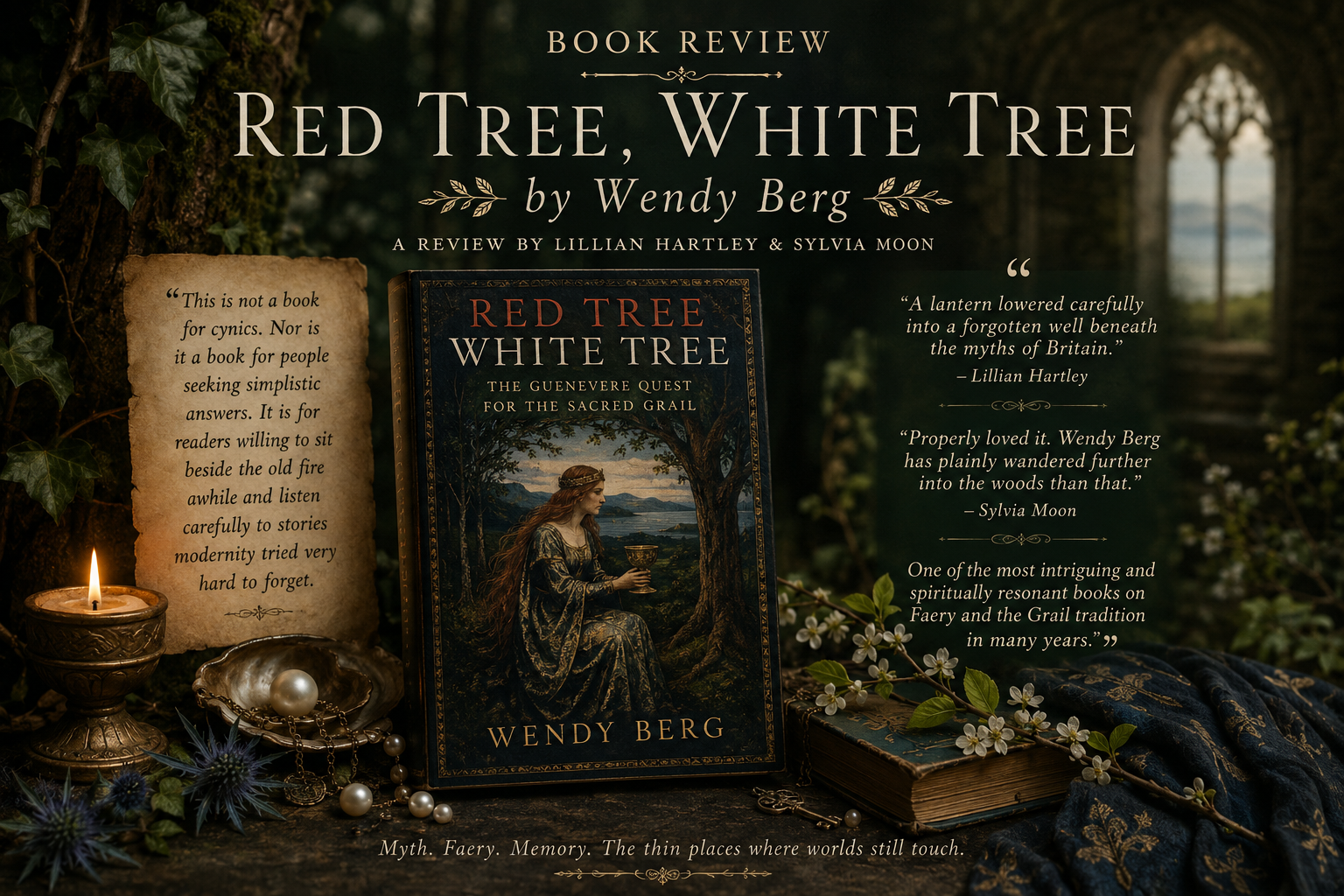
There are books one admires, books one studies, and books one quietly carries around in the soul afterwards. Red Tree, White Tree belongs firmly to the last category. Wendy Berg has achieved something extraordinarily difficult here: she has written a work that is intellectually ambitious, spiritually provocative, and yet deeply alive with enchantment. It is not merely a study of Arthurian tradition or Faery lore, though it is certainly both of those things. Rather, it feels like a lantern lowered carefully into a forgotten well beneath the myths of Britain.
What impressed me most was Berg’s refusal to reduce the Arthurian stories to either naïve fantasy or dry symbolism. She treats them as living memory — layered, distorted perhaps by time, but still carrying traces of something numinous beneath the surface. Her central proposition — that the relationship between Faery and humanity lies at the very core of the Grail tradition — is handled with remarkable seriousness and imaginative courage. (Skylight Press)
As someone inclined toward scholarship and evidence, I was surprised by how persuasive I found much of her argument. Berg moves elegantly between medieval sources, esoteric traditions, Christian mysticism, mythology, and even modern literature without losing the thread of her vision. There are passages in this book that feel less like reading and more like remembering.
And perhaps that is its true accomplishment. It restores mystery without abandoning intelligence.
Too many modern books on Faery either sentimentalise the subject into decorative whimsy or flatten it into anthropology. Berg does neither. Her Faery is ancient, unsettling, beautiful, and profoundly entangled with the fate of humanity itself. One comes away with the uneasy impression that the old stories may not be stories at all, but veiled records of a different relationship between the seen and unseen worlds.
I suspect this is a book that will continue to unfold years after one first reads it.
Sylvia Moon:
Oh, I loved this book. Properly loved it.
Some books about Faery feel like they were written by people who have only ever met the Fair Folk in greeting cards. Wendy Berg has plainly wandered further into the woods than that.
There’s a strange old sadness in Red Tree, White Tree, but beauty too — the kind you find at twilight when the sea mist rolls in and the world feels thin around the edges. Berg understands something many writers do not: that Faery is not merely fantasy. It is relationship. Exchange. Memory. Debt. Longing. The old covenants between worlds.
Her vision of Guenevere as a Faery queen is utterly compelling. Once you’ve read Berg’s interpretation, much of Arthurian legend begins rearranging itself in your mind like pieces of a puzzle finally finding their rightful place. Suddenly the stories glow differently. Characters who once seemed symbolic become uncanny and alive. (Skylight Press)
And oh, the atmosphere of it all! Ancient stars over Britain. Hidden ritual beneath the Round Table. The old powers moving quietly under Christian language and courtly romance. It reminded me very much of those moments when one stands on a Cornish cliff at dusk and senses — just for an instant — that the land remembers more than we do.
I especially admired Berg’s willingness to cross boundaries others avoid. Christianity and Faery. Ritual magic and folklore. Myth and bloodline. The visible and invisible world. Even when one does not agree with every conclusion — and truly, one need not — the book remains enthralling because it dares to think mythically instead of merely analytically.
That is rare now.
This is not a book for cynics. Nor is it a book for people seeking simplistic answers. It is for readers willing to sit beside the old fire awhile and listen carefully to stories modernity tried very hard to forget.
Frankly, I think Wendy Berg has written one of the most intriguing and spiritually resonant books on Faery and the Grail tradition in many years. Gareth Knight called it “the most important and challenging book on Arthurian and Grail tradition for many a long year,” and for once the praise does not feel exaggerated. (Skylight Press)
Read it slowly. Preferably near the sea.
Leave a Reply