
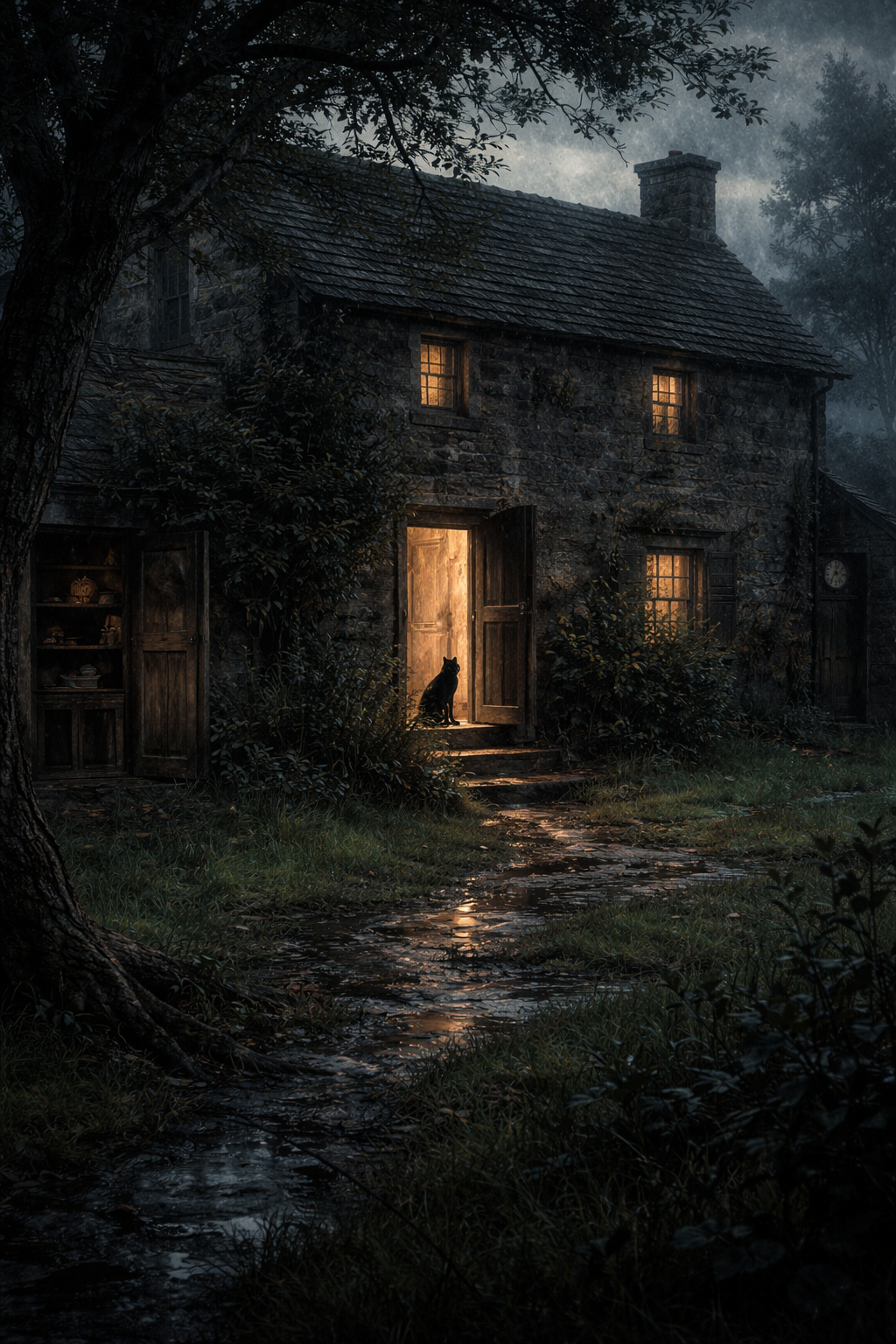
There are novels that declare their ghosts.
Saltward Farm (currently looking for representation) does not.
Instead, it arranges unease in the margins — in the pause of a clock, the slight opening of a cupboard door, the silent regard of a cat — and then refuses to confirm what, if anything, has crossed the threshold.
This restraint is not indecision. It is design.
To understand how the novel works — and why it lingers — it helps to revisit what Freud, Heidegger, and Jung meant by “the uncanny,” and how their ideas illuminate both the story and our own lives.
Freud: When the Familiar Turns Strange
In his 1919 essay The Uncanny (Das Unheimliche), Freud defines the uncanny as something frightening precisely because it was once familiar.
The German heimlich means “homely,” but also “hidden.” The uncanny (unheimlich) is what was concealed and has come to light. It is the return of what should have remained secret.
For Freud, the uncanny emerges when:
- Repressed material resurfaces.
- The boundary between life and death blurs.
- The inanimate seems briefly alive.
- Repetition feels like fate.
- Doubles appear.
At Saltward Farm, the disturbances are domestic. The home itself becomes subtly unhomely. The cat appears at thresholds. The clock falters. The cupboard seems to contain more than shelves.
Nothing dramatic happens.
And that is precisely why it works.
The uncanny is not spectacle — it is recognition. Something in us stirs.
Used wisely, Freud’s insight becomes developmental: when something unsettles us, we might ask — What is returning? What has not yet been integrated?
Heidegger: The Unhomely Condition of Being
Heidegger takes the idea further. In Being and Time, he uses Unheimlichkeit to describe a deeper truth: human beings are never entirely at home in the world.
Most of the time, routine protects us from noticing this. But when everyday certainty fractures — through silence, isolation, storm, or mortality — we experience a tremor in being itself.
The uncanny, for Heidegger, signals not repression but exposure.
At Saltward Farm, the storm isolates the house. Time hesitates. The air thickens. The land presses in.
Nothing supernatural is confirmed. Yet something foundational feels displaced.
The novel allows us to experience unhomeliness without resolving it. The effect is existential rather than theatrical.
And here lies its strength: it does not terrify — it awakens.
Jung: The Symbol That Seeks Integration
Jung offers perhaps the most constructive reading.
For him, uncanny moments often signal the activation of the unconscious — shadow material rising, archetypes constellating, symbols seeking expression.
The cat may represent instinct or the shadow.
The halted clock may signal suspended psychological time.
The cupboard may function as a container of what has been stored away.
But Jung would caution us not to literalise the symbol.
The moment we decide, “It was a ghost,” or dismiss it as “nothing at all,” we collapse the symbolic field. The psyche loses its language.
Instead, we ask:
What does this image awaken in me?
In this way, the uncanny becomes useful. It becomes invitation rather than threat.
How the Novel Builds Unease: Pacing, Repetition, Focalisation
The uncanny in Saltward Farm is not merely thematic. It is structural.
Pacing: Moments of disturbance are brief and carefully placed. The narrative slows around them, stretching time — much like the faltering clock — before resuming normal rhythm. This oscillation prevents melodrama while heightening sensitivity.
Repetition: The cat reappears. The sense of being watched recurs. The house seems to hold its breath more than once. But never identically. Pattern forms without confirmation. Repetition invites projection.
Focalisation: We are tethered to subjective perception. There is no omniscient reassurance, no authoritative explanation. We see only what the characters see. The ambiguity belongs to us.
The novel never proves the supernatural.
It allows the reader to hover.
The Cat: From Liminal Presence to Mortal Fact
Throughout the story, the cat functions as quiet threshold presence — watcher, witness, almost-symbol.
Then, after the storm breaks and the characters finally step outside, the cat is found dead in the garden.
No visible wound.
No explanation.
Only stillness.
The uncanny shifts from suggestion to fact.
The animate has become inanimate — a boundary Freud considered deeply unsettling. Heidegger would see mortality laid bare. Jung might suggest that a symbol has completed its task.
But the novel does not interpret the death.
It simply presents it.
And at the very end, Inspector Wren — steady, skeptical, resistant to symbolic inflation — chooses to bury the cat.
He does not speculate.
He does not dramatise.
He performs a practical, humane act.
Sylvia might murmur that mystery deserves respect.
Lillian would likely insist that dignity is not superstition.
And Wren, with quiet firmness, might say:
“It’s only a cat. And it deserves proper ground.”
In that gesture, something resolves — not metaphysically, but ethically.
The uncanny is not banished. It is grounded.
What the Uncanny Offers Us
Saltward Farm never confirms a haunting.
Instead, it explores how we respond to uncertainty.
Freud reminds us to examine what returns.
Heidegger reminds us that unease can disclose truth.
Jung reminds us that symbols seek integration, not literal belief.
The novel’s wisdom lies in its balance.
The cat watches.
The clock falters.
The cupboard waits.
The storm passes.
The cat lies still.
Wren digs.
We are not asked to believe in ghosts.
We are asked to tolerate ambiguity.
And perhaps that is the deepest personal lesson of the uncanny: when something in life feels slightly unhomely, resist the urge to dismiss or dramatise. Pause. Reflect. Ask what is surfacing.
Then tend it — thoughtfully, grounded, with care.
Not every mystery must be solved.
But what has died, in story or in self, deserves proper ground.
Leave a Reply